 English
  العربية
  日本語
日本語  한국어
한국어  Tiếng Việt
  ไทย
ไทย  Bahasa Melayu
  فارسی
فارسی  Bahasa Indonesia
  ဗမာစာ
ဗမာစာ  简体中文
简体中文  香港中文
香港中文  繁體中文
繁體中文  Русский
  Deutsch
  Nederlands
  Italiano
  Français
  Español
  Português
  Afrikaans
  Azərbaycan dili
  Български
  ਪੰਜਾਬੀ
  हिन्दी
  اردو
اردو  বাংলা
বাংলা  Հայերեն
  Íslenska
  Қазақ тілі
  नेपाली
  Српски језик
  Kiswahili
  తెలుగు
  Basa Jawa
  தமிழ்
தமிழ்  मराठी
मराठी Grid return / commissioning note
Will an Energy Storage System Automatically Reconnect to the Grid?
What closes next?
A battery does not reconnect itself. The inverter, anti-islanding protection, transfer device, grid profile, and BMS must agree that the utility supply is stable.
Usually, yes. A properly commissioned hybrid energy storage system can return to grid-connected operation without a technician moving a switch. It will not do so the instant it detects voltage. The controller first verifies the grid, observes the required waiting period, synchronizes the inverter, and then closes the approved path.
That distinction matters when a distributor specifies a 48V home battery or an all-in-one ESS. The battery may show 90% state of charge while the system remains in backup mode because the grid frequency is outside the configured window, the anti-islanding timer has not expired, or the automatic transfer equipment is not installed.
What the system checks before reconnection
During an outage, a backup-capable inverter separates the protected loads from the utility. This isolation prevents the battery inverter from energizing utility lines while line workers expect them to be dead. The system then forms a local voltage on the EPS or backup output.
When utility power returns, the controller does not treat voltage alone as proof of a usable grid. It measures voltage, frequency, phase relationship, and sometimes rate of change. A 230V, 50Hz profile and a 120V, 60Hz profile require different limits. The installer must load the correct regional grid code and confirm neutral and phase switching in the single-line diagram.
The waiting period varies by inverter firmware, local interconnection rules and the event itself. A short voltage dip may restart the timer. Repeated outages can therefore make a system appear slow even when it is following the correct protection logic.
Which hardware actually determines the result
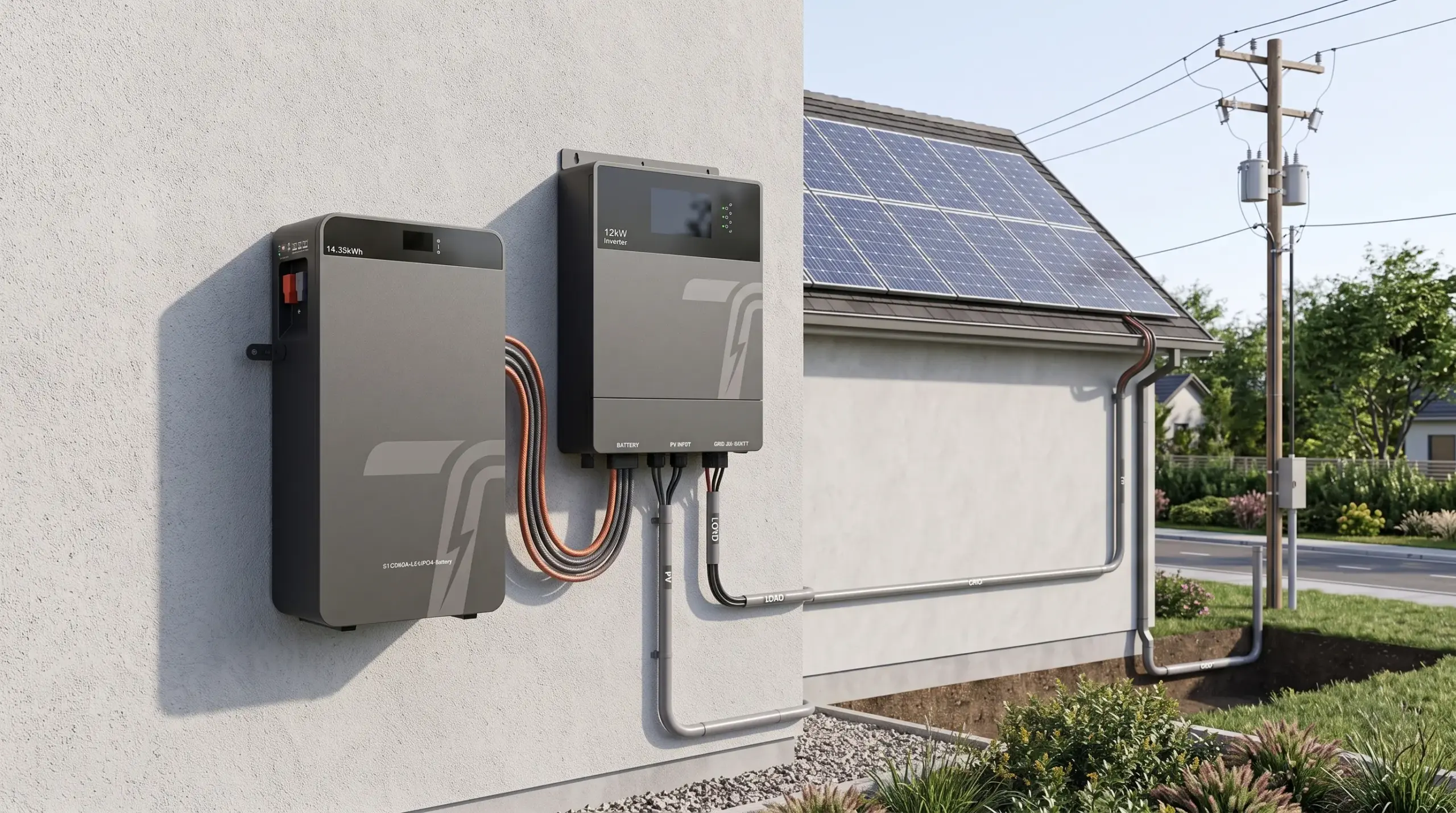
The battery is only one part of the return path. In a typical 51.2V LFP home system, the BMS reports voltage, temperature, state of charge and allowable current through CAN or RS485. The hybrid inverter uses those limits while it controls the AC relay or external automatic transfer switch.
A 5kW inverter can draw about 98A from a 51.2V battery before conversion losses. Loose terminals, a cold pack, a conservative BMS discharge limit or a communication fault can prevent a clean transfer even when the utility waveform is acceptable. TURSAN’s 6kW hybrid inverter platform and 48V battery range should therefore be evaluated as a matched system, not as unrelated catalogue items.
The wiring boundary matters just as much. Loads on the normal grid bus will remain without power during an outage. Only circuits downstream of the EPS output or backup gateway receive inverter-formed power. After the grid returns, the system reconnects that protected branch; it does not magically move circuits that were never wired to the backup side.
For larger residential loads, compare the inverter’s continuous EPS rating, surge rating and phase arrangement with the actual motor-start current. A refrigerator compressor or pump can trip a system during transfer even though average household demand looks modest.
Automatic and manual configurations compared
The table below separates the battery chemistry from the switching architecture. A standalone battery or a grid-compatible charger does not automatically provide automatic reconnection.
| Configuration | After utility power returns | Best fit | Buyer check |
|---|---|---|---|
| Hybrid inverter with internal EPS relay | Usually reconnects after voltage, frequency and timer checks. | Homes with protected essential loads | Request the regional grid profile and measured transfer sequence. |
| Hybrid inverter with external ATS | Controller and ATS coordinate the return path; timing depends on both devices. | Whole-home or larger essential-load panels | Confirm pole count, neutral treatment, surge rating and ATS delay. |
| Battery with manual changeover switch | Requires an operator to restore the normal supply path. | Simple off-grid or low-cost backup installations | Do not market the system as automatic backup. |
| Off-grid inverter without grid input | Cannot reconnect to the utility because no grid-following path exists. | Remote sites and weak-grid applications | Size PV, battery and generator reserve for full autonomy. |
TURSAN offers both hybrid home energy storage solutions for PV, grid and battery coordination and off-grid home ESS solutions where reconnection is not part of the operating model. The product family must match the project brief.
How OEM and ODM buyers should specify reconnection
Put the return behavior in the purchase specification before the factory starts enclosure artwork. Ask for the grid-loss and grid-return test report, including nominal voltage, frequency, battery state of charge, load percentage, load type, ambient temperature and measurement method.
For an OEM or ODM program, lock the following items with the sample BOM:
- Grid-code profile, voltage and frequency windows, reconnection delay and retry behavior.
- Internal relay or external ATS model, pole configuration, neutral switching and maximum fault current.
- CAN or RS485 pinout, protocol version, BMS current limits, firmware revision and alarm mapping.
- EPS continuous power, short-duration surge power and the protected-load wiring diagram.
- Acceptance tests at low and high state of charge, several load levels and the minimum operating temperature.
A sample that reconnects at 25°C with a resistive load does not prove performance with a compressor at 0°C. Record the approved inverter, battery, relay and firmware combination. A later component substitution can change the timing or the BMS handshake and should trigger regression testing.
For a product family, link the control behavior to the physical SKU. TURSAN’s 51.2V 5.22kWh battery, 10.44kWh and 16.07kWh modules offer different runtime and surge headroom, but none removes the inverter’s detection and synchronization interval.
Four commissioning mistakes that delay return to grid
Assuming voltage means a stable grid
A multimeter can show nominal voltage while frequency, phase sequence or repeated dips keep the inverter isolated. Read the event log and measure the supply under load.
Leaving automatic mode disabled
Some systems ship with manual or commissioning mode selected. Confirm auto-reconnect, grid standard, time zone and reserve settings before handover.
Putting loads on the wrong bus
A charged battery cannot back up a circuit connected upstream of the EPS output. Test each protected branch from the single-line diagram.
Ignoring the BMS handshake
Wrong CAN profiles, reversed pins or old firmware can block discharge and reconnection. Bench-test the exact battery, inverter, cable and firmware set.
If the system stays isolated beyond its documented waiting period, check the app for grid, relay, frequency or BMS alarms. Do not bypass protection or force a contactor closed. Have the installer verify the event log and grid settings.
Questions buyers ask about grid return
Not necessarily. Once grid-connected, the inverter may keep the battery in self-consumption, time-of-use or reserve mode. Reconnection changes the AC operating state; it does not dictate the battery’s charge or discharge schedule.
There is no universal number. The system must satisfy the applicable grid code and its configured stable-window timer. Use the inverter manual and commissioning record rather than promising a fixed delay across markets.
No. More capacity improves runtime and may improve voltage support under load. It does not shorten grid detection, anti-islanding or synchronization delays.
Test grid loss and return at several state-of-charge levels, with representative resistive and motor loads. Confirm the protected circuits, record the delay, review alarms, and save the approved firmware and grid profile.
Procurement conclusion
Specify the return path, not just the battery capacity
Most properly configured hybrid systems reconnect automatically, but the behavior belongs to the complete inverter, switching, wiring and BMS package. Treat automatic return as a tested system function with defined grid conditions, timing and load limits.
Send TURSAN your target market, grid voltage and frequency, single-line diagram, protected-load list, desired battery capacity and first-batch quantity. The engineering team can return a preliminary BOM and sample validation plan for an OEM or ODM project.