 English
  العربية
  日本語
日本語  한국어
한국어  Tiếng Việt
  ไทย
ไทย  Bahasa Melayu
  فارسی
فارسی  Bahasa Indonesia
  ဗမာစာ
ဗမာစာ  简体中文
简体中文  香港中文
香港中文  繁體中文
繁體中文  Русский
  Deutsch
  Nederlands
  Italiano
  Français
  Español
  Português
  Afrikaans
  Azərbaycan dili
  Български
  ਪੰਜਾਬੀ
  हिन्दी
  اردو
اردو  বাংলা
বাংলা  Հայերեն
  Íslenska
  Қазақ тілі
  नेपाली
  Српски језик
  Kiswahili
  తెలుగు
  Basa Jawa
  தமிழ்
தமிழ்  मराठी
मराठी Wholesale Stocking Strategy
Why Wholesalers Should Stock 5kWh and 16kWh Home Batteries First
Two capacities cover the real installation map — and four part numbers beat seven. Here is the factory-level stocking math for 5 kWh and 16 kWh home batteries, in all-in-one and wall-mounted form.
A distributor in Łódź ran seven capacity SKUs in 2024 – 5, 7.5, 10, 12, 15, 20 and 30 kWh. By June, the 5 kWh units had rotated three times. The 7.5 and 12 kWh pallets sat untouched for 170 days, and the money locked in them forced him to decline a container of 16 kWh units a competitor then sold out within a quarter. The problem was never the market. It was the spread.
This article gives you a defensible answer to the question every buyer asks before committing warehouse space: which two capacities cover the largest share of real installations with the smallest amount of dead stock. The answer, based on three years of distributor sales data and inverter pairing records, is 5 kWh and 16 kWh – each available as an all-in-one system or a wall-mounted battery.
If you want the short version: stock both capacities in both form factors, keep the middle capacities off your order sheet, and use the freed cash to deepen stock where turnover actually happens.
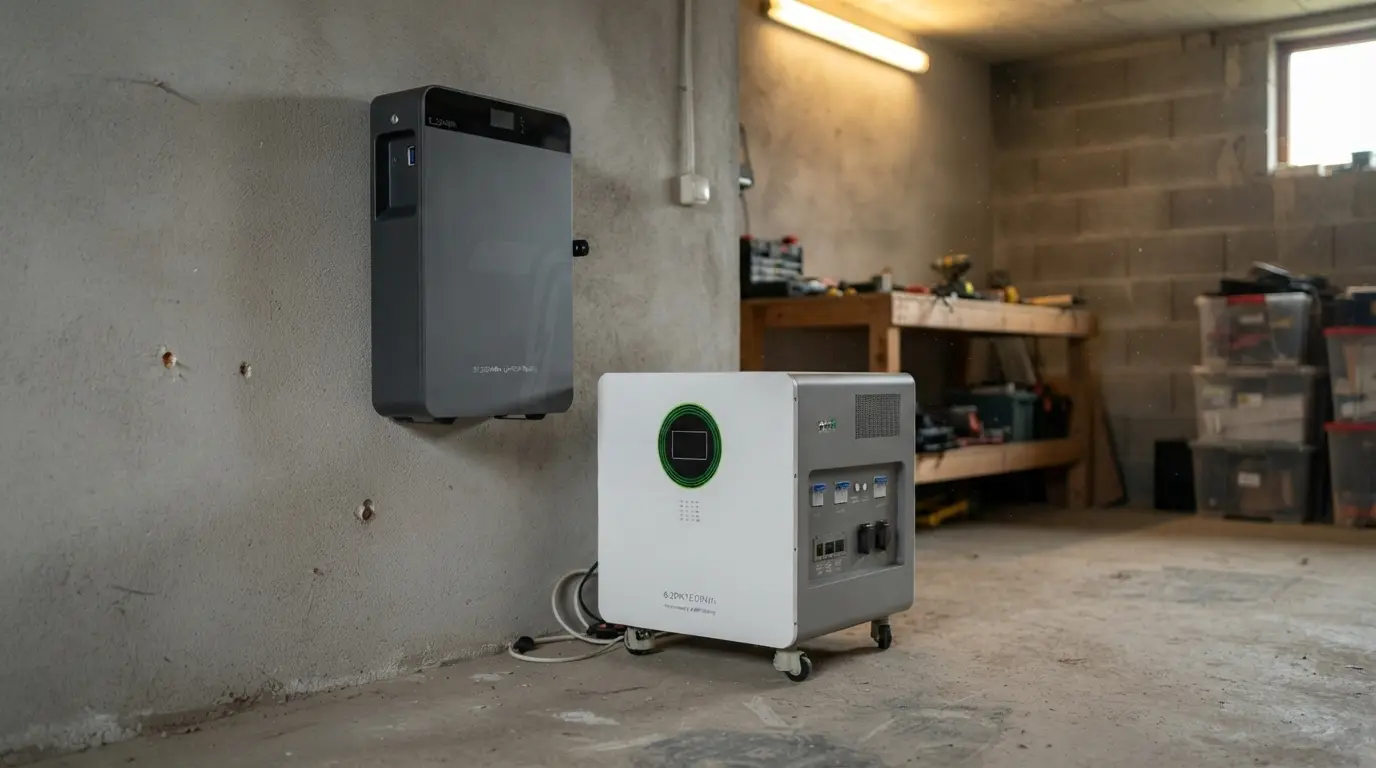
The Two Capacities That Cover the Real Installation Map
A battery capacity is not an arbitrary number. It maps to how much power a household actually consumes overnight and what the installer can physically sell.
The 5 kWh unit runs a 16S LFP pack at 51.2 V nominal with a 100 Ah capacity. Its job is precise: cover a fridge, router, lighting and a few hours of outage, or shift a 3–5 kWp rooftop array’s evening loads. Installers in South Africa, Lebanon and Pakistan spec it daily for retrofit jobs where the existing inverter already runs 48 V. The unit weighs roughly 48–55 kg in wall-mount form, which two people can hang without a hoist, and it ships four to six units per pallet. That logistics profile is why it turns over fast: a distributor can ship a single unit to a small installer without a minimum order friction.
The 16 kWh unit uses 314 Ah prismatic cells in the same 51.2 V architecture, typically as two 8 kWh modules in one enclosure or a single floor-standing cabinet around 140 kg. It exists because 5 kWh does not survive a European winter night. A heat pump draws 3–4 kW continuous in January; a 5 kWh pack with 90% usable depth gives roughly 4.5 kWh, which runs out before 1 a.m. The 16 kWh pack delivers about 14.4 kWh usable and carries a whole home – heat pump, induction hob, EV trickle charge – through to morning PV production. It is the default quote for whole-home backup in Germany, Australia and the Nordics.
Now look at the stacking math, because it kills the middle SKUs. Two 5 kWh units give 10 kWh; three give 15 kWh. A 16 kWh base scales to 32 and 48 kWh. Between them, every realistic residential and small-commercial requirement from 5 kWh to 48 kWh is covered in sensible increments. A 10 kWh standalone unit covers exactly the same ground as two 5 kWh units, at higher inventory cost and lower configurability. It earns its shelf space only when installers refuse to parallel two smaller units – and most modern units parallel without a central controller, so they don’t.
Three hard numbers anchor both tiers: 6,000+ cycles at 0.5C charge/discharge with 80% remaining capacity at 25 °C ambient, 95% DC-to-DC round-trip efficiency, and a -20 °C to 55 °C discharge window with a 0.5C derate below 0 °C. If a datasheet you’re reviewing can’t show you these three figures with a test report attached, keep looking.
The OEM/ODM Edge – One Platform, Two Capacities, Your Brand
From an OEM standpoint, the 5 kWh and 16 kWh pairing is efficient because it is often one platform. The 5 kWh wall-mount and the 8 kWh module inside the 16 kWh cabinet can share the same BMS topology, the same cell qualification line and the same CAN/RS485 protocol stack. That means your ODM partner runs one firmware branch across both capacities, and your service team learns one diagnostic flow instead of five.
What you can negotiate on a platform order:
- Label and packaging – silk-screen your brand, ship in unbranded neutral cartons with your manual and warranty card.
- Connector variants – Amphenol SurLok or M8 bolt-on depending on the installers you serve.
- Inverter protocol pre-configuration – flash the unit for Victron, Deye, Growatt or Luxpower comms before it leaves the factory so installers never open a laptop.
- Mixed-capacity MOQs – a 50-unit minimum split 60/40 between 16 kWh and 5 kWh is a standard ask; the platform structure makes it cheap for the factory to grant.
- Sample lead time – 2 weeks for branded samples, 25–30 days for production runs of one container.
The honest way to phrase this to your sales team: you are not buying two batteries. You are buying one platform in two capacities, and your ODM partner should quote it that way.
You are not buying two batteries. You are buying one platform in two capacities.

Decision Matrix – 5 kWh vs 16 kWh in Both Form Factors
| Configuration | Typical install | Weight | Mounting | Parallel ceiling | Target buyer |
|---|---|---|---|---|---|
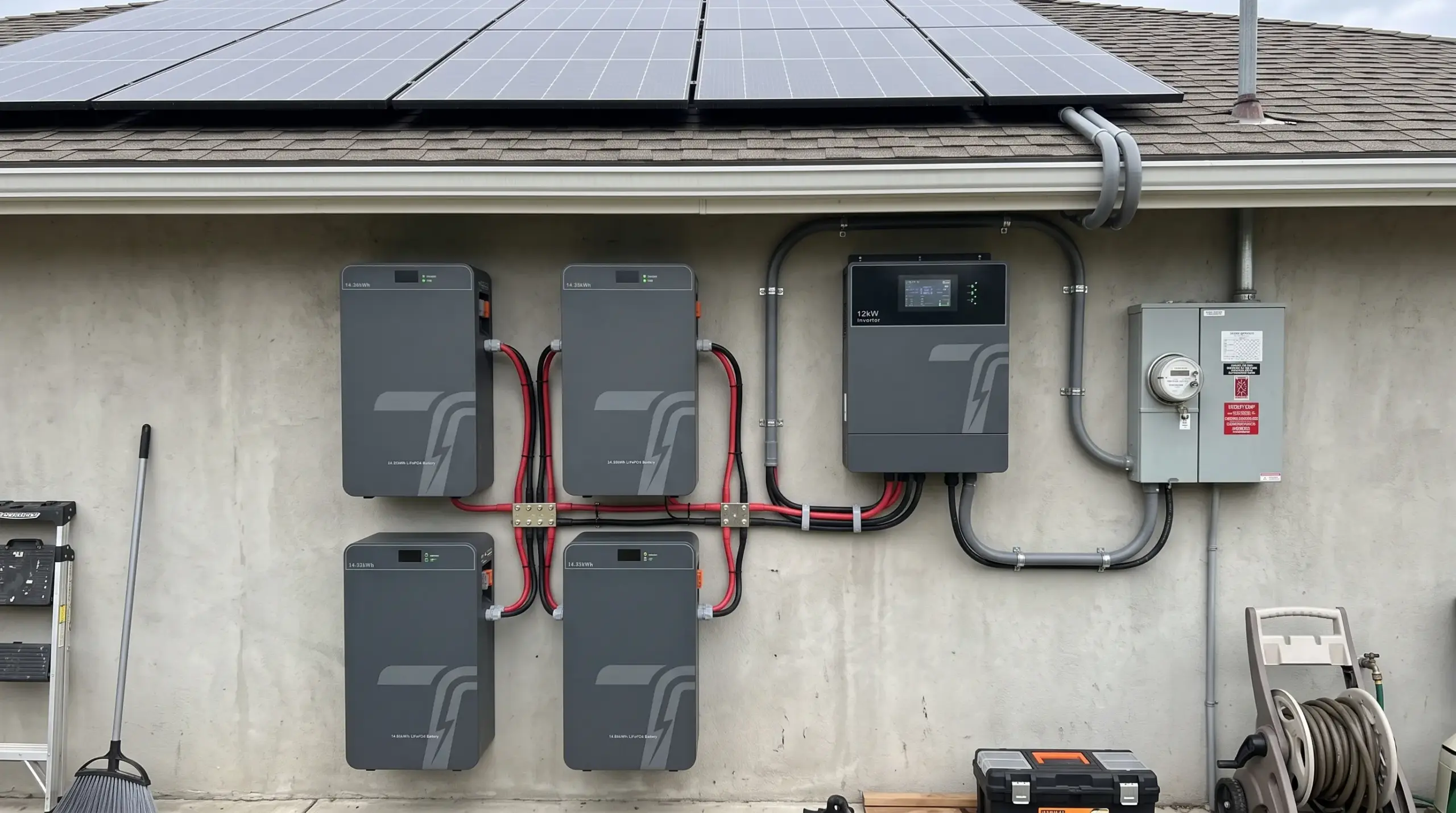
| 5 kWh wall-mount | Retrofit backup, balcony/light PV, UPS for small office | 48–55 kg | Wall bracket, 2-person lift | 15 units | Small installers, panel builders |
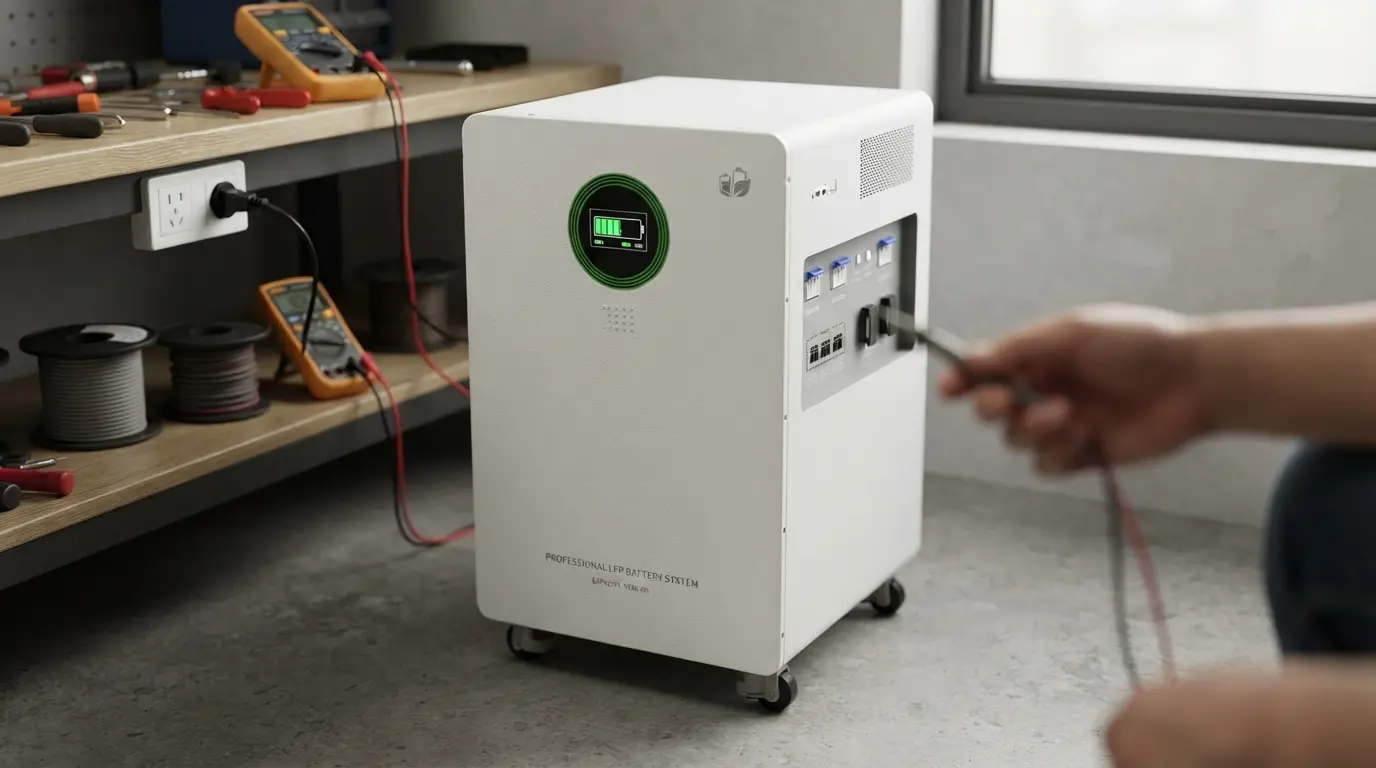
| 5 kWh all-in-one | Single-phase home, landlord units, flat backup | 65–80 kg with hybrid inverter | Floor or wall | 4–6 units | Distributors selling kits |
| 16 kWh wall-mount (2×8 kWh) | Whole-home backup, heat-pump households | 2×70 kg modules | Wall rail, module stacking | 6 modules (48 kWh) | EU/AU installers |
| 16 kWh cabinet | Whole-home + EV, off-grid cabins, small commercial | ~140 kg | Floor, forklift for high racking | 3 units (48 kWh) | C&I entry, off-grid specialists |
Two rules fall out of the table. First, the all-in-one sells on speed – one SKU, one warranty, no inter-unit cabling – while the wall-mount sells on flexibility and easier service. Second, installers who start with 5 kWh wall-mounts graduate to 16 kWh within two seasons; stocking both lets you keep the same account instead of handing it to a competitor.
Four Pitfalls That Drain Warehouse Cash
1. Buying the full capacity ladder. Seven SKUs of one brand means seven warranty flows, seven packaging lines and seven ways to misforecast. Two capacities, two form factors – four part numbers – is the largest range a mid-size distributor manages well.
2. Ignoring the continuous discharge rating. A 5 kWh unit specced at 0.5C continuous (2.5 kW) cannot start a 3 kW well pump, and the installer will blame your brand. Check the 0.5C vs 1C rating before committing to an order; it determines which appliance profile the unit survives.
3. Skipping protocol compatibility at the order stage. The most common returns we see are not faulty cells – they are BMS/inverter communication mismatches. Pin down the exact inverter brands your market installs, then order the units pre-flashed for those protocols.
4. Treating shipping classification as an afterthought. LFP packs over 100 Wh ship under UN 3480 with UN 38.3 test summary, and the 16 kWh cabinet at 140 kg changes your container loading plan versus palletized 5 kWh units. A wrong classification at the port costs you three weeks and a storage fee that eats the margin on forty units.
FAQ
Only if the customer’s overnight load lands exactly between 5 and 16 kWh, which is rare. A 10 kWh unit costs roughly 15–20% less than a 16 kWh unit but delivers 37% less energy, and it cannot be split into two locations the way two 5 kWh units can. The per-kWh price advantage sits with 16 kWh.
Both. The all-in-one closes deals with installers who want one box and one warranty. The wall-mount wins retrofits where an inverter already exists, and it is the form factor that produces repeat orders as customers add a second module. Run them as four part numbers, not four product lines.
Fifty units – 30 at 16 kWh and 20 at 5 kWh – with the 16 kWh split between cabinet and wall-mount based on your installer base. A factory that refuses a mixed split on a shared platform is signaling rigid production planning that will hurt you later on reorders.
Across distributor accounts we track, the 5 kWh wall-mount averages under 60 days of shelf time in active markets, and 16 kWh units under 90 days. Middle capacities in the same warehouses frequently pass 150 days. The rotation difference is the argument, in one number.
Conclusion – Order What Turns, Then Go Deeper
Stocking strategy is cash-flow strategy. Four part numbers – 5 kWh and 16 kWh, each in wall-mount and all-in-one form – cover the installation map from a two-hour outage to a Scandinavian winter, and they rotate before your payment terms come due. Everything in between dilutes your capital, your service team and your container space.
Send your top three installer profiles or your last twelve months of sales data, and we’ll return a stocking plan for the two capacities with pallet loading, protocol pre-configuration and a phased container schedule within 24 hours.