 English
  العربية
  日本語
日本語  한국어
한국어  Tiếng Việt
  ไทย
ไทย  Bahasa Melayu
  فارسی
فارسی  Bahasa Indonesia
  ဗမာစာ
ဗမာစာ  简体中文
简体中文  香港中文
香港中文  繁體中文
繁體中文  Русский
  Deutsch
  Nederlands
  Italiano
  Français
  Español
  Português
  Afrikaans
  Azərbaycan dili
  Български
  ਪੰਜਾਬੀ
  हिन्दी
  اردو
اردو  বাংলা
বাংলা  Հայերեն
  Íslenska
  Қазақ тілі
  नेपाली
  Српски језик
  Kiswahili
  తెలుగు
  Basa Jawa
  தமிழ்
தமிழ்  मराठी
मराठी Are you trying to choose between a portable power station and a UPS? Both provide backup power, but they solve different problems: a UPS protects sensitive electronics from brief outages, while a portable power station offers longer runtime, flexible outputs, and solar charging.
The real question isn’t which one is better—it’s whether you need instant switchover for a computer, router, or NAS, or hours of backup power for appliances, travel, and off-grid use. In this guide, I’ll explain their key differences, overlaps, and best use cases so you can make the right choice with confidence.
Let’s dive right in!
Portable Power Station vs. UPS: Understanding the Differences and Overlaps
Backup power serves two different needs: continuous protection for connected electronics or portable energy for longer off-grid use. Understanding the difference between a UPS and a portable power station helps buyers select the right system for home, office, outdoor, and commercial applications.
What Is an Uninterruptible Power Supply (UPS)?
An Uninterruptible Power Supply (UPS) is a grid-connected backup system designed to protect sensitive electronics during power interruptions. It provides continuous pass-through power and switches to battery power within milliseconds when the grid fails.
A UPS is mainly used for:
- Computers, servers, networking equipment, and control systems
- Short-duration backup during blackouts
- Data loss and system interruption prevention
- Grid-tied emergency power protection
Its main advantage is fast transfer performance, although backup runtime is typically designed for short shutdown or transition periods.
What Is a Portable Power Station (PPS)?
A Portable Power Station (PPS) is a rechargeable battery system built for mobile, emergency, and off-grid power. It combines battery storage, an inverter, charging controls, and multiple output ports in one transportable unit.
TURSAN portable power stations use LiFePO4 prismatic cells, pure sine wave inverter technology, and built-in battery management systems. Available models support output levels from 300W to 3600W and energy capacities from 806.4Wh to 3,225.6Wh.
A PPS is suited to:
- Off-grid power backup
- Outdoor and mobile applications
- Home office and emergency power
- High-wattage equipment
- Solar-rechargeable energy storage
The core difference is simple: a UPS prioritizes rapid grid-failure protection, while a portable power station prioritizes capacity, flexibility, and mobility.
Technical Differences: Transfer Speed, Battery Life, Capacity, and Inverter Quality
When I compare a portable power station with a UPS, I focus on four practical factors: transfer speed, battery life, stored energy, and inverter quality. A UPS prioritizes rapid grid-failure protection, while a portable power station provides larger, mobile energy storage for high-wattage and off-grid use.
Transfer Speed: The Switchover Interval
A dedicated UPS is designed to keep connected equipment powered during a grid failure. Many UPS systems switch in under 10–20 milliseconds. A standard portable power station may switch more slowly, while models with Emergency Power Supply (EPS) functionality can typically transfer in about 20–30 milliseconds.
For sensitive office or computing equipment, this difference can affect continuity during a blackout.
Battery Chemistry and Longevity
Many UPS systems use lead-acid batteries or lower-cycle lithium batteries. Modern portable power stations commonly use LiFePO4 cells, also called lithium iron phosphate cells.
LiFePO4 technology offers:
- 6,000+ cycles in supported systems
- Lower maintenance than traditional lead-acid batteries
- A strong fit for repeated backup, mobile, and off-grid use
I use LiFePO4 battery solutions to assess cycle life and long-term suitability before selecting a battery system.
Capacity vs. Runtime Architecture
A portable power station is built around stored energy and flexible output. Available systems can provide approximately 800Wh to more than 3,200Wh of capacity, with portable models reaching up to 3,600W output.
A UPS usually offers a smaller battery reserve because its main role is to provide enough runtime for a controlled shutdown or short interruption. Actual runtime depends on the connected load and the system’s usable battery capacity.
Inverter Quality: Pure Sine Wave vs. Modified Sine Wave
A pure sine wave inverter delivers cleaner AC power and supports a wider range of electronics and high-load devices. TURSAN portable power stations use pure sine wave output with intelligent battery management for stable power delivery.
UPS output varies by model. Some use pure sine wave technology, while others use modified sine wave output.
| Performance Metric | Portable Power Station | UPS |
|---|---|---|
| Main purpose | Mobile, off-grid, and emergency energy | Grid-failure protection |
| Transfer time | Varies; EPS models may transfer in about 20–30 ms | Often under 10–20 ms |
| Battery chemistry | LiFePO4 in modern systems | Often lead-acid or lower-cycle lithium |
| Capacity | About 800Wh to 3,200Wh+ | Generally lower, for short backup periods |
| Maximum output | Up to 3,600W in supported portable systems | Varies by model and application |
| Inverter output | Pure sine wave | Pure or modified sine wave, depending on model |
Portable Power Station vs. UPS: Key Performance Metrics
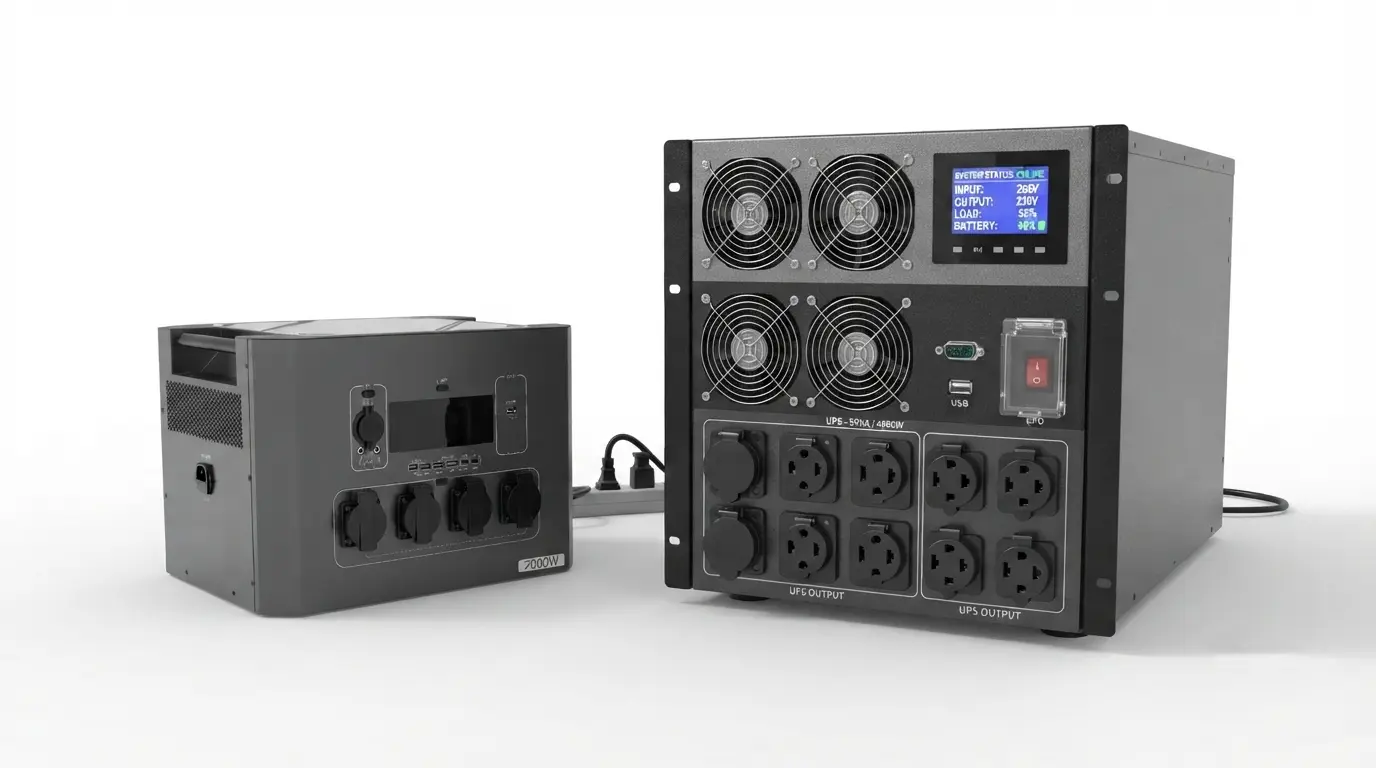
I compare the two systems by the factors that matter most for blackout protection, mobility, runtime, and load support.
| Performance metric | Portable Power Station (PPS) | Uninterruptible Power Supply (UPS) |
|---|---|---|
| Primary role | Mobile off-grid and emergency power | Grid-fail protection and short-term backup |
| Transfer time | Slower; EPS models typically switch in about 20–30 ms | Instant or ultra-fast switching, generally under 10–20 ms |
| Battery technology | LiFePO4 cells with a rated life of 6,000+ cycles | Often lead-acid or lower-cycle lithium, depending on the model |
| Capacity and output | About 800Wh to 3,200Wh+ and up to 3,600W | Usually lower capacity for short shutdown windows |
| Recharge options | AC and solar charging support | Primarily grid charging |
| Inverter output | Pure sine wave for sensitive and high-load equipment | Pure or modified sine wave, depending on the tier |
| Best use case | Multi-day backup, outdoor use, solar storage, and mobile power | Continuous PC, server, and office equipment protection |
Bottom line: A UPS prioritizes fast switchover, while a portable power station provides greater capacity, mobility, and longer off-grid runtime.
The Technical Overlap: Hybrid EPS / UPS Modes in Modern Power Stations

Modern portable power stations can combine mobile energy storage with emergency backup. TURSAN EPS models use pass-through charging and fast EPS transfer to keep connected equipment powered when mains power fails. This reduces the gap between a portable power station and a traditional UPS, although transfer performance should still match the needs of sensitive equipment.
Understanding Pass-Through Charging
Pass-through charging allows the power station to receive AC input while supplying power to connected devices. I use this arrangement for temporary home office, emergency, and off-grid backup.
| Function | Hybrid portable power station |
|---|---|
| Normal operation | Supplies connected loads and charges the battery |
| Power failure | Switches to battery power through EPS mode |
| Transfer time | About 20–30 ms in EPS mode |
| Output quality | Pure sine wave inverter output |
| Battery control | Smart BMS manages battery operation |
For reliable backup planning, charging performance also matters. Guidance on battery quality control provides useful background when assessing battery-based power systems.
The Rise of Emergency Power Supply (EPS) Engineering
EPS engineering brings together:
- Portable power: TURSAN units provide up to 3,600W output and about 3.2kWh of energy storage.
- Long service life: LiFePO4 prismatic cells support 6,000+ cycles.
- Clean power: Pure sine wave output supports a range of home and office electronics.
- Smart control: Built-in BMS technology helps manage charging and battery protection.
A hybrid portable power station is therefore practical for emergency backup, but equipment requiring zero-transfer protection should use a dedicated UPS designed for that specific requirement.
Portable Power Station vs. UPS: Strategic Selection Framework

I match the system to three priorities: transfer speed, runtime, and mobility.
| Priority | Best fit | Main reason |
|---|---|---|
| Fast grid-failure protection | Dedicated UPS | Designed for continuous pass-through and rapid switchover |
| High capacity and mobility | Portable power station | Supports off-grid use, multiple outputs, and solar recharging |
| Fast backup plus longer runtime | Hybrid deployment | Combines UPS protection with portable energy storage |
Scenario A: Choose a Dedicated UPS If…
Choose a dedicated uninterruptible power supply when:
- Critical PCs, servers, or network equipment need rapid transfer during a blackout.
- Data loss prevention is more important than portability.
- The system will remain connected to the grid.
- Backup is mainly needed for short shutdown or ride-through periods.
A UPS is the stronger choice when even a short power interruption could affect sensitive electronics.
Scenario B: Choose a Portable Power Station If…
Choose a LiFePO4 portable power station when:
- You need mobile, off-grid, or emergency power.
- Longer runtime and higher capacity matter more than zero-transfer switching.
- You need multiple output ports, solar rechargeability, or support for high-wattage loads.
- A pure sine wave inverter and long battery life are important.
TURSAN portable power stations cover models from 300W to 3600W and approximately 806.4Wh to 3,225.6Wh, with LiFePO4 cells rated for 6000+ cycles. EPS models can provide a faster backup transition for selected home and office applications.
Scenario C: Use a Hybrid Deployment Strategy
A hybrid setup assigns each device to the power source that fits its needs:
- Use a dedicated UPS for equipment requiring the fastest transfer.
- Use a portable power station for longer backup, mobile loads, and high-power appliances.
- Use an EPS-capable model when pass-through charging and faster transfer are required.
- Check the rated output, transfer time, waveform, and pass-through specifications before connecting sensitive equipment.
For custom battery-backed systems, BMS and battery protection helps align battery protection with the wider power architecture.
Engineering Better Power: The TURSAN Advantage
When I assess a portable power station vs. UPS, I look at more than output ratings. TURSAN combines LiFePO4 storage, intelligent protection and practical monitoring for homes, installers, distributors and off-grid applications.
Industrial-Grade Reliability
We use BYD LiFePO4 prismatic cells, Smart BMS technology and pure sine wave inverter output. TURSAN systems support:
- 6000+ battery cycles
- 95% inverter efficiency
- A standard 5-year warranty
- Pre-certification support including UN38.3, MSDS, UL1973, CE and FCC
With 15 production lines serving more than 30 countries and a reported 99.89% on-time delivery rate, we support reliable supply for both portable units and stationary energy storage. Our backup power systems are designed for practical residential and commercial power needs.
Smart Integration
Built-in Wi-Fi and Bluetooth monitoring helps users track system performance. Multi-API protocol support also makes integration more practical for installers and project teams managing connected energy equipment.
Customizable Power Infrastructure
TURSAN supports OEM and ODM development, including free exterior ID modelling. Our range covers portable power stations, home battery backup systems, all-in-one ESS products and EPS model variants.
For larger requirements, we provide B2B wholesale and project support for installers and distributors, helping businesses develop power infrastructure around their required capacity, housing style and application.
Portable Power Station vs. UPS: Frequently Asked Questions
Can I use a portable power station as a permanent UPS for my gaming PC?
Yes, but only when the portable power station supports EPS mode, pass-through charging, and fast transfer. A LiFePO4 portable power station with a pure sine wave inverter can provide flexible home office or gaming backup.
However, a dedicated UPS remains the safer choice when uninterrupted PC uptime and minimal transfer delay are essential. I treat a portable power station as a permanent UPS only when its specifications and operating instructions support continuous use.
What Is the Difference Between an Online UPS and an Offline UPS?
| UPS type | How it works | Best suited for |
|---|---|---|
| Online UPS | Continuously supplies connected equipment through its inverter | Critical systems requiring continuous power |
| Offline UPS | Normally passes through grid power and switches to battery during an outage | General electronics and short backup periods |
Battery design also varies between systems. An lithium battery configurations for backup systems is a different configuration from the LiFePO4 prismatic cells used in TURSAN portable power stations.
How Long Will a 1000Wh Portable Power Station Run a Home Office Setup?
Runtime depends on the total power draw. Using the stated 95% inverter efficiency, a simple planning estimate is:
Estimated runtime = 1000Wh × 0.95 ÷ load in watts
| Home office load | Estimated runtime |
|---|---|
| 50W | About 19 hours |
| 100W | About 9.5 hours |
| 200W | About 4.75 hours |
Actual runtime may be shorter because of device demand, charging losses, and operating conditions.
Do Portable Power Stations Damage Electronics if Left Plugged In Permanently?
Not necessarily. A model with pass-through charging, EPS support, a Smart BMS, and pure sine wave output can provide practical emergency backup while connected to the grid.
Still, not every portable power station is designed for permanent UPS operation. Before leaving one plugged in, I check:
- EPS and pass-through support
- Transfer-time requirements
- Pure sine wave output
- Manufacturer operating instructions
- Required ventilation and charging conditions