 English
  العربية
  日本語
日本語  한국어
한국어  Tiếng Việt
  ไทย
ไทย  Bahasa Melayu
  فارسی
فارسی  Bahasa Indonesia
  ဗမာစာ
ဗမာစာ  简体中文
简体中文  香港中文
香港中文  繁體中文
繁體中文  Русский
  Deutsch
  Nederlands
  Italiano
  Français
  Español
  Português
  Afrikaans
  Azərbaycan dili
  Български
  ਪੰਜਾਬੀ
  हिन्दी
  اردو
اردو  বাংলা
বাংলা  Հայերեն
  Íslenska
  Қазақ тілі
  नेपाली
  Српски језик
  Kiswahili
  తెలుగు
  Basa Jawa
  தமிழ்
தமிழ்  मराठी
मराठी OEM / ODM Field Note
A brand owner in the Netherlands wants to launch a 5 kWh wall-mount battery under his own label. He has a logo, a target price, and a distributor waiting. What he doesn’t have is a clear answer to the first question every factory asks back: how many units are you committing to?
The answer is not a single number. It is a function of four things – cell procurement, certification, tooling, and how much of the product you want to change. Get the MOQ structure right and a first order of 50 units is workable. Get it wrong and you either overcommit cash on a product you haven’t sold yet, or pay a per-unit premium that kills your margin before the first container ships.
This article explains what actually sets the minimum order quantity for an OEM home energy storage system, what a realistic first order looks like, and how to negotiate it without overpaying.
What Actually Sets the MOQ – Cells, Certification and Tooling
The minimum order quantity is not a policy a factory invents to be difficult. It is the smallest batch that lets the factory buy cells, run a production line, and still make a margin. Three costs dominate.
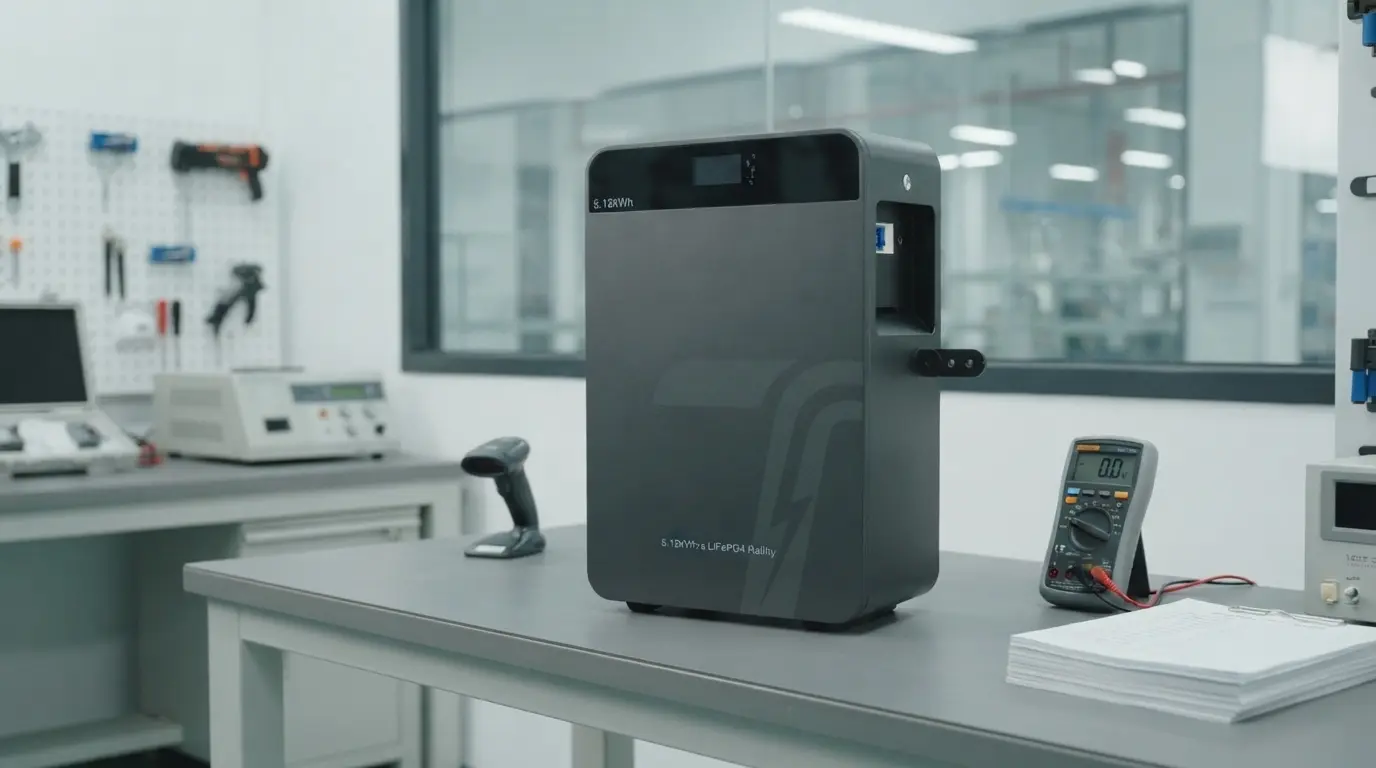
Cell procurement is the floor. A 5 kWh LFP wall-mount battery holds 16 prismatic cells in a 16S1P configuration, each cell at 3.2V nominal and 100 Ah. Cell suppliers sell in tray and pallet quantities, and a factory that buys fewer than a full pallet pays a spot price that is 8–15% higher per cell. That is why a 50-unit order of a 5 kWh system – roughly 800 cells – is often the practical floor: it is the smallest batch that lets the factory buy cells at a pallet rate instead of a tray rate.
Certification is a fixed cost you amortise. A UL 1973 and IEC 62619 certification run for a specific pack design costs tens of thousands of dollars and takes months. That cost is identical whether you order 50 units or 5,000. The factory spreads it across your order, which is why the per-unit certification burden on a 50-unit order is brutal and on a 500-unit order is trivial. This single fact explains most of the MOQ structure you will see.
Tooling and label printing set the customisation threshold. A standard enclosure, standard BMS and standard firmware carry no tooling cost, so the MOQ stays low. The moment you change the enclosure colour, the front-panel silk screen, the connector type or the firmware charge ceiling, you trigger a setup cost that only makes sense above a certain volume. Label printing is the cheapest customisation – a roll of branded labels can be amortised over 50 units. A new injection-moulded front panel is the most expensive – it can need 500 units to justify the mould.
What a Real OEM/ODM Partner Does With Your First Order
A trading company quotes you a flat MOQ and walks away. A manufacturer explains the MOQ as a menu, because a genuine OEM/ODM partner knows your first order is a test, not a commitment.
A real partner will separate the product into three layers and price each one differently. The standard layer – cells, BMS, enclosure, inverter interface – carries the base MOQ, typically 50 to 100 units for a 5 kWh wall-mount system. The branding layer – label, silk screen, packaging, user manual – can be applied at that same 50-unit floor with almost no added cost, because label printing and manual localisation are cheap to set up. The engineering layer – firmware tuning, connector changes, enclosure modifications – is where the MOQ climbs, because each change is a new BOM line and a new test cycle.
They will also be honest about the sample path. Before you commit to 50 units, you should buy two to five pre-production samples at a higher per-unit price, run them through your own cycle and thermal testing, and only then place the production order. A partner who refuses to sell samples before a production order is a red flag, not a cost-saving measure.
MOQ by Customisation Level – The Decision Matrix
Here is how a realistic first order breaks down for a 5 kWh LFP wall-mount system, using grade-A cells and a full certification set.
| Customisation level | Typical MOQ | Per-unit cost impact | What you get |
|---|---|---|---|
| Standard product, your label only | 50–100 units | Baseline | Stock enclosure, stock BMS, branded label and manual |
| Label plus firmware tuning | 100–200 units | +3–6% | Custom charge/discharge limits, custom SOC window |
| Connector or port changes | 200–500 units | +5–10% | Different terminal type, added comms port, new harness |
| New enclosure or front panel | 500–1,000 units | +10–20% | New injection mould, custom colour, custom layout |
| Full ODM from scratch | 1,000+ units | Negotiated | New mechanical and electrical design, new certification |
The pattern is simple. The more of the product you change, the more units you must buy to amortise the change. Your label is nearly free. Your own enclosure is a serious commitment.
Four Ways a First Order Goes Wrong
One – Confusing MOQ with a single number. A factory that quotes “MOQ 500” without asking what you want to change is quoting you a full-custom product you may not need. Ask for the MOQ at each customisation level before you accept any number.
Two – Skipping the sample stage. Buying 50 units of a product you have never cycled is how brand owners end up with a container of batteries that derate in their market’s heat. Buy two to five samples, test them at your peak ambient temperature, then commit.
Three – Ignoring the certification amortisation. A 50-unit order carries a certification cost per unit that can be 10 times the cost on a 500-unit order. If your market requires UL 1973 or IEC 62619, run the per-unit certification math before you fix the order size.
Four – Over-customising the first order. Changing the enclosure, the connector and the firmware all at once turns a 50-unit test into a 500-unit gamble. Launch with your label on a standard product, prove the market, then customise on the second order.
Questions Buyers Ask Before They Place a First Order
For a standard 5 kWh LFP wall-mount battery with your label only, 50 to 100 units is a realistic floor. Full customisation pushes it to 500 units or more.
It usually isn’t. Label printing and manual localisation are cheap to set up, so a good partner applies your branding at the same 50-unit floor as the standard product. The MOQ climbs when you change hardware or firmware.
Yes, and you should. Expect to pay a higher per-unit price for two to five pre-production samples, run your own testing, then place the production order. A partner who refuses samples is not a partner.
Not linearly. The biggest price drop comes from cell pallet pricing and certification amortisation, both of which are mostly captured by 200 to 500 units. Beyond that, the savings flatten out.
Start With Your Label, Not Your Enclosure
The minimum order quantity for an OEM home energy storage system is not a wall you hit – it is a menu you read. Your label is nearly free at 50 units. Your firmware costs a little more. Your own enclosure is a real commitment. The smart first order puts your brand on a proven standard product, proves the market, and reserves the expensive customisation for the second order.
If you are planning a first order, tell us your target system voltage, daily load profile and the certifications your market requires, and we will return a MOQ breakdown at each customisation level – with the cell supplier, certification path and per-unit cost named in full – within 24 hours.