 English
  العربية
  日本語
日本語  한국어
한국어  Tiếng Việt
  ไทย
ไทย  Bahasa Melayu
  فارسی
فارسی  Bahasa Indonesia
  ဗမာစာ
ဗမာစာ  简体中文
简体中文  香港中文
香港中文  繁體中文
繁體中文  Русский
  Deutsch
  Nederlands
  Italiano
  Français
  Español
  Português
  Afrikaans
  Azərbaycan dili
  Български
  ਪੰਜਾਬੀ
  हिन्दी
  اردو
اردو  বাংলা
বাংলা  Հայերեն
  Íslenska
  Қазақ тілі
  नेपाली
  Српски језик
  Kiswahili
  తెలుగు
  Basa Jawa
  தமிழ்
தமிழ்  मराठी
मराठी Cell Format Engineering Brief
Why Home Energy Storage Prefers Prismatic Cells Over Cylindrical Cells
A 5.12 kWh wall battery is sixteen prismatic LFP cells in a single 16S1P string — or about 450 18650 cylinders welded into a 14S32P matrix. Both carry the same nameplate label. Here is the packaging, BMS, and supply-chain math behind why OEMs keep choosing prismatic.
A distributor I worked with in Germany once called with a container problem. Two wall batteries carried the same 10 kWh label, but one BOM listed 32 cells and the other listed more than nine hundred. The freight bill was identical, the enclosure sizes were not — and his installers wanted to know which unit they could still repair in year eight. The answer had nothing to do with brand marketing. It was cell format.
The 51.2V, 100Ah wall battery that has become the default for residential storage in Europe and North America is built from 16 prismatic LFP cells in a 16S1P string. The same 5.12 kWh of energy can be assembled from roughly 450 18650 cylinders in a 14S32P matrix. Both packs deliver the same nameplate energy. They are not the same product.
This article explains why the residential market — wall units, rack systems, and all-in-one cabinets — settled on prismatic cells, and what that choice means for a wholesaler, installer, or brand owner who sources OEM/ODM capacity.
The Cell Count Math Behind a 5.12 kWh Wall Battery
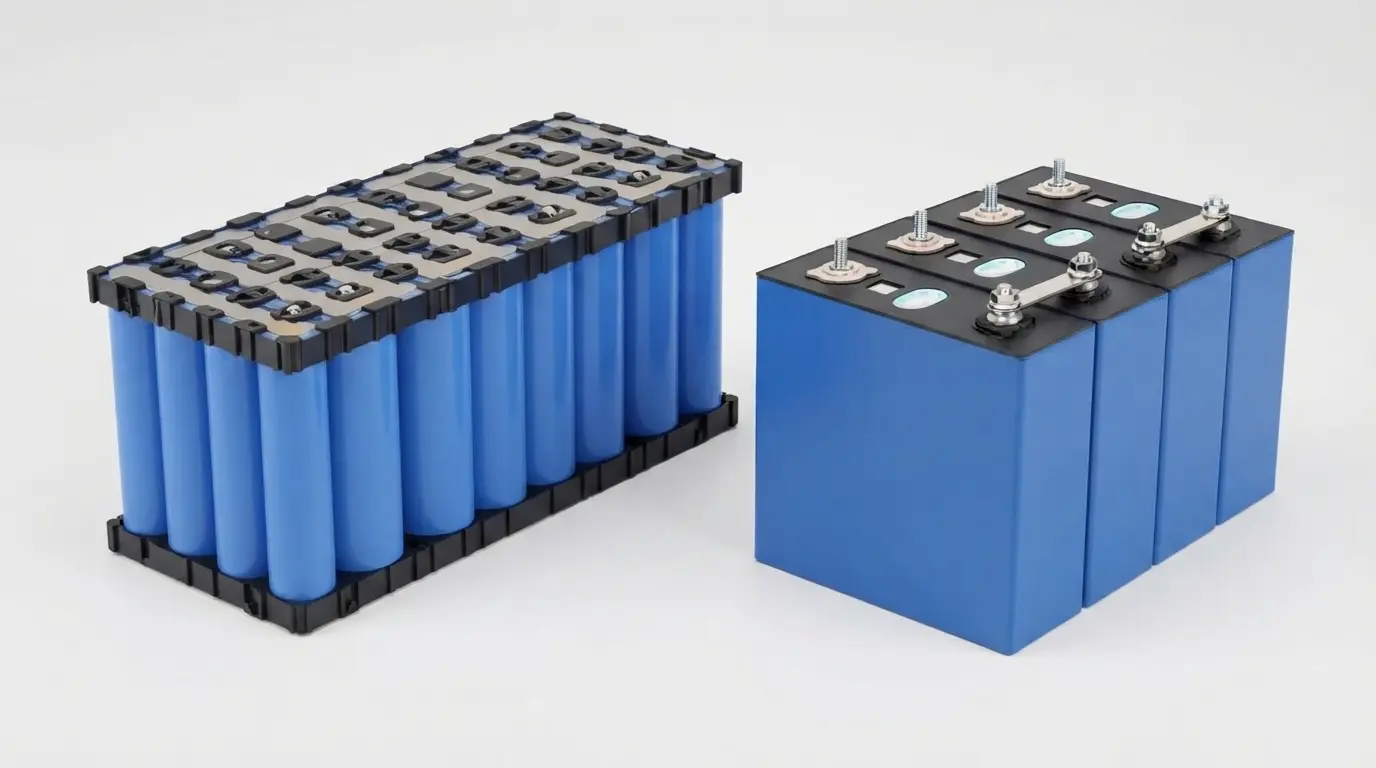
Sixteen cells. That is the entire string in a 51.2V, 100Ah wall battery — 16 cells at 3.2V nominal and 100Ah each, for 5.12 kWh of nameplate capacity. Run the same energy through the cylindrical route and the BOM changes completely. A typical 18650 NMC cell holds 3.2Ah at 3.6V nominal, roughly 11.5 Wh. Divide 5,120 Wh by 11.5 and you need about 450 cells, wired 14S32P to hit the same 48V-class voltage window.
The difference shows up first in assembly labor. Each 18650 gets four spot welds onto nickel strip — about 1,800 welds in a 450-cell pack, plus cell holders, insulation sleeves, and fuse links. A 16-cell prismatic pack needs fewer than 50 bolted or laser-welded busbar joints. Fewer joints mean fewer failure points, less inline testing time on the line, and faster build throughput per station.
Now the counterintuitive part, the one that surprises buyers who compare raw cell datasheets. A single 18650 is a better battery on paper. It stores about 245 Wh per kilogram and close to 700 Wh per liter. A 280Ah LFP prismatic cell stores about 165 Wh per kilogram and 350 Wh per liter. The cylinder wins the cell-level comparison by a wide margin, and yet home battery makers keep choosing the prismatic format. The reason is packaging.
The cylinder wins the cell-level comparison by a wide margin, and yet home battery makers keep choosing the prismatic format.
Cylinders in a rectangular enclosure leave dead space. Pure hexagonal packing converts about 91% of a box’s volume, but a real pack with insulation sleeves, can holders, and current collectors lands between 65% and 70% active cell volume. Prismatic cells stack like bricks and convert 85% to 92% of the enclosure. So the prismatic pack gives most of the cylinder’s cell-level advantage back at the pack level, while costing far less to assemble.
You’ll also notice the difference inside the BMS. In a 16S1P pack the BMS measures 16 voltages and balances 16 cells individually, typically with 1–2A active balancing. In a 14S32P pack, 14 sense channels each average 32 parallel cells. A weak cell inside a parallel group stays invisible until it drags the whole group down, and the balancing current must be shared across 32 cells. For a product carrying a 10-year warranty, that granularity matters.
Thermal management tells the same story. A home battery cycles once a day at 0.2–0.5C with brief 1C surges for inverter peaks, then sits sealed in an IP65 enclosure. Prismatic flat faces bolt directly against an aluminum plate that conducts heat out of the pack. Cylindrical cells need gap filler and an indirect thermal path. The load is gentle, but heat soak over a decade of daily cycling still eats cycle life.
Then chemistry closes the case. Format and chemistry travel together in this market. LFP prismatic cells deliver 6,000–8,000 cycles at 0.5C to 80% capacity, while NMC 18650s manage 1,000–1,500. A residential battery sees about 3,650 cycles in ten years at one cycle per day. A 6,000-cycle cell outlives the warranty with margin. A 1,200-cycle cell makes the warranty math tight.
Serviceability follows the same logic. Bolted busbars let a field technician replace one prismatic cell in a customer’s garage. A welded cylindrical pack ships back to the factory or lands in a recycler’s bin. Distributors who handle returns notice this long before the datasheet comparison happens.
What Prismatic Architecture Means for Your OEM and ODM Program
The prismatic format also changes what a factory can do for you. The 280Ah-class LFP cell now ships in a de facto standard footprint of about 72 × 174 × 207 mm — the LF280K, LF304, and LF314 family from CATL, EVE, REPT, Ganfeng, and Hithium all share it within a few millimeters. For an ODM program this is leverage: qualify one enclosure design and keep two or three approved cell suppliers behind it. When one factory runs short on allocation or raises prices, you swap in the approved alternative without re-tooling and without re-certifying.
That sourcing flexibility extends into the BMS. We tune the firmware to your inverter partner list — RS485 or CAN protocol matching, absorption at 57.6V and float at 55.2V for 16S LFP, active balancing thresholds, and temperature derating curves that match your warranty terms. The cell count stays small enough that every cell gets its own sense channel, which makes field diagnostics genuinely readable.
On the hardware side, the standard options stack up quickly: label branding, enclosure color, terminal orientation, bolted versus laser-welded busbars, parallel operation up to 16 units, and 0.5C continuous with 1C for 10 seconds to match a 10 kW hybrid inverter. A pilot order of 50–100 units starts the program, samples ship in 7–15 days, and we match cell capacity and internal resistance within ±1% using A-grade cells only.
Certification gets shorter too. LFP raises the thermal runaway onset to roughly 250°C versus 150–180°C for NMC chemistries, which trims the evidence trail for UN38.3, IEC 62619, UL 1973, and UL 9540A submissions. If your market is North America, Europe, or Australia, that is time-to-revenue, not paperwork.

Prismatic vs Cylindrical for Home Storage – A Buyer’s Comparison
| Attribute | Prismatic LFP 280Ah 16S1P | Cylindrical NMC 18650 14S32P | Cylindrical LFP 40135 16S6P |
|---|---|---|---|
| Cells per 5.12 kWh pack | 16 | ~450 | ~96 |
| Cell-level energy density | ~165 Wh/kg, ~350 Wh/L | ~245 Wh/kg, ~700 Wh/L | ~165 Wh/kg, ~320 Wh/L |
| Pack volume utilization | 85–92% | 65–70% | 70–78% |
| Assembly joints | <50 bolted or laser welds | ~1,800 spot welds | ~400 spot welds |
| Cycle life to 80% capacity | 6,000–8,000 at 0.5C | 1,000–1,500 at 0.5C | 3,000–5,000 at 0.5C |
| Thermal interface | Flat face to metal plate | Gap filler, indirect | Moderate contact |
| Field serviceability | Cell-level replacement | Welded, non-serviceable | Welded, non-serviceable |
| Residential market position | Dominant | Legacy and portable stations | Niche |
Four Mistakes Buyers Make When Choosing a Cell Format
Comparing cell prices instead of pack BOMs. Cylindrical cells run 5–15% cheaper per kWh at the cell level because 18650 lines are mature. The pack BOM — cell holders, nickel strip, welding stations, inline test time — flips the total. Ask every supplier for the full pack BOM, not a cell quote, and compare delivered cost per kWh, not datasheet cost.
Borrowing the EV playbook. EVs demand 3C bursts and squeeze every Wh/kg out of the pack, which is exactly where cylindrical cells shine. A home battery cycles at 0.2–0.5C and never moves. If you spec the format for a use case you don’t have, you pay for power density nobody uses and inherit a BOM with nine hundred welds to QA.
Ignoring expansion force. LFP prismatic cells expand by 1–3% over their service life. Rack designs need compression plates — around 300 kgf for a 280Ah cell — to keep the jelly roll under pressure. Skip the fixture and cycle life drops, cell swelling voids the warranty, and your returns rate climbs in year three.
Mixing cell grades and batches. Capacity and internal resistance must match within ±1% inside one pack. B-grade or mixed-batch cells drift, the active balancer overworks, and the BMS starts throwing alarms the installer can’t explain. The datasheet won’t save you; the grading report will.
Questions Wholesalers Ask Before Locking a Format
Why do portable power stations still use 18650 and 21700 cells if prismatic is better?
Because portability changes the math. Small packs, odd form factors, and 3–5C surges for inverter peaks favor the cylinder’s power density and shape flexibility. A portable station gets dropped in a truck bed; a wall battery does not. Different product, different format.
Can we build a home battery from cylindrical LFP cells?
Yes. 32700 and 40135 LFP cells exist and work. But the pack comes out larger and heavier than a prismatic equivalent, assembly cost is higher, and cell supply is thinner. Unless you have a specific form factor constraint, the market has already voted.
Which prismatic size should we spec for a 10 kWh wall battery?
Two clean paths. 16S2P with 100Ah cells gives 10.24 kWh. 16S1P with a 280Ah-class cell gives about 14.3 kWh. Most new designs use 16S1P with the standard footprint because the 280–314Ah family is easier to multi-source.
Does choosing prismatic cells lock us into LFP chemistry?
No. NMC prismatic cells exist in EV supply chains. But for residential duty, LFP’s cycle life and thermal stability win the case on their own, which is why the two choices usually arrive together.
Conclusion – Get a Cell Format Recommendation for Your Market
Cell format is an engineering decision, not a fashion one. The residential market chose prismatic LFP because it means 16 cells instead of 450, per-cell BMS visibility, a thermal face that bolts to a plate, 6,000+ cycles against a 10-year warranty, and packs an installer can actually repair. The cylinder still owns the portable and high-power segments, and it should stay there.
Send us your target system voltage, daily load profile, and certification market — UL 9540A for North America, CE for Europe, CEC for Australia — and we’ll return a preliminary BOM with cell format, pack layout, and projected cycle life within 24 hours.