 English
  العربية
  日本語
日本語  한국어
한국어  Tiếng Việt
  ไทย
ไทย  Bahasa Melayu
  فارسی
فارسی  Bahasa Indonesia
  ဗမာစာ
ဗမာစာ  简体中文
简体中文  香港中文
香港中文  繁體中文
繁體中文  Русский
  Deutsch
  Nederlands
  Italiano
  Français
  Español
  Português
  Afrikaans
  Azərbaycan dili
  Български
  ਪੰਜਾਬੀ
  हिन्दी
  اردو
اردو  বাংলা
বাংলা  Հայերեն
  Íslenska
  Қазақ тілі
  नेपाली
  Српски језик
  Kiswahili
  తెలుగు
  Basa Jawa
  தமிழ்
தமிழ்  मराठी
मराठी How to Charge LiFePO4 Batteries with Solar Power
A practical guide to controllers, charging parameters, array sizing, cold-weather protection, and safe commissioning.
Why Charge LiFePO4 Batteries with Solar Power?
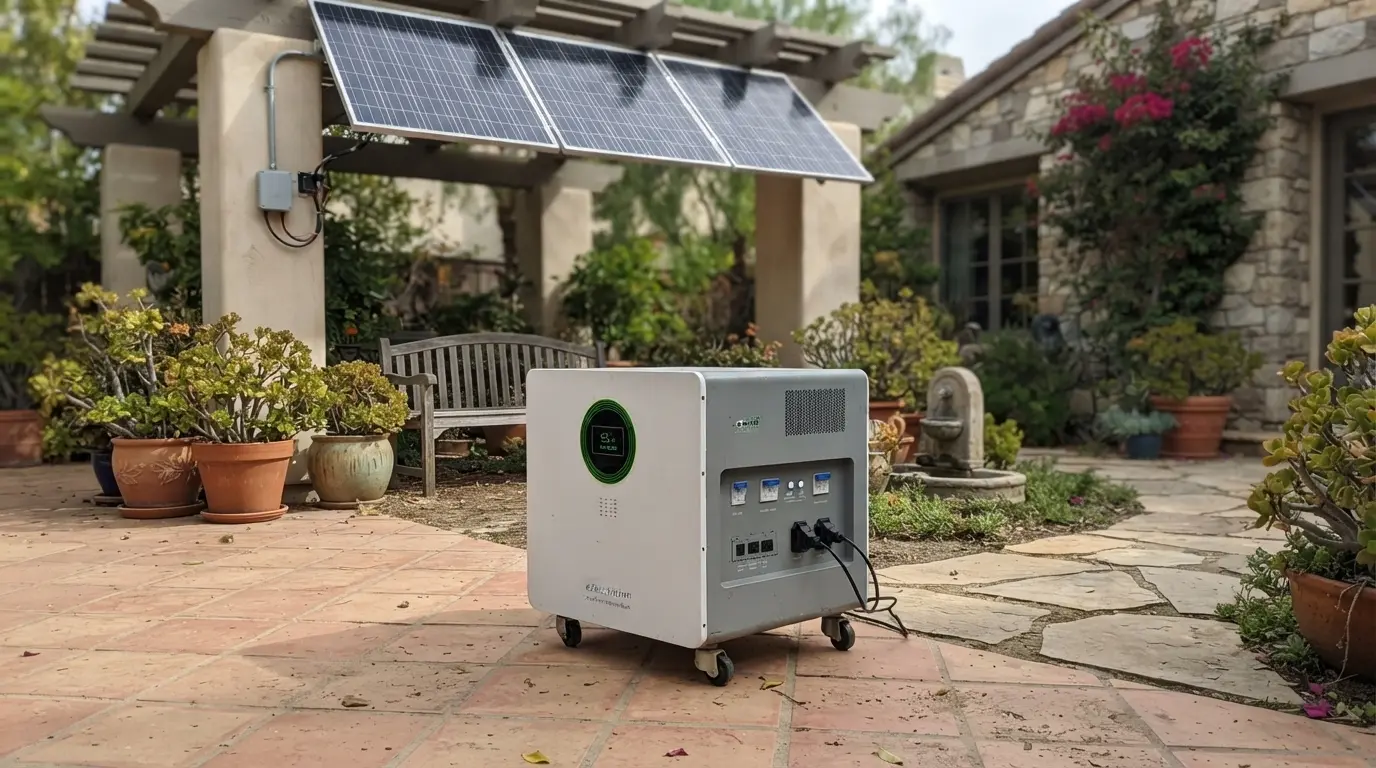
Pairing solar panels with Lithium Iron Phosphate (LiFePO4) batteries creates the ultimate reliable, long-lasting off-grid power system. Solar energy generates clean, sustainable electricity, while LiFePO4 technology stores that power with industry-leading efficiency, safety, and longevity.
Benefits of Pairing Solar Energy with LiFePO4 Batteries
LiFePO4 chemistry outperforms traditional battery options across every critical metric, making it the premier choice for solar energy storage in RV, marine, and off-grid installations.
| Feature | LiFePO4 Solar Setup | Lead-Acid Solar Setup |
|---|---|---|
| Round-Trip Efficiency | 95% – 98% | 75% – 80% |
| Cycle Life | 3,000 – 5,000+ cycles | 300 – 500 cycles |
| Usable Capacity (DoD) | Up to 100% depth of discharge | Max 50% depth of discharge |
| Weight | ~70% lighter | Heavy, high physical bulk |
| Maintenance | Zero maintenance required | Regular watering & equalization |
- Faster Solar Charging: Accepts high charge currents, fully replenishing capacity in a fraction of the time required by lead-acid alternatives.
- Stable Power Delivery: Maintains consistent voltage output throughout the entire discharge cycle.
- Maximum Space & Weight Savings: Delivers higher energy density in a lightweight, compact footprint ideal for mobile off-grid solar systems.
Can You Charge a LiFePO4 Battery Directly from a Solar Panel?
No. Connecting a solar panel directly to a LiFePO4 battery is not recommended and can damage your energy storage system.
- Unregulated Voltage: Solar panel output fluctuates constantly based on sunlight intensity, often spiking higher than the safe charging threshold of a LiFePO4 battery.
- BMS Shutdown: Uncontrolled voltage or current will trigger the integrated Battery Management System (BMS) to disconnect to protect the cells, halting the charging process.
- Overcharging Risk: Direct solar power lacks the multi-stage voltage regulation required to properly terminate charging, leading to cell degradation or irreversible damage.
To safely charge a LiFePO4 battery with solar power, always install a dedicated solar charge controller between the panel array and the battery bank to regulate incoming voltage and current precisely.
Key Components Needed for Solar Charging LiFePO4 Batteries
Building a reliable setup to charge lithium iron phosphate batteries requires a balanced combination of hardware. Each part plays a specific role in keeping power flowing safely into your energy storage bank.
Solar Panels
Solar panels capture sunlight and convert it into direct current (DC) electricity. Whether you use rigid glass panels on a roof, flexible panels, or portable folding kits, selecting adequate panel wattage ensures your battery recharges fully within available daylight hours.
Solar Charge Controller
You cannot safely connect solar panels directly to a lithium battery without regulation. A quality charge controller sits between your solar panels and battery bank to step down voltage and regulate current. It prevents overcharging, stops back-feeding at night, and optimizes power generation for your off-grid solar system or RV solar power setup.
LiFePO4 Battery with BMS (Battery Management System)
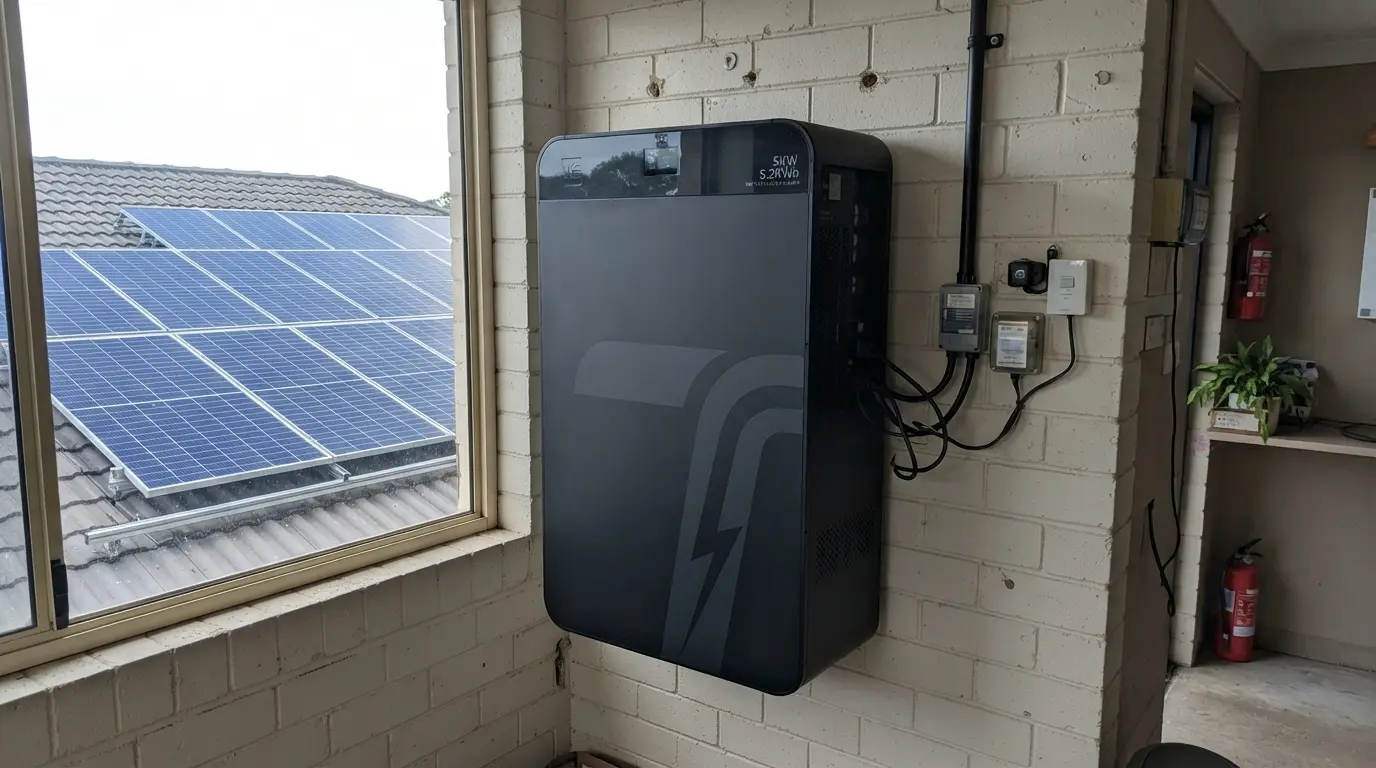
The core of your storage system is the lithium iron phosphate battery. Every reliable unit requires an integrated Battery Management System (BMS). The BMS acts as an internal safety brain, balancing individual cell voltages, preventing over-voltage or deep discharge, and shutting down charging if temperatures swing outside safe operating limits.
Inverter and Auxiliary Wiring
While DC power runs directly from the battery to small electronics, an inverter is necessary to power standard AC household appliances. Heavy-gauge copper wiring, inline fuses, circuit breakers, and quick-disconnect switches tie these pieces together securely. If you are designing a full off-grid setup from scratch, review our guide on building a home battery backup system for details on cable sizing, disconnects, and safety gear.
Choosing a Solar Charge Controller: MPPT vs. PWM
A solar charge controller regulates the voltage and current coming from your solar array to keep your lithium iron phosphate battery safe from overcharging. Selecting the right controller determines how efficiently your solar system captures and stores energy.
Features of PWM Charge Controllers
Pulse Width Modulation (PWM) controllers act as a direct electronic switch between the solar panels and the battery.
- Direct Voltage Matching: Forces solar panels to run at the target battery voltage, dropping overall power output.
- Cost-Effective: Low initial cost, making it attractive for tight budget builds.
- Simple Electronics: Easy to set up, best suited for small systems under 100W.
- Lower Energy Yield: Loses roughly 15% to 30% of potential solar energy during peak sun hours.
Advantages of MPPT Charge Controllers
Maximum Power Point Tracking (MPPT) charge controllers operate as intelligent DC-to-DC converters, constantly adjusting parameters to pull maximum wattage out of your solar array.
- High Efficiency: Converts extra voltage into usable current, delivering up to 30% more power than PWM units.
- Voltage Flexibility: Allows high-voltage solar panels to charge lower-voltage battery banks safely.
- Optimal Low-Light Yield: Converts available panel voltage into charge current during overcast or shaded conditions.
- BMS Compatibility: Integrates smoothly with a LiFePO4 battery management system (BMS) to deliver precise bulk charging profiles.
Which Controller is Best for LiFePO4 Solar Systems?
For virtually all RV solar power installations and off-grid solar system builds, an MPPT charge controller is the clear choice. Lithium batteries accept high charge currents rapidly, and an MPPT unit delivers maximum power to take full advantage of that capability. If you are building a reliable off-grid power setup, pairing your panels with an MPPT controller guarantees faster recharge times and maximum energy efficiency.
| Feature | PWM Charge Controller | MPPT Charge Controller |
|---|---|---|
| Average Efficiency | 70% – 80% | 95% – 99% |
| Input Voltage | Must match battery voltage | Supports higher panel voltages |
| Ideal Array Size | Under 100W | Any system size (100W+) |
| LiFePO4 Fit | Basic / Limited | Optimal performance |
Recommended LiFePO4 Solar Charging Settings and Parameters
I always set exact parameters on my solar charge controller to protect lithium iron phosphate batteries and maximize their lifespan. Unlike lead-acid batteries, LiFePO4 chemistry requires precise voltage thresholds to ensure efficient, safe energy harvesting.
Absorption and Float Voltages
LiFePO4 batteries thrive on a two-stage charging profile: Bulk/Absorption and Float.
- Absorption Voltage: Set this between 14.2V – 14.6V for a 12V system (3.55V – 3.65V per cell). This enables full saturation without triggering BMS over-voltage protection.
- Float Charge Voltage: Set float charging between 13.5V – 13.8V (3.375V – 3.45V per cell). This maintains full capacity without stressing the cell chemistry.
- Equalization: Disable equalization entirely. High-voltage spikes will damage lithium cells and shut down the BMS.
If you are expanding your off-grid storage, knowing how to choose a floor standing LiFePO4 battery manufacturer ensures your hardware seamlessly supports these customized charging profiles.
Low Voltage Cutoff and Equalization Settings
Preventing deep discharge keeps your battery health optimal over thousands of cycles. Configure these vital safeguards on your system:
- Low Voltage Disconnect (LVD): 11.5V – 12.0V (2.875V – 3.0V per cell).
- Low Voltage Reconnect: 12.4V – 12.8V once solar input restores charge.
- Low-Temperature Cutoff: Program your controller to stop charging below 0°C (32°F) to prevent permanent cell damage.
LiFePO4 Voltage and State of Charge (SoC) Chart
Use this resting voltage table to quickly check the State of Charge (SoC) for a 12V LiFePO4 battery bank:
| State of Charge (SoC) | 12V System Voltage | Per-Cell Voltage |
|---|---|---|
| 100% | 13.6V – 14.4V | 3.40V – 3.60V |
| 90% | 13.3V | 3.325V |
| 70% | 13.2V | 3.30V |
| 50% | 13.1V | 3.275V |
| 30% | 13.0V | 3.25V |
| 10% | 12.8V | 3.20V |
| 0% | 10.0V – 12.0V | 2.50V – 3.00V |
How to Size Your Solar Panel System for LiFePO4 Batteries
Sizing your solar panels correctly keeps your lithium iron phosphate batteries healthy and ensures you never run out of power off-grid. I always design solar arrays to fully recharge a depleted battery bank within 4 to 5 hours of peak daily sunlight.
Determining Solar Panel Capacity for Your Battery Size
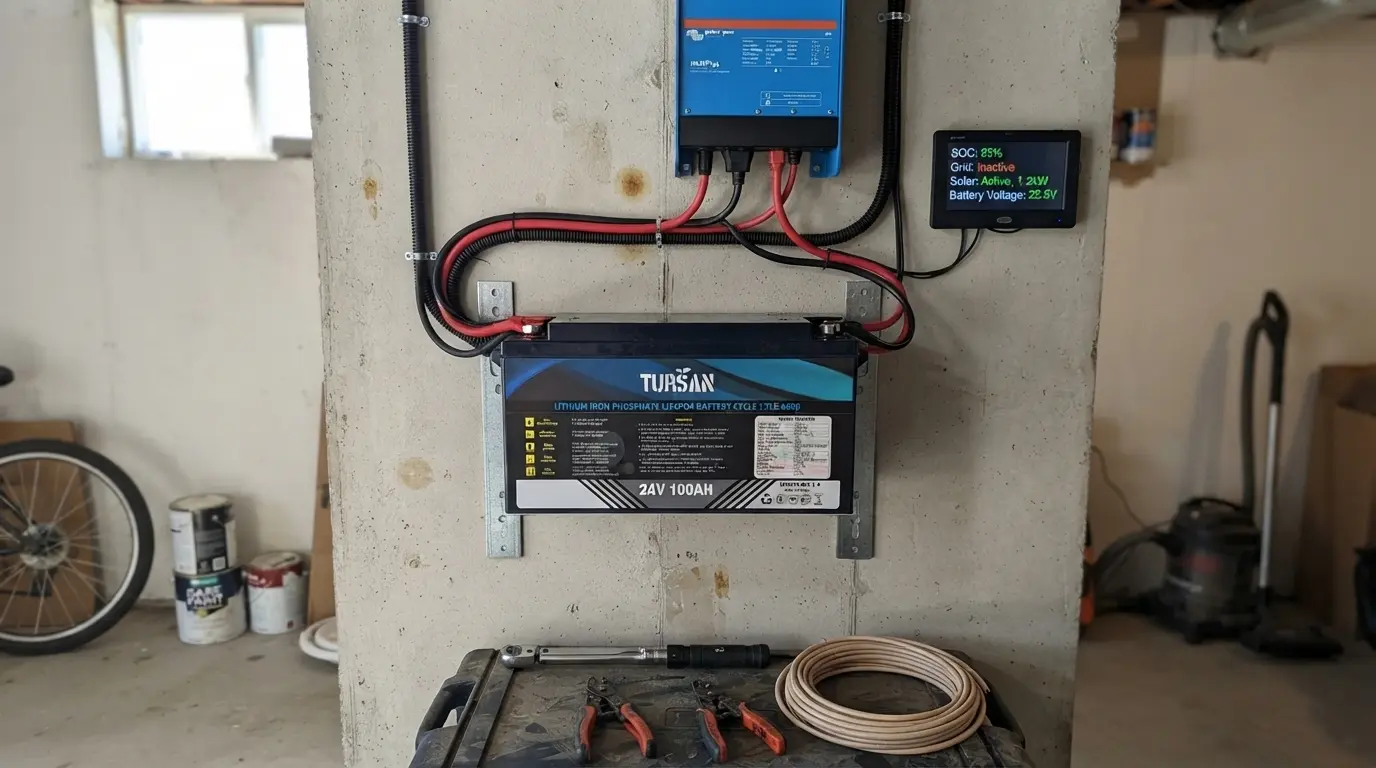
To find the right solar panel capacity, start by converting your battery capacity from Amp-hours (Ah) to Watt-hours (Wh). Multiply the nominal battery voltage by its amp-hour rating:
- 12V 100Ah Battery: 12.8V x 100Ah = 1,280Wh
- 12V 200Ah Battery: 12.8V x 200Ah = 2,560Wh
- 24V 200Ah Battery: 25.6V x 200Ah = 5,120Wh
Divide your total watt-hours by your average daily peak sun hours (typically 4 to 5 hours), then add a 15% to 20% margin to account for real-world system inefficiencies like wiring resistance, panel angle, and high heat.
If you are building an off-grid solar system or an RV solar power rig from scratch, review our guide on how to size a home battery backup system to accurately calculate your total daily watt-hour consumption before buying panels.
Calculating LiFePO4 Solar Charging Time
To estimate your solar charging time from 0% to 100% State of Charge (SoC), use this quick formula:
Charging Time (Hours) = Battery Capacity (Wh) / (Solar Panel Wattage x 0.85 Efficiency)
Here is how different solar array sizes perform when charging a standard 12V 100Ah (1,280Wh) LiFePO4 battery:
| Solar Array Size | Real-World Output (~85%) | Estimated Charge Time (0% to 100%) |
|---|---|---|
| 100W Array | ~85 Watts | ~15 hours (2-3 sunny days) |
| 200W Array | ~170 Watts | ~7.5 hours (1.5 sunny days) |
| 400W Array | ~340 Watts | ~3.8 hours (1 sunny day) |
| 600W Array | ~510 Watts | ~2.5 hours (Optimal fast charge) |
Sizing for a 3.5 to 4-hour charge window allows your MPPT charge controller and battery management system (BMS) to seamlessly complete the bulk charging stage and balance the battery cells well before sunset.
Step-by-Step Guide to Charging LiFePO4 Batteries with Solar
Charging LiFePO4 batteries with solar requires a strict connection sequence to protect your equipment and ensure maximum battery life. Follow these four straightforward steps to build a safe, reliable setup for your off-grid solar system.
Step 1: Connect the Charge Controller to the Battery
Always connect your charge controller to the lithium iron phosphate battery before attaching any solar panels. This allows the controller to power up and correctly detect system voltage (12V, 24V, or 48V).
- Wire Order: Attach the positive battery wire first, followed by the negative wire to the designated battery terminals on the controller.
- Circuit Protection: Place an inline fuse on the positive cable as close to the battery terminal as possible.
- Power Check: Confirm the charge controller screen or indicator LEDs light up before moving to the next step.
Step 2: Configure Charging Parameters on the Controller
Select the LiFePO4 preset on your MPPT charge controller or manually program the specific charging voltages to match your battery management system (BMS) requirements.
| Parameter | Recommended 12V LiFePO4 Setting | Purpose |
|---|---|---|
| Bulk / Absorption Voltage | 14.2V – 14.6V | Rapidly charges battery to full capacity |
| Float Voltage | 13.5V – 13.6V | Maintains charge without overstressing cells |
| Low Voltage Cutoff | 10.8V – 11.5V | Prevents harmful deep discharge |
| Equalization | Disabled | Prevents high-voltage cell damage |
Step 3: Wire the Solar Panels to the Charge Controller
Once the controller is powered by the battery, wire your solar panel array to the PV inputs on the charge controller.
- Polarity Check: Use a multimeter to verify positive (+) and negative (-) PV wires before securing them into the terminals.
- Connection: Secure the positive PV wire first, then the negative PV wire.
- Simplified Alternatives: If wiring discrete components feels too complex for your RV solar power setup, determining if a solar generator is worth the investment can help you decide if an all-in-one power station fits your needs better.
Step 4: Verify System Operation and Monitor Charging
With all wiring complete, verify that current is actively flowing from the solar panels into the battery bank.
- Check PV Input: Ensure panel voltage reading on the controller display is higher than the current battery voltage.
- Monitor Charging Status: Verify the controller moves through bulk charging into absorption mode as the battery reaches capacity.
- Inspect BMS Metrics: Use a Bluetooth battery monitor or smartphone app to confirm balanced cell voltages and steady incoming current.
Charging LiFePO4 Batteries in Cold Weather
Charging lithium iron phosphate batteries in sub-zero environments requires specific precautions to safeguard your off-grid solar system investment.
Understanding Low-Temperature Charging Risks
Sending charging current to a LiFePO4 battery when cell temperatures drop below 0°C (32°F) causes severe, irreversible damage.
- Lithium Plating: Cold temperatures slow down chemical reactions. Instead of lithium ions embedding safely into the graphite anode, metallic lithium plates onto the anode surface.
- Permanent Capacity Loss: Plated lithium blocks energy pathways, resulting in immediate and permanent capacity reduction.
- Internal Short Circuits: Over time, lithium plating forms sharp dendrites that can pierce internal cell separators, risking short circuits and complete battery failure.
Cold-Temperature Cutoff and Self-Heating Solutions
Preventing cold-weather damage relies on smart hardware controls and active protection features integrated into your energy storage setup.
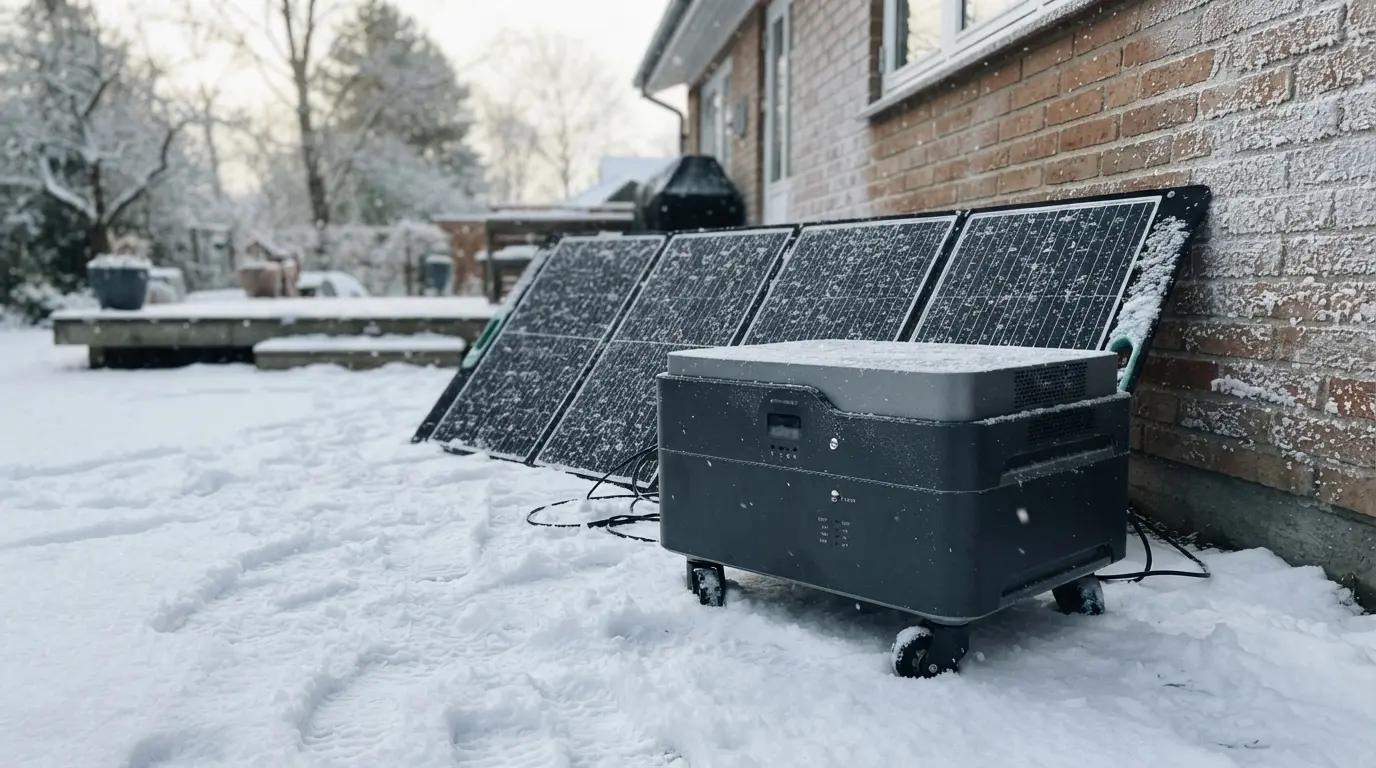
- BMS Low-Temperature Cutoff: A high-quality battery management system (BMS) detects sub-freezing cell temperatures and immediately blocks incoming charging current from your solar charge controller while still allowing discharging to power loads.
- Self-Heating Technology: Advanced batteries feature internal heating elements. When solar energy flows in, the BMS directs power to heat the internal cells to a safe temperature before permitting bulk charging.
- Insulated Enclosures: Installing batteries in climate-controlled spaces or insulated battery boxes helps retain operating thermal energy.
When setting up energy storage for harsh winters, working with an experienced floor-standing LiFePO4 battery manufacturer ensures your equipment incorporates built-in thermal protection features and automated heating cycles right out of the box.
Safety Best Practices and Maintenance Tips
Keeping safety front and center protects your investment and ensures your off-grid solar system runs smoothly for over a decade.
Charging LiFePO4 Batteries in Series vs. Parallel
Wiring multiple batteries changes your system’s overall voltage or capacity, requiring careful preparation:
- Series Wiring (Higher Voltage): Connect positive to negative to boost voltage (for example, combining two 12V batteries into a 24V system). Fully charge and balance each battery individually before linking them in series.
- Parallel Wiring (Higher Capacity): Connect positive to positive and negative to negative to increase total amp-hour capacity. Always use identical cable lengths and heavy wire gauges to guarantee equal current distribution across all units.
- Battery Matching: Only combine batteries of the same model, capacity, and age. If you are looking to build a reliable energy setup, review our guide on the best home battery brands to source perfectly matched units.
Preventing Overcharging and Deep Discharging
While lithium iron phosphate chemistry is inherently safe, extreme voltage swings cause unnecessary stress on the cells:
- BMS Protection: Never charge a battery without an active battery management system (BMS) to guard against overvoltage, cell imbalance, and short circuits.
- Smart Cutoffs: Configure your MPPT charge controller low-voltage disconnect to stop discharging when the battery reaches 10%-20% State of Charge (SoC).
- Storage Protocol: If storing an RV solar power setup for the off-season, leave the battery bank at roughly 50%-70% charge rather than fully depleted or continuously pegged at 100%.
Essential Circuit Protection and Fusing
Properly sized fuses and circuit breakers prevent high currents from melting wires or damaging your gear:
- Battery-to-Controller Line: Install a fuse (sized at roughly 1.25x the charge controller’s maximum output) as close to the battery’s positive terminal as possible.
- Solar Panel Isolator: Place a DC circuit breaker between your solar array and the controller so you can safely disconnect power during routine maintenance.
- Inverter Circuit Protection: Fit high-amp ANL or terminal fuses on main inverter lines to handle rapid power surges safely.
Frequently Asked Questions About LiFePO4 Solar Charging
Can You Charge a LiFePO4 Battery with a Standard Lead-Acid Charger?
Technically, yes, but I don’t recommend it for long-term use. Standard lead-acid chargers use multi-stage algorithms with higher float charge levels and automatic equalization cycles. These high-voltage spikes can trigger your battery management system (BMS) to cut off power, or slowly degrade your lithium iron phosphate cells over time.
If you must use a lead-acid charger in a pinch: Turn off any auto-equalization modes completely. Ensure maximum voltage does not exceed an absorption voltage of 14.6V. Disconnect the charger manually once full to prevent overcharging.
Can I Leave My LiFePO4 Battery Continuously Connected to Solar?
Yes, you can leave your battery connected to your solar setup indefinitely, provided you use a dedicated solar charge controller programmed for lithium profiles.
Unlike lead-acid units, LiFePO4 batteries do not suffer from self-discharge issues that require constant trickle charging. A smart MPPT charge controller manages bulk charging efficiently, tops off the battery, and then stops pushing current once full. This makes continuous connections safe and maintenance-free for both off-grid solar system setups and RV solar power applications.
How Long Does It Take to Charge a LiFePO4 Battery with Solar?
On average, a fully depleted 100Ah LiFePO4 battery takes about 3 to 5 hours of clear, peak sunlight to reach full capacity using a 300W solar panel array paired with an MPPT charge controller.
You can estimate your charging duration using this basic formula:
- Charge Time (Hours) = Battery Capacity (Ah) / Net Solar Output (Amps)
Key variables that impact your real-world charging speed include: Solar Array Wattage: Higher output delivers higher charging current. Peak Sun Hours: Geographic location and panel orientation dictate daily energy yield. Controller Type: MPPT controllers convert sunlight to usable energy up to 30% faster than basic PWM units.
Accurately calculating your recharge speed is vital when sizing your setup and determining how long a solar battery can power a house or essential loads during extended off-grid periods.