 English
  العربية
  日本語
日本語  한국어
한국어  Tiếng Việt
  ไทย
ไทย  Bahasa Melayu
  فارسی
فارسی  Bahasa Indonesia
  ဗမာစာ
ဗမာစာ  简体中文
简体中文  香港中文
香港中文  繁體中文
繁體中文  Русский
  Deutsch
  Nederlands
  Italiano
  Français
  Español
  Português
  Afrikaans
  Azərbaycan dili
  Български
  ਪੰਜਾਬੀ
  हिन्दी
  اردو
اردو  বাংলা
বাংলা  Հայերեն
  Íslenska
  Қазақ тілі
  नेपाली
  Српски језик
  Kiswahili
  తెలుగు
  Basa Jawa
  தமிழ்
தமிழ்  मराठी
मराठी From energy-load calculations to component selection and final commissioning, this guide maps the decisions behind a reliable residential backup system.
Step 1: System Sizing and Energy Load Calculations
When I build a home battery backup system, I start with the essential circuits-not the entire house. A refrigerator, well pump, HVAC equipment, internet router, lighting, medical devices, and sump pump can have very different power demands.
The system must cover two values:
- Continuous running watts: Power used while an appliance is operating normally.
- Surge or starting watts: Short-duration power required when motors and compressors start.
Refrigerators, pumps, and HVAC compressors may need substantially more power at startup than during normal operation. The inverter must support both the total continuous load and the highest expected surge demand.
Calculate Continuous Power Demand
Add the running wattage of every load that must operate at the same time:
Wtotal = W1 + W2 + W3 + …
For example, if a refrigerator, lighting, router, and well pump may run together, their combined running wattage determines the minimum continuous inverter output. Then check whether a motor startup surge can be handled without exceeding the inverter’s surge capability.
Essential Load Reference Table
Actual consumption varies by appliance model, operating conditions, and household use. Use product labels, manuals, or measured load data for final system sizing.
| Essential Load | Typical Planning Input | Daily Energy Calculation |
|---|---|---|
| Refrigerator | Running watts plus compressor surge | Watts x operating hours |
| Well pump | High motor starting demand | Watts x pump runtime |
| HVAC equipment | High running and compressor surge demand | Watts x operating hours |
| Internet equipment | Continuous low-power load | Watts x 24 hours |
| LED lighting | Low running demand | Watts x hours used |
| Medical or critical equipment | Device-specific continuous demand | Watts x required hours |
Estimate Daily Energy Use in kWh
Battery capacity is measured in kilowatt-hours (kWh), not only amp-hours. Calculate the energy required for each essential appliance:
Daily watt-hours (Wh) = Appliance watts x Hours of use
Daily kWh = Total Wh / 1,000
For example, a 100W load operating for 10 hours uses:
100W x 10 hours = 1,000Wh = 1kWh
Add each essential load to estimate the daily energy requirement for the battery bank.
Size Battery Capacity for Runtime
A battery bank should account for the required backup time, usable Depth of Discharge (DoD), and inverter losses. Inverter conversion losses can be approximately 10-15%, so the battery must store more energy than the AC loads consume.
Use this planning formula:
Required battery capacity (kWh) = Required load energy (kWh) / DoD / inverter efficiency
For a LiFePO4 battery bank, use the manufacturer’s specified DoD and operating limits. A 51.2V 200Ah battery module provides approximately:
51.2V x 200Ah = 10.24kWh nominal energy
The usable energy depends on the configured DoD and system efficiency.
Match Capacity to the Backup Goal
| Backup Goal | Practical Sizing Focus |
|---|---|
| Short outage | Essential lighting, internet equipment, refrigerator, and limited small loads |
| Overnight backup | Essential loads plus expected evening and overnight energy use |
| Extended emergency operation | Larger battery capacity, controlled loads, and solar or generator charging support |
Do not size a home battery backup system from appliance wattage alone. I calculate continuous running watts, peak surge wattage, daily kWh use, required runtime, DoD, and inverter losses together. This prevents an undersized inverter, inadequate battery capacity, and avoidable shutdowns during an outage.
Step 2: Select Home Battery Backup Components
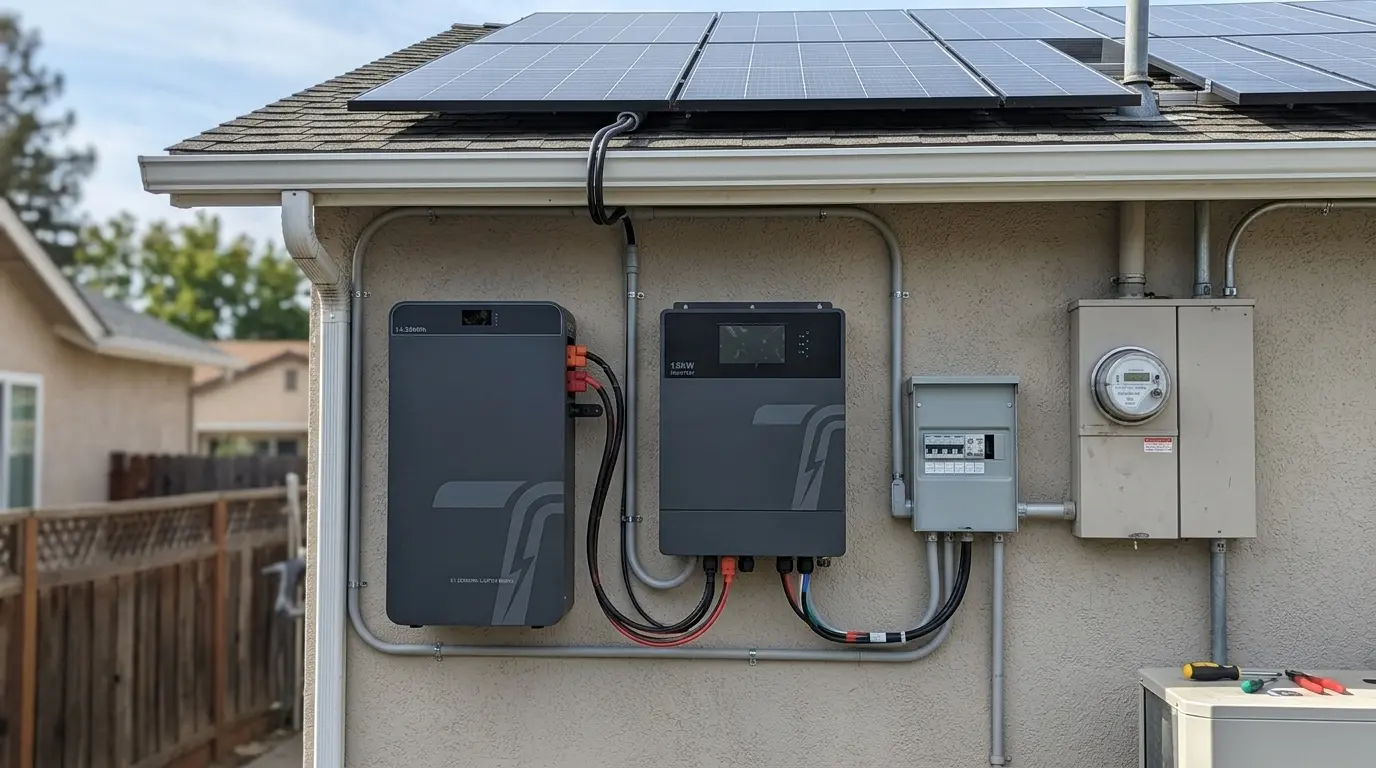
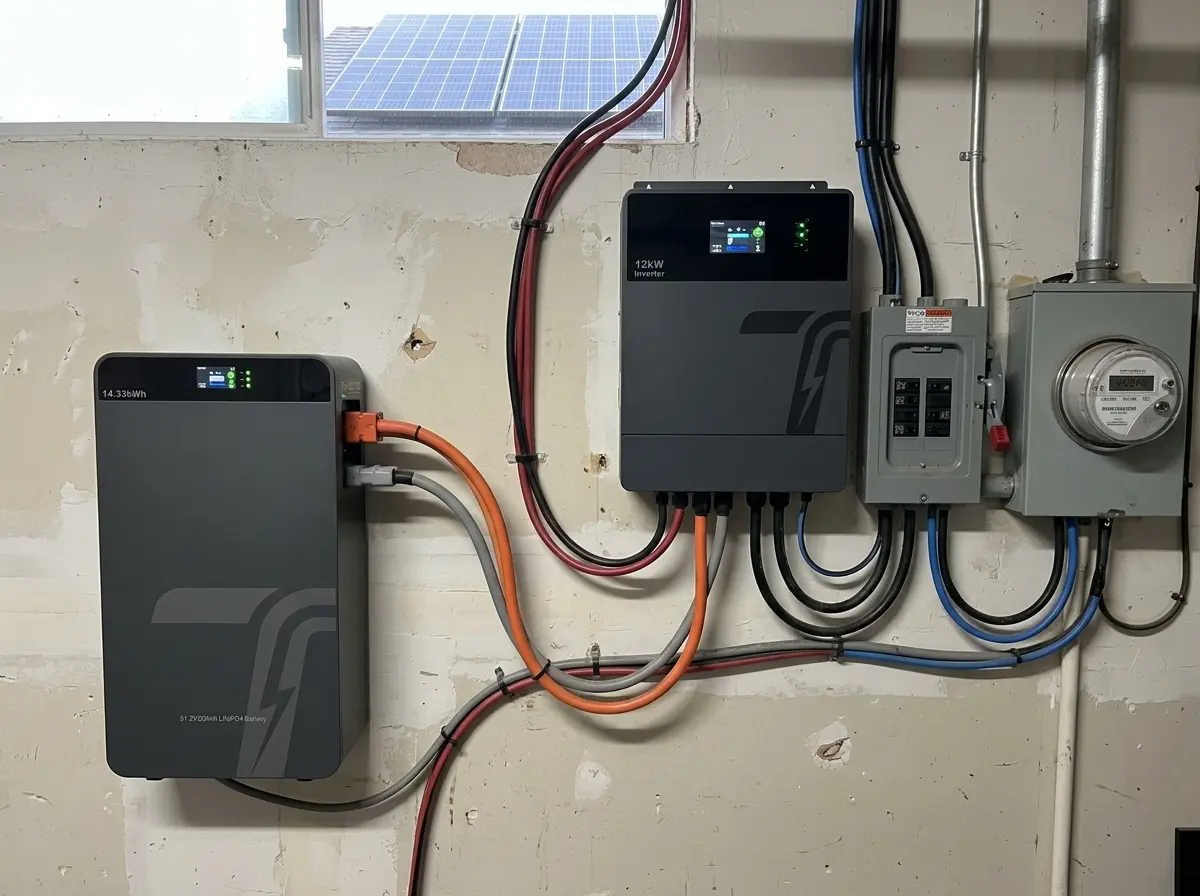
I select each component as one matched system: battery voltage, battery capacity, inverter output, solar charging input, and household load profile must work together.
Choose the Battery Chemistry
| Battery type | General use | Key consideration |
|---|---|---|
| Lead-acid | Basic backup applications | Larger and typically less suitable for compact, high-cycle home storage |
| Standard lithium-ion | Energy storage applications | Chemistry, protection design, and documentation vary by product |
| LiFePO4 (LFP) | Residential ESS and solar backup | High-safety chemistry with long service life potential |
For a home battery backup system, I prioritize LiFePO4 batteries. TURSAN systems use LiFePO4 prismatic cells designed for energy storage, with a stated 6,000+ cycle life. Complete battery modules also simplify system integration compared with building an individual cell pack.
For higher-capacity projects, I evaluate a floor-standing LiFePO4 battery manufacturer based on module design, available certifications, communication options, and system scalability.
Select the Battery Voltage
| System voltage | Suitable use |
|---|---|
| 12.8V | Small backup loads and compact systems |
| 25.6V / 24V | Medium-demand backup systems |
| 48V / 51.2V | Larger residential loads and scalable ESS installations |
A 48V solar lithium battery or 51.2V battery system is generally the practical choice for higher residential loads. At the same power level, a higher-voltage system operates with lower DC current than a 12V or 24V setup. This supports more manageable cable sizing and is well suited to larger inverter ratings.
TURSAN offers 12.8V, 25.6V, and 51.2V LiFePO4 battery options, including battery modules ranging from 100Ah to 628Ah and system capacities up to 32.15kWh.
Match the Pure Sine Wave Inverter
A pure sine wave inverter is the right choice for refrigerators, computers, internet equipment, medical equipment, and other sensitive electronics. It provides a stable AC output designed for household appliances and electronics.
| Inverter type | Best fit |
|---|---|
| Modified sine wave | Basic loads only; may not suit sensitive equipment |
| Pure sine wave off-grid inverter | Backup and off-grid power systems |
| Pure sine wave hybrid inverter | Solar, battery, and grid-connected backup systems |
I match inverter power to both the household’s continuous running watts and its motor-starting surge demand. TURSAN off-grid inverter ratings include 1.2kW, 3.6kW, 5.5kW, 10kW, and 12kW. Hybrid inverter options include 5.6kW and 12kW units with MPPT functionality.
| Inverter rating | Typical system role |
|---|---|
| 3.6kW | Essential circuits and moderate household loads |
| 5.5kW / 5.6kW | Larger critical-load backup systems |
| 12kW | Higher-demand residential backup configurations |
The inverter must handle the combined running load and the temporary starting demand from compressors, pumps, and other motor-driven equipment.
Use MPPT for Solar Charging
For solar-connected backup systems, I use an inverter or charge controller with Maximum Power Point Tracking (MPPT). MPPT helps manage solar PV charging into the battery system and is available in TURSAN off-grid and hybrid inverter solutions.
Confirm these ratings before finalizing the equipment:
- Battery voltage: 12.8V, 25.6V, or 51.2V
- Inverter continuous power: matched to essential running loads
- Surge capability: matched to refrigerator, pump, or HVAC startup demand
- PV input range: compatible with the solar array design
- Charging power: appropriate for the selected battery capacity
- Inverter type: off-grid or hybrid, based on solar and grid requirements
A correctly matched battery, MPPT inverter, and solar input creates a more reliable home energy storage system (ESS) for backup power, solar self-consumption, and time-of-use peak shaving.
Intelligent Battery Management System (BMS)
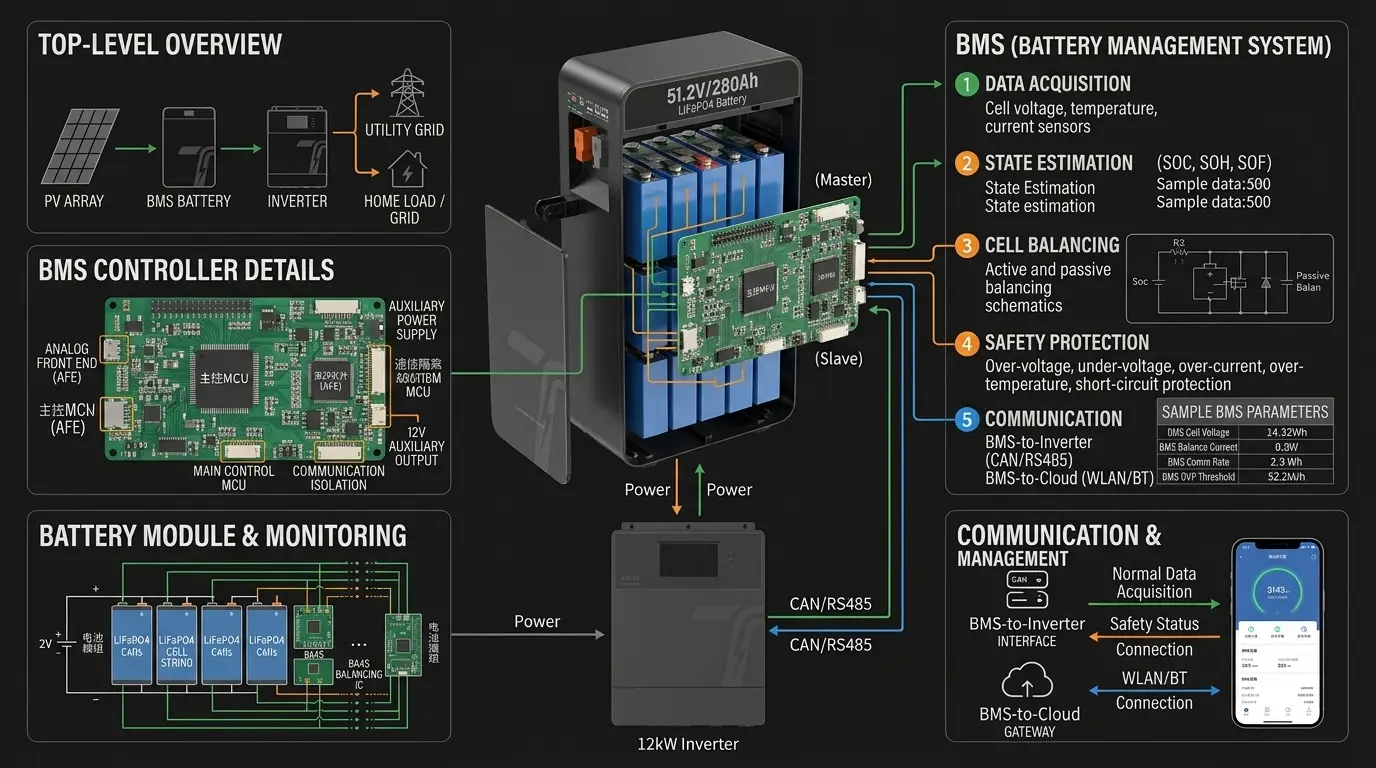
A reliable battery management system (BMS) is essential when we build a home battery backup system. It continuously manages LiFePO4 battery operation and helps protect the battery bank from:
- Overcharge and over-discharge
- Short circuits and overcurrent
- Overtemperature conditions
- Cell voltage imbalance
A quality intelligent BMS monitors individual cell voltages and automatically balances cells to support stable performance and long battery service life. LiFePO4 battery modules with 6,000+ cycle life should include this level of cell-level management.
Temperature sensors are also important for indoor and outdoor installations. The BMS can monitor thermal conditions and activate protection when operating temperatures move outside safe limits.
For easier operation, use smart monitoring that supports Bluetooth, Wi-Fi, or IoT communication protocols. This provides access to battery status, state of charge, temperature, alarms, and diagnostics from a connected device or monitoring platform.
Before installation, confirm battery-to-inverter communication compatibility. The BMS communication protocol must match the inverter requirements so the inverter can receive accurate battery data and apply the correct charging and discharge controls.
Step 3: Wiring, Safety Standards, and System Assembly
Safe wiring is the foundation of a reliable home battery backup system. DC battery circuits can carry very high current, especially with lower-voltage battery banks. I size every cable, fuse, breaker, and disconnect for the system’s maximum current, installation environment, and cable length.
Calculate DC Current and Cable Size
Use this basic calculation to estimate DC current:
DC current (A) = inverter power (W) / battery voltage (V)
For example, a higher-voltage 48V or 51.2V battery system generally carries less DC current than a 12V system delivering the same inverter power. This can simplify cable management for higher residential loads.
Cable selection must account for:
- Maximum continuous and surge current
- Battery system voltage
- Copper or aluminum conductor type
- Cable run length and voltage drop
- Local electrical code requirements
- Terminal and breaker ratings
Use a manufacturer-approved wire gauge and fusing chart rather than selecting cable by appearance alone.
| Circuit | Cable Sizing Basis | Protection Location |
|---|---|---|
| Battery to inverter | Maximum inverter DC current and cable length | Fuse and DC disconnect close to battery |
| Battery interconnects | Maximum battery bank current | Protected as specified by battery manufacturer |
| Charge controller to battery | Maximum controller output current | DC breaker or fuse near battery |
| Solar PV input | PV string voltage and current | PV-rated disconnect and overcurrent protection |
Install DC Fuses, Breakers, and Disconnects
Install correctly rated overcurrent protection close to the battery bank. A DC-rated fuse, such as a Class T fuse where appropriate, helps protect the battery-to-inverter cable from a short circuit. Use DC circuit breakers and rapid disconnects that are rated for the actual system voltage and current.
Protect each major DC circuit:
- Battery bank to inverter
- Battery bank to charge controller
- Solar PV array to controller or hybrid inverter
- Parallel battery connections, where required by the battery configuration
Never use AC-only breakers or undersized fuses on a battery circuit. DC arcs are more difficult to interrupt, so all protection devices must be designed for DC use.
Grounding, Bonding, and Safe Handling
Equipment grounding and bonding must follow local electrical rules and the installation instructions for the inverter, battery, enclosure, and PV equipment. Proper grounding helps reduce shock risk and supports fault protection.
During assembly:
- Use insulated tools and appropriate personal protective equipment.
- Remove metal jewelry before working near battery terminals.
- Keep battery terminals covered until final connection.
- Check polarity before making every DC connection.
- Keep batteries dry and away from combustible materials.
- Do not work on energized circuits unless qualified to do so.
Connect Series and Parallel Battery Banks Correctly
Batteries connected in series increase system voltage. Batteries connected in parallel increase available storage capacity in amp-hours and kWh.
For example, a 51.2V battery module is designed for a 48V-class energy storage system. Adding compatible modules in parallel can increase backup capacity while maintaining the same system voltage.
Follow the battery manufacturer’s rules for:
- Maximum series and parallel connections
- Compatible battery models and firmware
- Cable lengths and balanced parallel wiring
- Required BMS communication connections
- Approved inverter compatibility
Do not mix different battery chemistries, capacities, ages, or states of charge in the same battery bank.
Connect the BMS and Monitoring Cables
A complete LiFePO4 battery module may include an intelligent battery management system (BMS) that monitors cell voltage, temperature, charging, discharging, and protection events. Connect communication cables, temperature sensors, and monitoring equipment exactly as specified by the battery and inverter manufacturers.
Before energizing the system, confirm compatibility between the battery BMS and inverter communication protocol. Smart monitoring through Wi-Fi, Bluetooth, or supported API integration can provide visibility into battery status, alarms, and operating data.
For floor-standing storage equipment, selecting a supplier that supports system-level compatibility is important. This guide to choosing a floor-standing LiFePO4 battery manufacturer covers key considerations for battery modules, production capability, and documentation.
Complete Battery, Inverter, Grid, and Solar Connections
Connect the battery bank to the pure sine wave inverter with correctly sized DC cables, secure terminals, and required overcurrent protection. Tighten all connections to the manufacturer’s specified torque value and inspect for loose terminals or damaged insulation.
For hybrid systems:
- Connect approved grid or generator AC inputs to the compatible hybrid inverter.
- Route solar PV arrays through the correct PV disconnects and MPPT inputs.
- Verify PV voltage and current remain within the inverter or charge controller limits.
- Confirm all battery, PV, and AC circuits are isolated before service.
For residential systems connected to a utility supply, use a licensed electrician for service-panel work, AC input connections, grounding, and final commissioning.
Grid Isolation and Transfer Switches
Grid isolation is a non-negotiable part of any home battery backup system. Never backfeed utility wiring by connecting an inverter to a wall outlet or panel without approved isolation equipment. Backfeeding can energize utility lines during an outage, creating a serious hazard for utility workers and damaging the inverter or home electrical system. It is also not permitted without correctly installed, approved equipment.
Manual vs. Automatic Transfer Switch
A transfer switch safely separates backup power from the utility supply.
| Transfer equipment | How it works | Best fit |
|---|---|---|
| Manual Transfer Switch (MTS) | We manually move selected circuits from utility power to battery/inverter power. | Lower-cost systems where a short interruption is acceptable. |
| Automatic Transfer Switch (ATS) | Detects a utility outage and transfers supported circuits automatically. | Homes needing a smoother response for internet equipment, lighting, sump pumps, or medical devices. |
An automatic transfer switch (ATS) can provide seamless transfer for compatible backup systems, but its rating, switching method, and neutral configuration must match the inverter and local electrical installation.
Install a Critical Load Subpanel
We recommend a dedicated critical load subpanel rather than attempting to back up every circuit. This keeps demand within the inverter’s continuous rating and surge capability.
Typical priority circuits include:
- Refrigerator and freezer
- Internet modem, router, and communication equipment
- Essential lighting
- Medical equipment where applicable
- Sump pumps
- Selected outlets for charging and small appliances
Keep high-demand loads on the main panel unless the system has been designed for them. Central HVAC, electric water heating, large cooking appliances, and similar loads can exceed the available capacity of a 3.6kW, 5.5kW, or even larger inverter during normal operation or motor startup.
Verify Neutral and Ground Compatibility
Before connecting a battery bank, inverter, ATS, or critical load subpanel, verify the system’s neutral-to-ground bonding and transfer-switch configuration. Some inverters use a switched neutral, while others require a different arrangement. The grounding method, transfer equipment, AC input, and local utility rules must work together correctly.
Service-panel work, transfer-switch installation, and grid-connected wiring should be completed and inspected by a qualified electrician. For smaller backup needs, understanding the differences between a portable power station and a UPS can also help determine whether a full transfer-switch system is necessary.
Step 4: DIY Custom Build vs. Modular All-in-One Energy Storage Systems
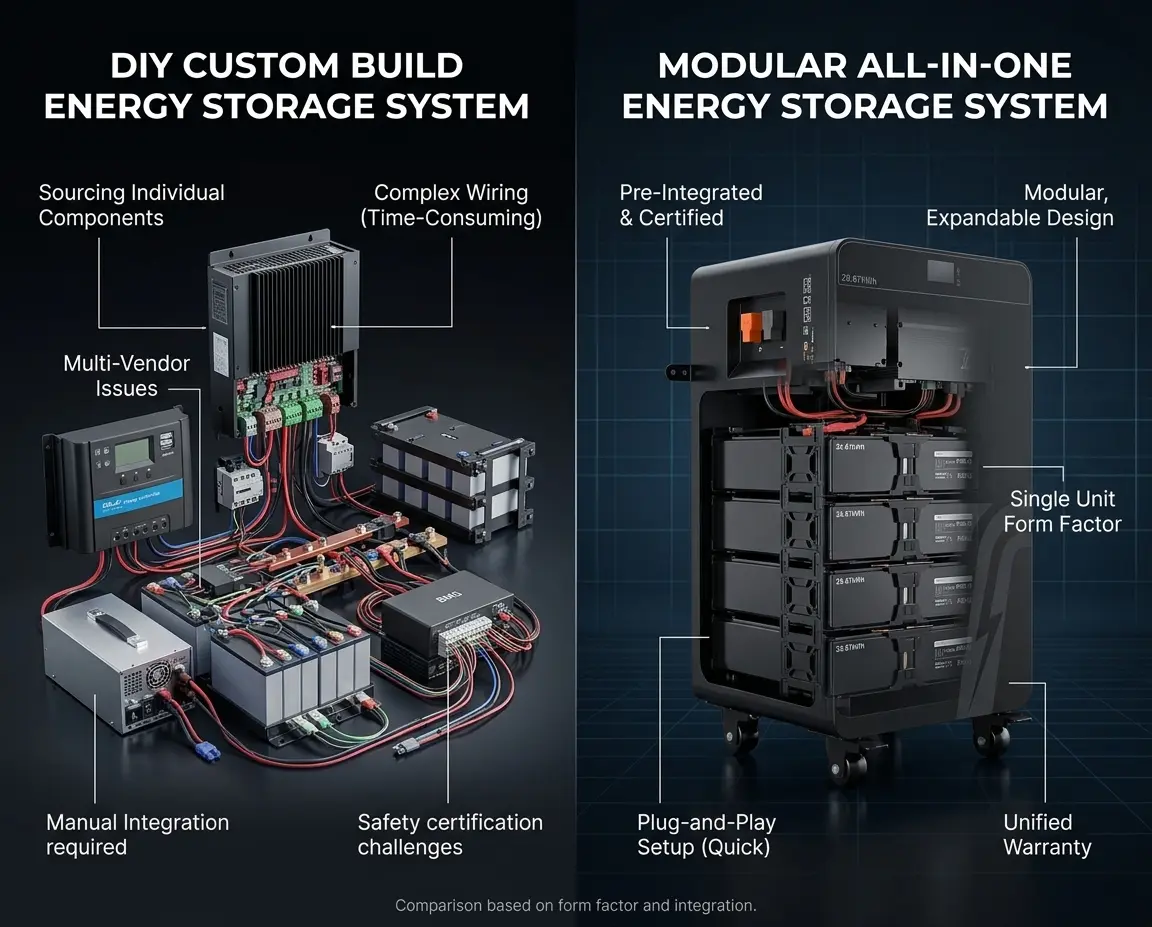
When we build a home battery backup system, we can either assemble separate components or use a pre-engineered Energy Storage System (ESS). The right option depends on the required capacity, installation environment, technical experience, expansion plan, and local compliance requirements.
DIY Component-Based Battery Backup
A DIY system combines separate batteries, an inverter, solar charge controller, disconnects, protection devices, and monitoring hardware. It offers the highest level of flexibility.
A custom LiFePO4 battery bank can be suitable when we need to:
- Match battery capacity precisely to essential household loads
- Select a specific inverter size, such as 3.6kW, 5.5kW, or 12kW
- Add solar PV charging or grid backup in stages
- Choose rack-mounted, wall-mounted, or custom enclosure layouts
- Expand storage capacity over time
- Integrate compatible Wi-Fi, Bluetooth, or API-based monitoring
However, a component-based build has more wiring, more connection points, and more installation risk. Battery-inverter communication, DC protection, cable sizing, grounding, and system settings must all be correct. It can also take longer to install and may create added code-compliance challenges.
| Factor | DIY Component System |
|---|---|
| Capacity flexibility | High |
| Inverter and solar selection | Fully customizable |
| Wiring complexity | High |
| Installation time | Usually longer |
| Failure points | More separate connections and devices |
| Best fit | Experienced integrators and specialized projects |
A custom battery bank should use compatible LiFePO4 modules rather than improvised cells or unverified battery packs. For higher-load homes, 48V and 51.2V architectures generally reduce DC current compared with lower-voltage systems, helping support larger inverter loads with a more practical cable layout.
Modular All-in-One ESS
A modular ESS combines major functions into a factory-designed platform. Depending on the configuration, it can include LiFePO4 prismatic cells, intelligent BMS protection, inverter functions, monitoring, and integrated protection hardware.
TURSAN offers floor-standing stacked ESS, all-in-one energy storage units, and 19-inch rack-mount battery solutions. These formats support residential backup, solar storage, and scalable installations. Modular capacities can start around 5kWh and expand through larger configurations, including 10kWh, 16.07kWh, 20kWh, 25kWh, and up to 32.15kWh.
For buyers assessing product supply, this guide on choosing a floor-standing LiFePO4 battery manufacturer helps identify practical evaluation points for manufacturing capability, battery design, and support.
| Factor | Modular All-in-One or Stacked ESS |
|---|---|
| Installation process | More streamlined |
| Battery management | Factory-integrated intelligent BMS |
| Inverter integration | Available in all-in-one configurations |
| Expansion | Modular, based on supported system limits |
| Serviceability | Clear module-based replacement approach |
| Best fit | Residential installers, distributors, and standardized backup projects |
Floor-Standing vs. Rack-Mount Storage
Floor-standing stacked ESS is a practical choice where a compact, organized residential installation is needed. Stacked modules make it easier to increase storage capacity while keeping the system in one location.
19-inch rack-mount ESS is better suited to equipment rooms, telecom-style backup layouts, and installations where rack organization is already in place. It provides a structured format for battery modules and related equipment.
Key Checks Before Selecting Either System
Whether we choose DIY components or a modular ESS, we should confirm:
- Battery voltage and inverter compatibility
- Continuous and surge power capability
- Supported solar PV input and MPPT configuration
- BMS communication compatibility
- Expansion limits for battery modules
- Required documentation and market approvals
- Available certifications, including UL1973, UN38.3, MSDS, CE, and FCC where applicable
- Manufacturer installation and maintenance requirements
TURSAN systems use LiFePO4 prismatic cells with 6,000+ cycle life and intelligent BMS functions supporting Wi-Fi, Bluetooth, and API protocol integration. Available inverter solutions include pure sine wave off-grid and hybrid models with built-in MPPT, supporting residential solar charging and backup configurations.
A DIY build delivers maximum control, but it requires strong electrical design and installation discipline. A factory-integrated ESS reduces assembly work and helps standardize battery management, protection, monitoring, and expansion for a more efficient home battery backup system.
Step 5: Safety Checklist and Local Code Compliance
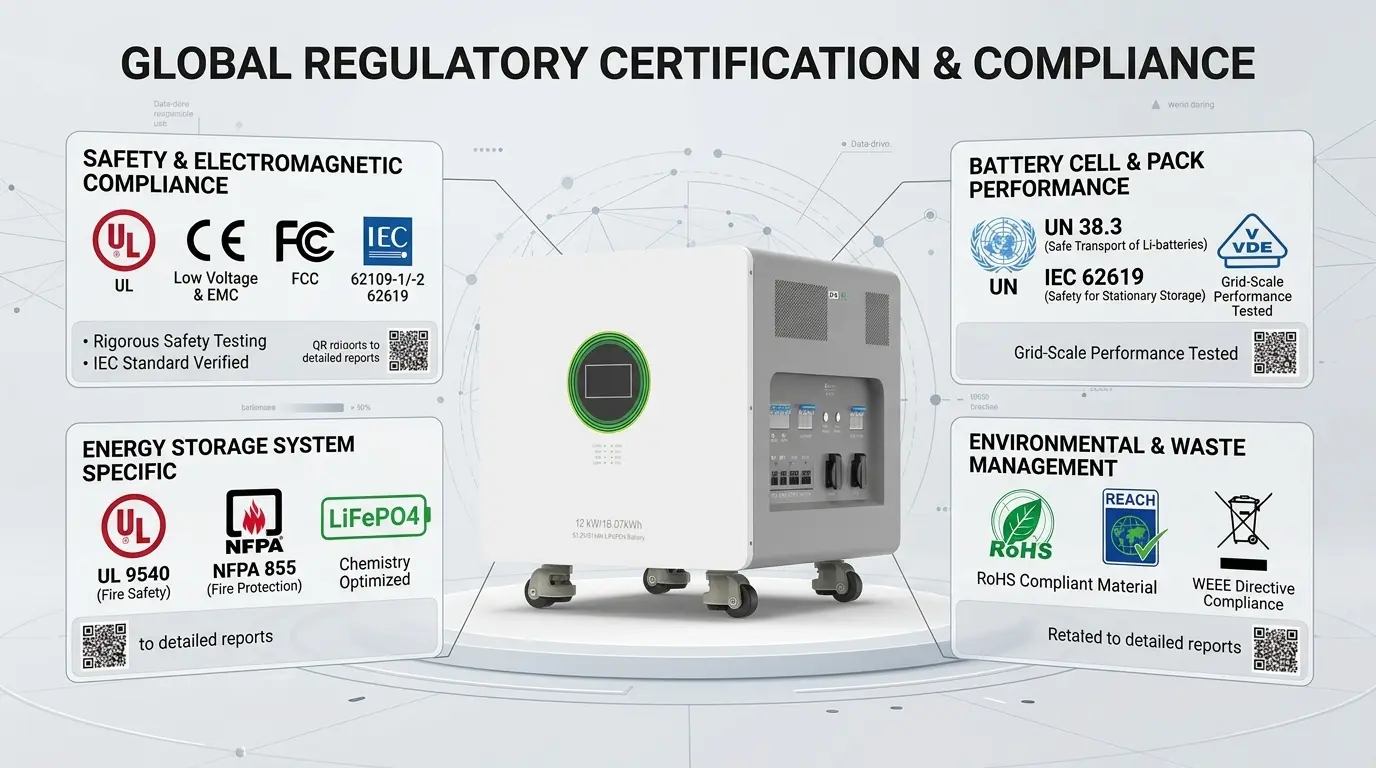
A home battery backup system must be designed around safety, local electrical rules, and manufacturer instructions. I treat battery storage, transfer equipment, and grid connections as electrical infrastructure-not as casual DIY wiring.
Code, Permits, and Approvals
Before installation, confirm the requirements that apply in your location:
| Item | What to Confirm |
|---|---|
| Electrical code | Applicable NEC requirements and local amendments for residential energy storage systems |
| Permits | Electrical, building, and fire permits required by the local authority |
| Inspection | Required inspection stages before the system is energized |
| Utility rules | Interconnection approval for grid-connected solar or hybrid inverter systems |
| Fire restrictions | Location, clearances, access, and installation limits for battery equipment |
Grid-connected systems require approved isolation equipment. Never allow a battery inverter to backfeed the utility grid. Service-panel work, transfer-switch installation, and utility-connected wiring should be completed by a licensed electrician.
Use Properly Rated Equipment
Confirm that the battery modules, inverter, transfer switch, DC disconnects, fuses, cables, and enclosures are rated for the system voltage and expected current. Check available documentation for certifications such as UL1973, UN38.3, CE, FCC, and MSDS.
For residential storage, a LiFePO4 battery module with an intelligent BMS provides controlled monitoring and protection. When comparing equipment, review documented specifications and certifications, not only capacity or inverter power ratings. Our guide to selecting a floor-standing LiFePO4 battery manufacturer explains key factors to review for modular ESS sourcing.
Installation Safety Checklist
- Install batteries and inverters in a dry, secure location.
- Keep equipment away from moisture, direct heat, combustible materials, and unauthorized access.
- Maintain the clearance distances required by local code and the equipment manufacturer.
- Provide ventilation or thermal management where the installation instructions require it.
- Use only approved battery series and parallel configurations.
- Ensure battery terminals, busbars, fuses, and disconnects are protected from accidental contact.
- Label battery disconnects, inverter AC inputs, critical load circuits, and emergency shutdown equipment clearly.
- Use insulated tools and appropriate personal protective equipment when servicing DC battery circuits.
Inspection and Ongoing Monitoring
Inspect the system before energizing it and at scheduled intervals afterward.
| Check Point | What to Look For |
|---|---|
| Terminals and busbars | Loose connections, corrosion, discoloration, or heat damage |
| Cables and fuses | Correct ratings, secure routing, damaged insulation, or overheating |
| Battery status | Voltage, temperature, state of charge, and active BMS alarms |
| Inverter status | Fault notifications, event logs, and communication status |
| Transfer equipment | Correct transfer operation between grid, generator, and backup circuits |
Keep firmware current where the manufacturer provides updates. Review BMS and inverter event logs after alarms, outages, or abnormal operating conditions. Test the transfer switch and critical load subpanel on a planned schedule so refrigerators, internet equipment, lighting, pumps, and other priority circuits are ready when utility power fails.
Follow the manufacturer’s installation, charging, storage, and maintenance instructions at all times. A correctly sized LiFePO4 energy storage system is only dependable when its wiring, protection devices, transfer equipment, and maintenance practices are equally reliable.
Frequently Asked Questions About Home Battery Backup Systems
Can I Build a Home Battery Backup System Without Solar Panels?
Yes. A battery backup system can charge from grid power and supply selected loads during an outage. Solar PV is optional, but pairing storage with a compatible hybrid or off-grid inverter with MPPT can add solar charging capability.
How Long Will a 10kWh Battery Backup Run?
Runtime depends on the actual load, not the battery size alone. A 10kWh system will run essential circuits longer than it will run a whole home with HVAC, electric heating, or other high-demand equipment.
| Backup Load | Expected Effect on Runtime |
|---|---|
| Internet equipment and LED lighting | Lower energy use; longer runtime |
| Refrigerator and small appliances | Moderate energy use |
| Well pump or sump pump | High starting surge |
| Central HVAC or electric heating | High continuous demand; shorter runtime |
Calculate runtime by dividing usable battery energy by the combined load in kilowatts. Always allow capacity for motor starts and changing household demand.
What Is the Difference Between 12V, 24V, 48V, and 51.2V Systems?
Higher-voltage systems can support higher power with lower DC current. This helps reduce cable size demands and is generally more practical for larger residential loads.
| System Voltage | Typical Use |
|---|---|
| 12.8V | Small backup loads and compact systems |
| 25.6V / 24V | Medium-demand backup applications |
| 51.2V / 48V | Whole-home backup, solar storage, and larger inverter loads |
For larger battery banks, a 48V-class system using 51.2V LiFePO4 modules is commonly a more efficient architecture than building around lower-voltage batteries.
Are DIY Lithium Battery Banks Safe Indoors?
A DIY lithium battery bank requires careful engineering, correct protection equipment, and compliance with local installation rules. For indoor use, we recommend using complete LiFePO4 battery modules with an integrated intelligent BMS rather than assembling individual cells without professional battery design experience.
LiFePO4 prismatic-cell modules provide a high-safety battery platform and can offer 6,000+ cycle life. Installation still requires proper enclosure selection, clearances, cable protection, and temperature management.
How Many Batteries Do I Need for High-Surge Appliances?
The answer depends on both energy capacity and inverter surge capability. Refrigerators, pumps, and HVAC equipment can require much more power at startup than during normal operation.
Match the system to:
- Continuous running watts of all loads operating together
- Peak starting watts of motors and compressors
- Required backup duration
- Battery voltage and available capacity
- Inverter continuous and surge ratings
A battery bank alone does not solve a surge-load problem. The pure sine wave inverter must also support the appliance startup demand.
What Battery Size Is Needed for Overnight or Multi-Day Backup?
Select capacity based on essential loads and required operating hours. A compact system may cover lighting, internet equipment, and refrigeration, while multi-day backup usually requires more storage and a charging source such as solar PV or grid charging.
TURSAN residential systems are available in modular capacities ranging from smaller battery modules to approximately 5kWh, 10kWh, 16.07kWh, 20kWh, 25kWh, and 32.15kWh configurations. Our home backup battery systems support scalable residential and off-grid energy storage planning.
Do I Need a Pure Sine Wave Inverter?
Yes, a pure sine wave inverter is the better choice for refrigerators, computers, network equipment, medical devices, and other sensitive electronics. It delivers stable AC output with low noise and low interference.
TURSAN off-grid and hybrid inverter options use pure sine wave output and are available across power levels from 1.2kW to 12kW, depending on the system type.
Manual Transfer Switch or Automatic Transfer Switch?
A manual transfer switch requires someone to change the power source during an outage. An automatic transfer switch can move critical loads to backup power automatically when utility power fails.
| Transfer Method | Best Fit |
|---|---|
| Manual transfer switch | Lower-complexity backup systems |
| Automatic transfer switch | Faster transfer for priority circuits |
A critical-load subpanel helps separate essential circuits, such as refrigeration, lighting, internet equipment, and pumps, from loads that exceed inverter capacity.
Can I Connect a Battery Backup System to Existing Solar Panels?
Yes, when the PV array, inverter, battery voltage, and charge-control equipment are compatible. A hybrid inverter with built-in MPPT is designed to manage solar input and battery charging in one system.
Confirm PV voltage limits, inverter input requirements, disconnect arrangement, and battery-inverter communication before installation.
What Permits and Electrical Rules Apply?
Requirements differ by country, state, city, and utility provider. Check local permits, inspection rules, utility interconnection requirements, and fire-code conditions before installing a grid-connected energy storage system.
Use appropriately rated components and verify available documentation, including UN38.3, MSDS, UL1973, CE, and FCC where applicable. Service-panel work, transfer-switch installation, and grid connections should be completed by a licensed electrician.
Is a DIY System Better Than a Modular All-in-One ESS?
A DIY component system offers flexibility in battery capacity, inverter selection, solar input, and future expansion. However, it also introduces more wiring work, more connection points, and greater responsibility for protection, configuration, and code compliance.
A modular all-in-one or stacked ESS simplifies integration by combining LiFePO4 storage, battery management, inverter functions, and monitoring in a coordinated system. Floor-standing stacked systems and 19-inch rack-mount systems can provide a more organized path for residential backup, solar storage, and time-of-use peak shaving.