 English
  العربية
  日本語
日本語  한국어
한국어  Tiếng Việt
  ไทย
ไทย  Bahasa Melayu
  فارسی
فارسی  Bahasa Indonesia
  ဗမာစာ
ဗမာစာ  简体中文
简体中文  香港中文
香港中文  繁體中文
繁體中文  Русский
  Deutsch
  Nederlands
  Italiano
  Français
  Español
  Português
  Afrikaans
  Azərbaycan dili
  Български
  ਪੰਜਾਬੀ
  हिन्दी
  اردو
اردو  বাংলা
বাংলা  Հայերեն
  Íslenska
  Қазақ тілі
  नेपाली
  Српски језик
  Kiswahili
  తెలుగు
  Basa Jawa
  தமிழ்
தமிழ்  मराठी
मराठी OEM / ODM · Localization Engineering
Can a Battery OEM Deliver Manuals and Installation Guides in Your Local Language
Localization is not a favor a factory grants. It is a documentation layer with revision control, native technical review and a defined lead time — and the difference shows up in installer tickets, not in the datasheet.
A distributor in Warsaw has a container of 5 kWh LFP wall-mount batteries sitting in his warehouse, and a growing pile of installer tickets on his desk. The batteries test fine. The installers are competent. The manual that shipped with the units is the problem: a wiring diagram in English, torque values the installers misread, and a DIP-switch table where one wrong setting parks the whole stack in fault mode.
When installers cannot read the documentation, the manufacturer’s engineering never reaches the wall. That is the real question behind this article: can a battery manufacturer actually deliver manuals and installation guides in your local language, what does it cost, how long does it take, and where do cheap translations fail?
The answer from a factory floor is yes, and it is a standard part of OEM/ODM business, not a favor. What separates a serious manufacturer from a trading company is how they treat localization: as a controlled engineering document, not as a document they run through a free translator on Friday afternoon.
What a Mistranslated Manual Actually Costs You
A residential battery manual is a stack of numbers that must survive translation intact. Take a typical 5 kWh LFP wall-mount unit: 16 prismatic cells in a 16S1P string, 3.2V nominal per cell, 51.2V pack nominal. The charge ceiling sits at 54.5V ±0.2V and the discharge cut-off at 43.2V. An installer who transposes a decimal, or who reads “cut-off” as “float”, configures the inverter outside the BMS window. The pack then either refuses to close its contactors or cycles in a range that quietly shortens its life.
Terminal torque is the classic failure point. The manual specifies 8 Nm on the power terminals. A translation that renders the unit as “ft-lb” without converting, or that drops the decimal, leaves terminals either loose or stripped. A loose terminal at 100 A discharge builds heat at the connection point, and that heat melts insulation long before the BMS sees an over-temperature alarm on the cells themselves.
Then there is the communication setup. Parallel stacks use DIP-switch addressing over CAN or RS485. Two units with duplicated addresses simply do not talk to each other, and every support call to the factory starts with the same photo: a wrong switch bank, sent by an installer who could not read the addressing table in the language it was printed in.
The numbers that matter are exact. Cycle life is quoted as 6,000 cycles at 0.5C, 80% DOD, 25°C. Charging is rated 0–45°C, discharging -20 to 55°C. A 51.2V 100 Ah pack weighs about 48 kg, which tells the installer he needs two people and a wall that holds the load. Every one of those values is a failure point if the translation softens, rounds, or rewrites it.
What a Real OEM/ODM Factory Can Localize — And Where the Limits Are
A genuine OEM factory treats documentation as a product layer, the same way it treats the enclosure and the BMS. Here is what that layer actually contains.
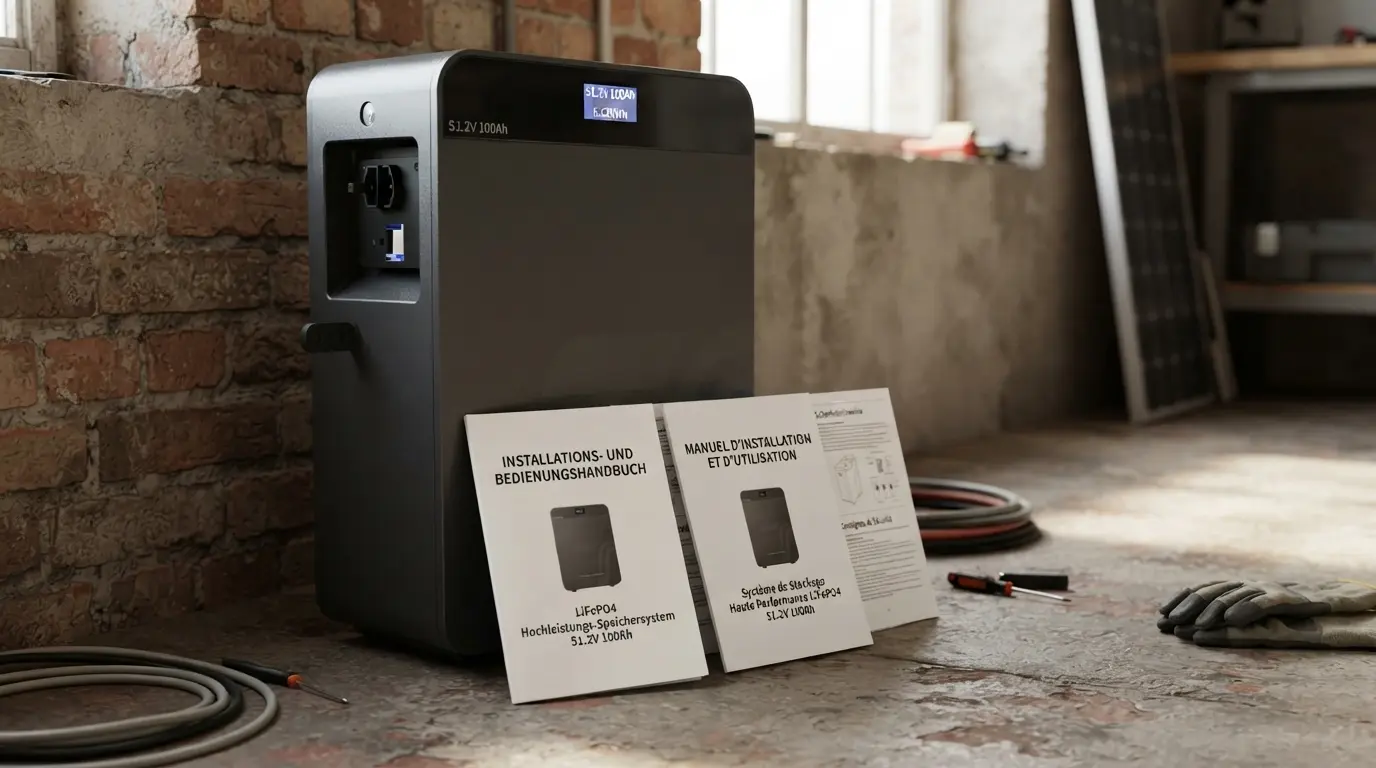
The factory maintains a master document in English, itself translated from the Chinese source of truth, and branches a copy per target language. PDF localization carries no MOQ. You can order one sample unit with a manual in your language, and the factory applies it to every unit after that.
The nameplate, the wiring sticker inside the cover, and the safety warnings on the pack all localize separately. Bilingual nameplates — local language plus English — are the most common choice, because customs officers in most markets read English while local inspectors want to see the national language.
Warranty terms must be legally legible in the buyer’s language, not merely translated. The MSDS and the UN38.3 test summary usually stay in English, because those documents travel with the product through freight forwarders and air cargo agents who standardize on English.
The app UI, alarm messages, and the LCD display text localize too, but the display strings need a separate firmware build cycle, so they move at firmware release speed, not documentation speed.
The limits are honest ones. A factory guarantees the accuracy of the technical content it wrote. It cannot guarantee the regulatory wording of your specific market, because that is your import compliance obligation, not the factory’s. What a good OEM gives you is a compliant technical base — IEC 62619, UN38.3, CE — in English, plus a controlled translation process on top of it, so the localized manual says the same thing the certified manual says.
Documentation Tiers — The Decision Matrix
Not every order needs the same localization depth. Here is how the options break down for a 5 kWh LFP wall-mount system.
| Tier | What you get | MOQ | Lead time | Typical cost |
|---|---|---|---|---|
| A — English master only | English manual PDF, English nameplate | None | In stock | Included |
| B — Localized PDF plus bilingual labels | Translated manual PDF, bilingual nameplate, localized quick-start sheet | None for PDF | 10–14 working days | Small per-language fee |
| C — Full localized print run | Printed localized manuals, localized nameplate, app language pack, localized warranty card | 200–500 units | 14–21 working days | Fee plus amortized print cost |
Tier B covers most first orders. Tier C makes sense once a market proves itself, because the print-run setup cost only disappears when you spread it across a few hundred units.
Four Localization Pitfalls That Cost Distributors Money
Free tools translate “over-discharge protection”, “float charge”, and “state of charge” into words that mean something slightly different, and slightly different is exactly what a protection threshold does not tolerate. One Polish manual from a competitor collapsed “charge” and “load” into a single word, and the installers who followed it wired the DC input backwards. Demand that a native speaker with battery knowledge reviews the final document, not just a translator.
CE markets require instructions in the official language of the member state where the product is sold. Germany and France enforce this at market surveillance, not at the border. Ship an English-only manual into Munich and your product can be withdrawn from sale, which is more expensive than any translation fee you were avoiding.
Factories update firmware constantly. A new firmware release may change the DIP-switch count from four positions to six, or move the charge ceiling from 54.5V to 55.2V, and the translated manual that still shows the old values becomes actively dangerous. Check that every manual carries a revision code that matches the BMS firmware version it shipped with.
The marketing datasheet says 48V. The manual says 51.2V nominal. The nameplate says 5,120 Wh. When customs or an insurer compares documents and finds three different numbers, the shipment stalls and the claim gets questioned. Insist that the factory generates the nameplate and the manual from the same BOM data, so the numbers agree by construction.
Questions Buyers Ask Before Signing
A typical OEM library covers English, German, French, Spanish, Italian, Polish, Portuguese, Dutch, Russian, and Arabic. Less common languages go through certified translation partners the factory has worked with before, and they still fall inside the 10–14 working day window.
No for PDF files. Printed localized manuals usually need a print run of 200–500 units. Below that, the standard play is a universal printed manual plus a localized quick-start insert, which costs a fraction of a full print run.
Ten to fourteen working days after you freeze the specification. Urgent projects can ship in seven. Every specification change resets the clock, so freeze the DIP table, the torque values, and the app screens before you ask for the translation.
Yes. UI strings and alarm messages localize on the app side, and the firmware display text follows the firmware release schedule. If the local language matters for the installer, ask for both, because the app is where your installers actually look.
The Short Answer
Yes, a serious battery OEM delivers manuals and installation guides in your local language, and treats the translation as an engineering document with revision control, native technical review, and a defined lead time. The ones who cannot are usually reselling someone else’s product and hoping you never notice.
Send your target market list — countries, languages, and your order forecast — and we’ll return a documentation localization plan with lead times and per-language costs within 24 hours.