 English
  العربية
  日本語
日本語  한국어
한국어  Tiếng Việt
  ไทย
ไทย  Bahasa Melayu
  فارسی
فارسی  Bahasa Indonesia
  ဗမာစာ
ဗမာစာ  简体中文
简体中文  香港中文
香港中文  繁體中文
繁體中文  Русский
  Deutsch
  Nederlands
  Italiano
  Français
  Español
  Português
  Afrikaans
  Azərbaycan dili
  Български
  ਪੰਜਾਬੀ
  हिन्दी
  اردو
اردو  বাংলা
বাংলা  Հայերեն
  Íslenska
  Қазақ тілі
  नेपाली
  Српски језик
  Kiswahili
  తెలుగు
  Basa Jawa
  தமிழ்
தமிழ்  मराठी
मराठी How Wholesalers Can Explain in One Sentence Why Their Energy Storage Product Beats the Competition
Installer sales language / 48V LFP
Make the spec repeatable.
An installer rarely needs another 30-page datasheet during a sales call. They need to know whether your battery will fit the inverter, finish commissioning without a second visit, and keep the homeowner from calling them at midnight. When two 48V lithium batteries both claim 10 kWh, the wholesaler who recites capacity usually loses the conversation.
The useful sentence connects one measurable product advantage to the installer’s daily risk. It names the hardware, the operating condition, and the labor saved. This article shows wholesalers how to build that kind of statement and support it with evidence.
Build the One-Sentence Advantage Around a Real Installation Risk
Start with the installer’s most expensive failure point, not your most impressive specification. A 48V LFP battery may advertise 10.24 kWh of nominal energy, but the installer cares about usable energy at the actual discharge rate, the inverter’s approved protocol, and the current available when several loads start together.
For a typical 51.2V 200Ah residential module, ask five technical questions before writing your pitch:
- Does the battery provide 200A continuously or only for a short peak?
- Does the BMS allow 100% depth of discharge, or does the warranty require an 80% window?
- Does the battery maintain its rated output at 45°C, or does it reduce current above 35°C?
- Can the inverter read state of charge through CAN at 250 kbit/s, or must the installer configure a generic voltage mode?
- Can one system parallel five modules with automatic address assignment and current sharing?
These details turn a vague claim into an operational promise. A good sentence normally follows this pattern:
Sentence architecture
“For [installation scenario], our [specific configuration] provides [measurable advantage] under [relevant condition], which lets you [installation or service outcome].”
Avoid packing every specification into the sentence. Select the single bottleneck that matters most to the installer segment you serve. An off-grid installer in a hot region may value thermal output and local service more than a higher peak current that lasts 10 seconds. A European retrofit installer may value inverter compatibility and a documented commissioning process over a 1C discharge claim.
The technical proof behind the sentence
Consider two batteries with the same nominal energy. Battery A uses 16 LFP prismatic cells in a 51.2V configuration, a 200A BMS, and passive balancing at 80 mA. Battery B uses the same cell count but limits continuous discharge to 100A and balances at 30 mA. At a 5 kW household load, both can run the load. At a 10 kW peak, Battery A offers a 10.24 kW continuous path at nominal voltage, while Battery B reaches only about 5.12 kW before the BMS limits output.
200A BMS · 80 mA balancing
100A BMS · 30 mA balancing
The difference becomes clearer when temperature enters the installation. LFP cells commonly operate within a charge range of 0°C to 55°C and a discharge range of -20°C to 55°C, but the battery controller may reduce current near the upper limit. If your BMS retains 200A discharge at 45°C while the competing unit derates to 120A at the same temperature, that is a useful sales fact. State the test condition and the measurement boundary. Do not present a laboratory peak as an all-day rating.
The battery should also report accurate state of charge through its communication interface. A CAN-enabled BMS can transmit voltage, current, temperature, alarm state, and remaining capacity to a compatible hybrid inverter. RS485 may suit a monitoring gateway or a parallel battery bus, but the installer needs the pinout, baud rate, termination guidance, and approved inverter list before arriving at the site.
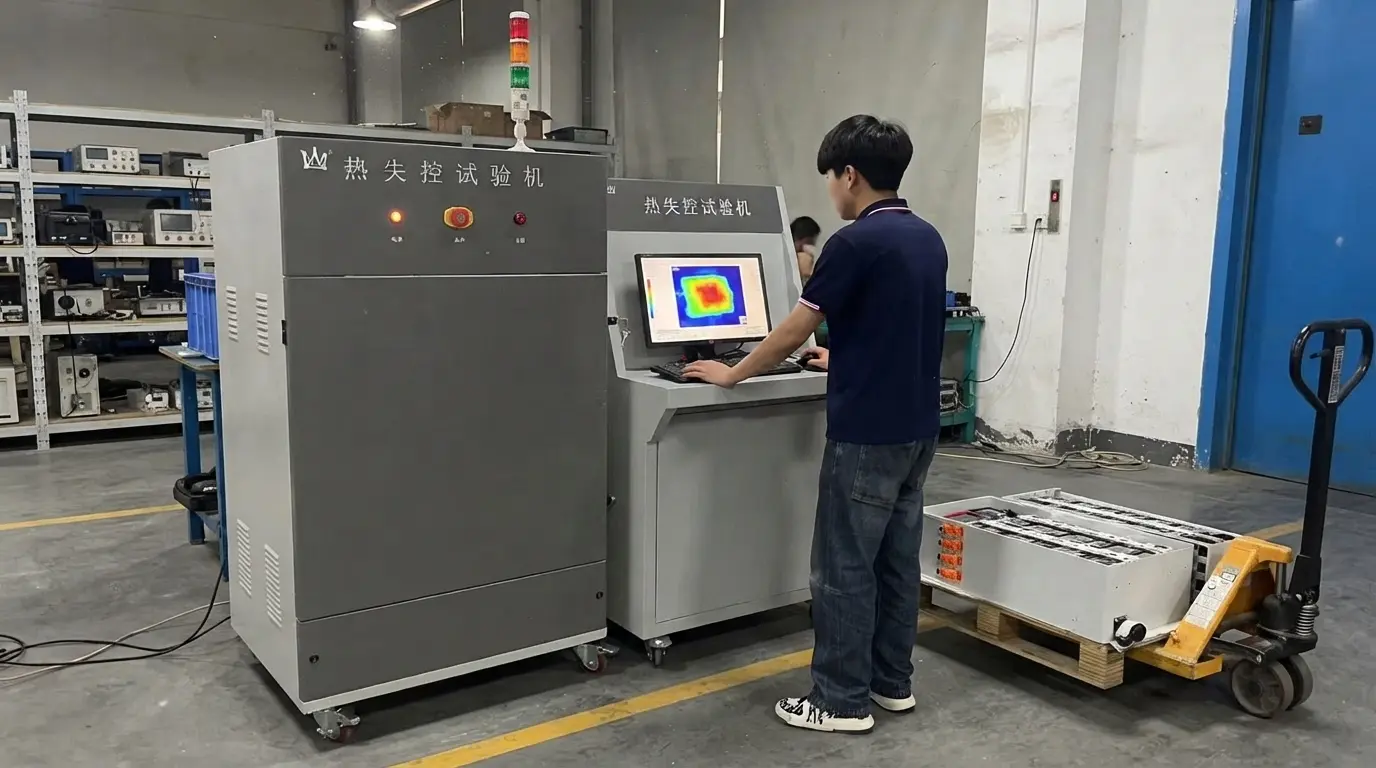 Image slot
Thermal and current test bench
Turn the Product Advantage Into an OEM and ODM Selling Tool
Wholesalers often represent several brands, so an installer may assume every product is interchangeable. Your advantage becomes more credible when you show that the manufacturer can adapt the product to the installer’s workflow instead of forcing a new process onto every project.
Ask the factory to define the available OEM and ODM options in operational terms:
Label and enclosure
Private-label front panels, QR-coded serial numbers, colour matching, and an IP65 steel or aluminium enclosure for indoor and sheltered outdoor installations.
Connector variants
M8 power terminals, Anderson-style connectors, or a specified inverter cable length with 25 mm² or 35 mm² conductors.
Firmware tuning
Approved CAN profiles, charge-voltage limits, low-temperature charge lockout, current derating thresholds, and parallel address logic.
Packaging and compliance
UN38.3 test reports, MSDS documentation, IEC 62619 or regional certification where required, and carton markings that match the shipping route.
Commercial support
Sample lead time, MOQ by configuration, spare BMS availability, remote fault-log review, and replacement-unit procedure.
This information helps you give an installer a sentence with a commercial consequence:
The point is not to promise unlimited customization. The point is to remove the installation variability that creates callbacks.
Before quoting, request the installer’s inverter models, target order volume, ambient temperature range, and preferred connector. A sample can then validate the mechanical fit and communication handshake before the first pallet ships. For a private-label project, a realistic sample lead time might be 7 to 14 working days after artwork and firmware requirements are confirmed, while a production run may require 30 to 45 days depending on cell allocation and certification review.
Decision Matrix for a Clearer Installer Pitch
The table below shows how the same 48V product family can support different installer messages. The figures are example engineering targets and must match the final approved datasheet.
| Configuration | 5.12 kWh module | 10.24 kWh module | 15.36 kWh three-module stack |
|---|---|---|---|
| Nominal voltage | 51.2 V | 51.2 V | 51.2 V system bus |
| Nominal capacity | 100 Ah | 200 Ah | 300 Ah |
| Continuous discharge | 100 A / 5.12 kW | 200 A / 10.24 kW | 300 A / 15.36 kW, subject to system limits |
| Recommended usable energy at 90% DoD | 4.61 kWh | 9.22 kWh | 13.82 kWh |
| Cell chemistry | LFP prismatic | LFP prismatic | LFP prismatic |
| BMS balancing current | 80 mA | 80 mA | 80 mA per module |
| Communication | CAN and RS485 | CAN and RS485 | CAN with parallel addressing |
| Enclosure target | IP65 | IP65 | IP65 per module |
| Best installer message | Easy to carry and add later | Full-load output from one cabinet | Higher reserve without changing the inverter |
The matrix prevents a common sales mistake: comparing nominal kWh while ignoring power. If the installer is replacing a 5 kW battery inverter, the 5.12 kWh module may be adequate. If the site includes a heat pump and an induction cooker, the 10.24 kWh module’s 200A path may matter more than the extra nominal capacity of a slower battery bank.
Four Common Pitfalls That Weaken a Wholesaler’s Claim
Quoting peak current as continuous power
A BMS may allow 250A for 10 seconds to start a motor, while the continuous rating remains 150A. Put both values on the quote and identify the duration. Otherwise, the installer may size cables, fuses, and inverter settings around a number the battery cannot sustain.
Saying “compatible” without naming the protocol
Compatibility requires more than a matching voltage. Give the inverter brand and model, CAN baud rate, connector pinout, termination requirement, and firmware version. If the inverter has no approved lithium profile, explain whether the system can run in voltage mode and what monitoring it loses.
Ignoring temperature derating
A battery installed in a metal utility room can exceed 40°C during summer. State the charge and discharge limits at 25°C, 35°C, and 45°C when those values differ. Include the low-temperature charge cut-off, often near 0°C, because charging LFP cells below that point can cause permanent damage.
Treating logistics documents as an afterthought
A delayed or rejected shipment destroys the credibility of a product claim. Confirm UN38.3 test summaries, safety data sheets, packaging instructions, net weight, and the applicable lithium battery transport classification before accepting the purchase order. The installer may never see these documents, but a missing file can still stop the project.
 Image slot
Inverter communication and commissioning
FAQ for Wholesalers Selling Through Installers
Make the Claim Specific Enough to Be Tested
An installer’s trust grows when your sentence survives a checklist. Replace “better battery life” with a cycle-life condition such as 6,000 cycles at 0.5C, 25°C, 90% DoD, and 80% remaining capacity. Replace “fast installation” with a defined package such as pre-terminated 35 mm² cables, labelled communication leads, wall brackets, and a documented two-person lifting weight of 92 kg. Replace “safe outdoor use” with the enclosure rating, operating temperature, mounting limits, and certification scope.
The winning sentence will differ by market, but its structure stays stable: a specific hardware fact, a relevant operating condition, and a direct reduction in installer work or risk. That is how a wholesaler turns technical data into a message someone can repeat accurately on a jobsite.
Send your target inverter list, daily load curve, installation temperature range, and expected annual volume. We’ll return a one-sentence product position, a matched comparison table, and a preliminary battery BOM within 24 hours.