 English
  العربية
  日本語
日本語  한국어
한국어  Tiếng Việt
  ไทย
ไทย  Bahasa Melayu
  فارسی
فارسی  Bahasa Indonesia
  ဗမာစာ
ဗမာစာ  简体中文
简体中文  香港中文
香港中文  繁體中文
繁體中文  Русский
  Deutsch
  Nederlands
  Italiano
  Français
  Español
  Português
  Afrikaans
  Azərbaycan dili
  Български
  ਪੰਜਾਬੀ
  हिन्दी
  اردو
اردو  বাংলা
বাংলা  Հայերեն
  Íslenska
  Қазақ тілі
  नेपाली
  Српски језик
  Kiswahili
  తెలుగు
  Basa Jawa
  தமிழ்
தமிழ்  मराठी
मराठी LFP or NMC for Home Energy Storage — Which Chemistry Belongs on Your Wall
A distributor in Germany is choosing between two 10 kWh wall-mount batteries for the same installer network. One uses LFP cells, the other NMC. The NMC unit is 18 kg lighter and fits a tighter wall cavity. The LFP unit is heavier, cheaper per kilowatt-hour, and rated for three times the cycle life. The sales rep for the NMC brand keeps saying “higher energy density” as if that settles it.
It doesn’t. For a stationary battery bolted to a garage wall, energy density is close to the least important number on the datasheet. The decision that actually matters is which chemistry survives ten years of daily cycling, in a hot enclosure, without turning a warranty into a liability.
This article compares LFP and NMC at the cell level, gives you the numbers that decide the outcome, and shows you which chemistry belongs in which market.
The Chemistry That Decides the Warranty — Cycle Life and Thermal Runaway
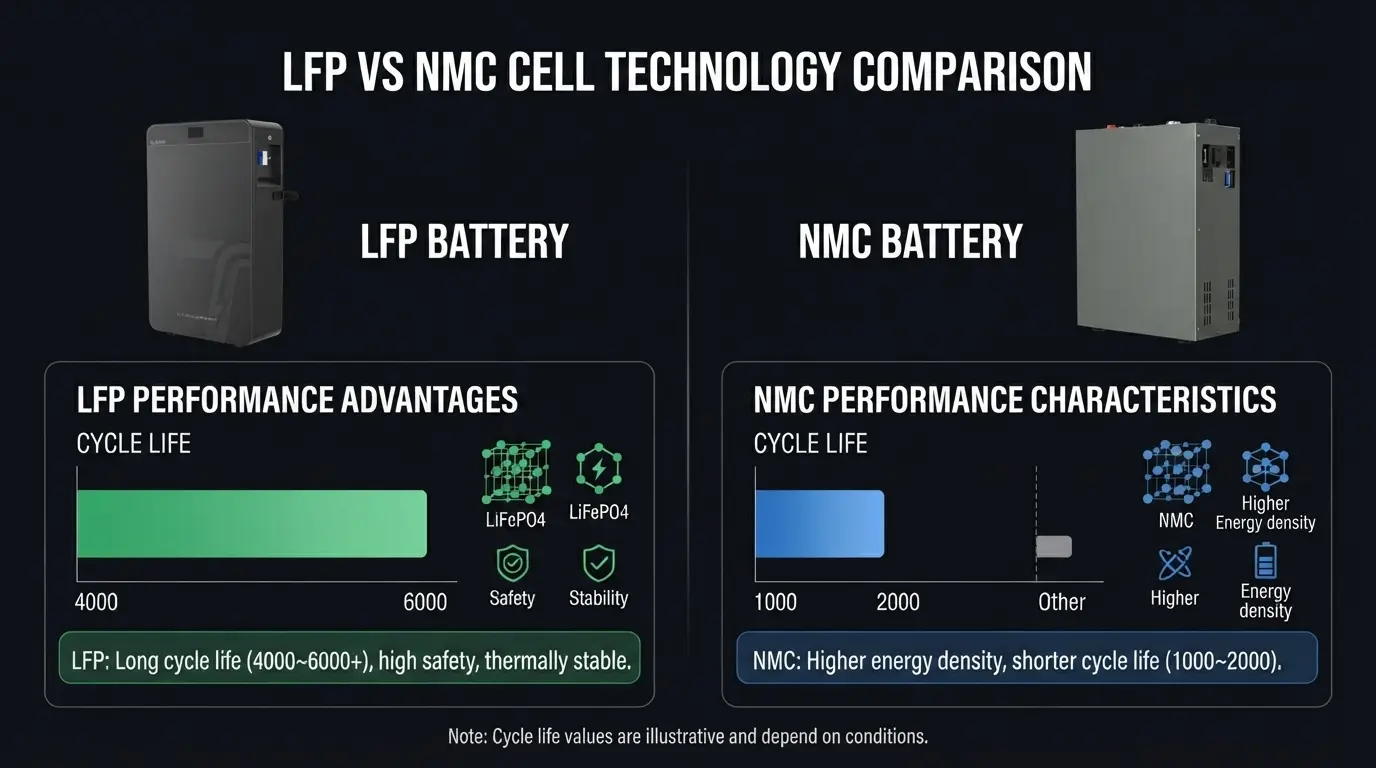
The two chemistries differ in one number that dominates everything else: how many full charge-discharge cycles the cell survives before it drops to 80% of original capacity.
LFP (lithium iron phosphate) is built for repetition.
A grade-A LFP prismatic cell with a 3.2V nominal voltage and a 2.5–3.65V operating window typically delivers 4,000–6,000 cycles at 0.5C and 25°C before hitting 80% capacity. At one full cycle per day, that is 11 to 16 years of service. The chemistry is also thermally boring in the best way: LFP does not enter thermal runaway until roughly 270°C, and even then it releases far less oxygen than nickel-based cathodes. That is why LFP packs routinely pass UL 9540A cell-level propagation tests without a fire.
NMC (nickel manganese cobalt) trades longevity for density.
A typical NMC cell with a 3.6–3.7V nominal voltage and a 3.0–4.2V window delivers 1,000–2,000 cycles at the same conditions. That is three to five years of daily cycling before the pack is at 80% and the warranty clock runs out. The trade-off is real: NMC reaches 150–220 Wh/kg against LFP’s 90–160 Wh/kg, so the same 10 kWh comes in a smaller, lighter box. But NMC’s thermal runaway threshold sits around 150–200°C, and the reaction is more energetic, which is why NMC systems lean harder on active cooling and more conservative BMS limits.
The number that should stop you: at 0.5C and 25°C, an LFP pack will still be above 80% capacity at cycle 4,000, while an NMC pack of the same nominal capacity is typically at end-of-life by cycle 1,500. For a stationary home battery that cycles daily, that gap is the entire warranty.
What a Real OEM/ODM Partner Does With the Chemistry Choice
A trading company sells you whichever chemistry is in stock. A manufacturer asks what your market actually does with the battery, then matches the cell to it.
A genuine OEM/ODM partner will walk you through the cell supplier and grade for both chemistries, because the LFP-versus-NMC decision is downstream of a bigger one: what your installers sell and what your customers tolerate. They will tune the BMS charge and discharge limits to the chemistry you pick — a 3.65V LFP ceiling versus a 4.2V NMC ceiling is a firmware decision, not a hardware one — and they will adjust the thermal management to match. An LFP pack can often run passive cooling with a simple heat path; an NMC pack in a hot market needs active cooling and a tighter SOC window, which adds cost and complexity.
They will also be honest about the one place NMC still wins. If your market is space-constrained — a European retrofit where the battery must fit a narrow utility cupboard — the 18 kg and 40% volume saving of NMC is a real selling point, and a good partner will say so instead of pushing LFP everywhere. The point of OEM/ODM is not one chemistry for all markets; it is the right chemistry, branded and tuned for yours.

LFP vs NMC — The Decision Matrix
Here is the comparison that matters for a residential buyer, using grade-A cells and a full certification set, at a 10 kWh nominal capacity.
| Specification | LFP (LiFePO4) | NMC (NCM) | What it means for a home install |
|---|---|---|---|
| Nominal cell voltage | 3.2V | 3.6–3.7V | NMC needs fewer cells in series for the same pack voltage |
| Cycle life to 80% | 4,000–6,000 | 1,000–2,000 | LFP outlasts NMC by 3–5x under daily cycling |
| Energy density | 90–160 Wh/kg | 150–220 Wh/kg | NMC is lighter and smaller for the same kWh |
| Thermal runaway onset | ~270°C | ~150–200°C | LFP is far less likely to propagate a fire |
| Cell cost per Wh | $0.06–0.08 | $0.09–0.12 | LFP is 30–40% cheaper at the cell level |
| Typical cooling need | Passive | Active | NMC adds cost and failure points in hot climates |
| Best fit | Daily-cycling, safety-first, cost-sensitive | Space-constrained, weight-sensitive, low-cycle | Match the chemistry to the duty cycle |
The pattern is clear. LFP wins on the three numbers a residential buyer actually lives with — cycle life, safety margin and cost per kilowatt-hour. NMC wins on the two numbers a spec sheet makes look important — density and weight — which matter far less when the battery sits on a wall and never moves.
Four Ways the Chemistry Choice Goes Wrong
-
01
Buying NMC for a daily-cycling market
If your installers sell self-consumption systems that cycle once a day, an NMC pack hits 80% capacity in three to five years and the warranty claims start. Match the chemistry to the duty cycle, not to the brochure.
-
02
Ignoring the thermal environment
An NMC pack in an unventilated garage in a hot climate derates hard and ages faster. LFP tolerates 45°C ambient with passive cooling; NMC in the same spot needs active cooling or a reduced charge ceiling. Ask for the derating curve at your market’s peak temperature.
-
03
Comparing cycle life without the test conditions
A 6,000-cycle LFP claim at 0.5C and 25°C is not the same as a 6,000-cycle claim at 1C and 40°C. Demand the C-rate, temperature and depth-of-discharge behind every cycle number, or the comparison is meaningless.
-
04
Forgetting the certification difference
LFP’s higher thermal stability makes UL 9540A and IEC 62619 propagation testing cheaper and faster to pass. NMC systems often need more test iterations and more conservative pack design. That cost lands in your quote either way — know which chemistry you are paying to certify.
Questions Buyers Ask Before They Pick a Chemistry
Is LFP always the right choice for home storage?
For daily-cycling, safety-first residential installs, yes in almost every case. The exception is a genuinely space- or weight-constrained retrofit where the smaller NMC footprint is worth the shorter life and higher cost.
Why is NMC more expensive if it lasts fewer cycles?
Cobalt and nickel cost more than iron and phosphate, and the higher energy density demands more careful thermal management and pack engineering. You are paying for density, not durability.
Can I mix LFP and NMC in the same system?
No. Different voltage windows and charge curves mean a mixed string will imbalance and the BMS will fight itself. Pick one chemistry per system and keep it consistent across the fleet.
How do I verify the cycle-life claim on a datasheet?
Ask for the test report showing C-rate, temperature and depth of discharge, and confirm the cell supplier and grade. A 6,000-cycle claim without those conditions is a marketing number, not an engineering one.
Pick the Chemistry Your Market Cycles, Not the One That Looks Lighter
For a stationary home battery, the chemistry decision comes down to one question: how many times will this pack cycle before the customer expects it to still work? If the answer is daily for a decade, LFP wins on cycle life, safety and cost per kilowatt-hour, and the extra weight is irrelevant on a wall. If the answer is occasional use in a tight space, NMC’s density earns its premium.
If you are sourcing residential systems at volume, tell us your market’s duty cycle, peak ambient temperature and space constraints, and we will return a chemistry recommendation with the cell supplier, cycle-life test conditions and certification path named in full within 24 hours.
Name your market. We’ll name the chemistry.
Duty cycle, peak ambient temperature and space constraints — send them over and get a full chemistry recommendation with cell supplier, test conditions and certification path within 24 hours.
Request a chemistry recommendation