 English
  العربية
  日本語
日本語  한국어
한국어  Tiếng Việt
  ไทย
ไทย  Bahasa Melayu
  فارسی
فارسی  Bahasa Indonesia
  ဗမာစာ
ဗမာစာ  简体中文
简体中文  香港中文
香港中文  繁體中文
繁體中文  Русский
  Deutsch
  Nederlands
  Italiano
  Français
  Español
  Português
  Afrikaans
  Azərbaycan dili
  Български
  ਪੰਜਾਬੀ
  हिन्दी
  اردو
اردو  বাংলা
বাংলা  Հայերեն
  Íslenska
  Қазақ тілі
  नेपाली
  Српски језик
  Kiswahili
  తెలుగు
  Basa Jawa
  தமிழ்
தமிழ்  मराठी
मराठी A distributor in Poland receives two quotes for a 10 kWh wall-mount battery. One is $2,850 (Factory A), the other $2,150 (Factory B). Same nominal capacity, same 48V architecture, same LFP chemistry on paper. The cheaper one looks like the obvious win until you notice the second quote lists no UN38.3 test summary, a BMS from a supplier you can’t trace, and a warranty that quietly excludes cycle life after year three.
The gap between those two numbers is not profit. It is a list of components, tests and reserves that one factory paid for and the other skipped. If you can’t see that list, you can’t tell a fair quote from a trap.
This article breaks a residential energy storage system into its real cost layers, gives you the benchmark numbers for each, and shows you how to read a supplier’s quote the way a factory cost engineer would.
Where the Money Actually Goes
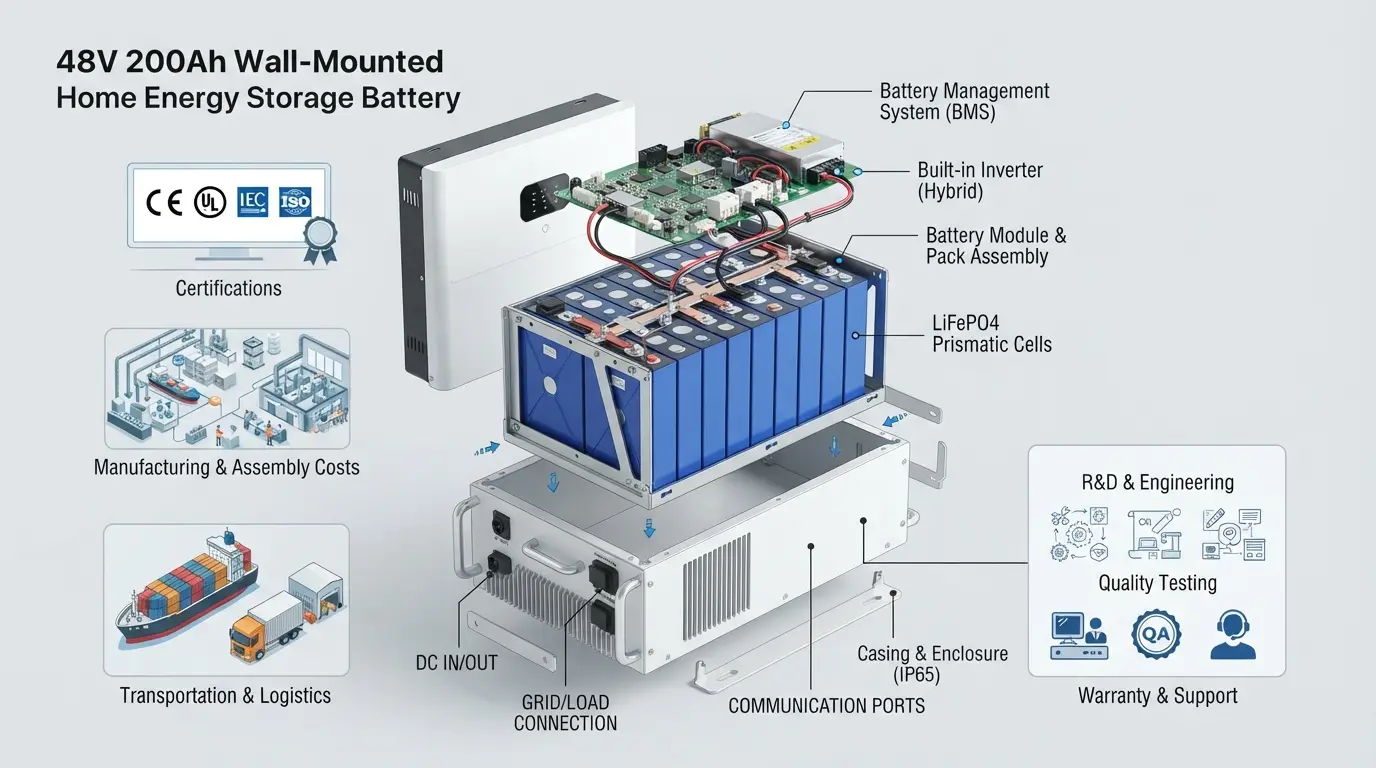
A residential system is not one product. It is a stack of components, each with its own market price, and the total lands somewhere predictable if you know the current cell market. Here is the breakdown for a typical 10 kWh, 48V LFP wall-mount unit, expressed as a share of the ex-works bill of materials.
- Cells50–60% of BOM
- Inverter / PCS$400–700
- Enclosure & assembly10–15%
- BMS$40–90
- Certificationamortised
- Freight & reserve$80–150 + 2–4%
LFP prismatic cells dominate the cost, running 50–60% of the BOM. At current market rates a grade-A 100 Ah LFP cell costs roughly $0.06–0.08 per Wh, so a 10 kWh pack carries $600–800 in cells alone before a single weld is made. This is the number that moves the whole quote, and it moves weekly with lithium carbonate prices. A supplier who quotes you a fixed price for six months is either hedging or hiding something.
A proper 16-cell BMS with active balancing, CAN and RS485, and a UL-recognised protection IC runs $40–90 at volume. A passive-balance board with no comms costs $15. The difference is invisible in a photo and decisive in year four, when one drifted cell takes the whole string down.
A 5 kW hybrid inverter with MPPT and grid-forming capability lands at $400–700 ex-works. This is where cheap quotes cut hardest, because a low-frequency transformer design that looks identical on a spec sheet costs half as much and derates badly under inductive loads.
These add another 10–15%. A wall-mount steel enclosure with IP65 sealing, a proper heat path and a drop-tested crate is not free, and neither is the labour to torque every terminal to 8 Nm and log every serial number.
UN38.3, IEC 62619, and for many markets UL 9540A or CE compliance cost $15,000–40,000 per pack family, amortised across the run. A factory that has already paid this spreads it thin; a factory that hasn’t will quietly leave it out of your quote and let you discover the gap at the port.
These are the layers most buyers forget. A 10 kWh pack is Class 9 dangerous goods, ships at 30% SOC or below, and needs UN-tested packaging. Add $80–150 per unit for sea freight and documentation, then add a warranty reserve of 2–4% of the selling price to cover the failures the factory knows will happen.
What a Real OEM/ODM Partner Does Differently
A trading company forwards you a price. A manufacturer hands you a cost sheet and explains the deltas. That distinction is the whole game when you are placing 500-unit orders.
A genuine OEM/ODM partner will show you the cell supplier and grade on request, because they buy cells by the container and their reputation rides on the BOM. They will offer to brand the enclosure, the BMS firmware and the shipping documents in your name, and they will tune the discharge curve and the SOC window to your market’s grid code. They will quote MOQs down to 100 units with shared-container options, and they will turn a sample with full documentation in about three weeks.
Most importantly, they will tell you when a spec is not worth paying for. A factory that has shipped 50,000 packs knows that a 6,000-cycle cell is overkill for a market that replaces systems at year ten, and they will say so instead of upselling you. That honesty is what you are actually buying when you pay a few dollars more per kilowatt-hour.

Judging a Quote – Three Configurations Side by Side
The fastest way to test a quote is to line it up against the market. Here is what a fair ex-works price looks like across three common residential configurations, assuming grade-A LFP cells and a full certification set.
| Configuration | Nominal capacity | Cell cost (est.) | BMS + inverter | Certification share | Fair ex-works range | Red flag below |
|---|---|---|---|---|---|---|
| 48V wall-mount, 5 kWh | 5.12 kWh | $320–410 | $180–260 | $40–70 | $1,050–1,350 | $850 |
| 48V wall-mount, 10 kWh | 10.24 kWh | $600–800 | $450–700 | $60–100 | $2,200–2,900 | $1,800 |
| High-voltage stack, 15 kWh | 15.36 kWh | $900–1,200 | $700–1,000 | $80–120 | $3,300–4,200 | $2,700 |
The “red flag below” column is the number that should make you pause. A quote under that floor almost always means one of three things: grade-B cells sold as grade-A, a BMS with no comms or no balancing, or certification that was never actually paid for. None of those show up in the first month. All of them show up in the warranty claims.
Four Ways a Cheap Quote Hides Its Real Cost
Grade-B cells dressed as grade-A
The single biggest source of “cheap” batteries is cells that failed the factory’s own sorting and got relabelled. They test fine on day one and drift apart by cycle 300. Ask for the cell supplier, the grade certificate and the batch test report. If the supplier won’t name the cell maker, walk away.
A BMS that can’t talk
A passive-balance BMS with no CAN or RS485 saves $25 a unit and costs you the ability to monitor, update firmware or diagnose a field failure remotely. For a distributor supporting installers, that $25 becomes a truck roll every time a pack misbehaves.
Certification that exists only on paper
Some quotes include a UN38.3 line item that was never tested against your exact BOM. Verify the model numbers on the report, the Test Summary and the battery label match, down to the firmware version. A mismatched report is worthless at the port.
A warranty that excludes the expensive part
Read the cycle-life clause. A warranty that covers “manufacturing defects” but caps cycle life at 2,000 cycles on a cell rated for 6,000 is not a warranty, it is a disclaimer. The reserve the factory sets aside for claims is the difference between a partner and a drop-shipper.
Questions Wholesalers Ask Before They Commit
A fair ex-works price for a grade-A, fully certified 10 kWh wall-mount unit runs $215–285 per kWh. Below $180 per kWh, start asking hard questions about the cells and the BMS.
Usually cells, BMS and certification. The cell grade alone can swing the BOM by 20%, and a missing certification set is another 5–8% that you will pay later at the port or in the market.
Only if your market holds systems past ten years. A 6,000-cycle cell costs more than a 4,000-cycle cell, and for most residential installs the extra cycles are never used. Match the cell to the market, not to the marketing.
Ask for the cell supplier name, the grade certificate and a batch test report showing capacity and internal resistance spread. A factory that buys grade-A cells by the container will show you all three without hesitation.
Judge the Cost Sheet, Not the Cover Price
A residential energy storage quote is a list of decisions someone made about cells, BMS, certification and reserve. The price is just the sum of those decisions. Learn to read the list and the cheap quote stops looking like a bargain and starts looking like a deferred invoice.
If you are sourcing residential systems at volume, send us your target capacity, your market’s grid code and your annual volume, and we will return a line-by-line cost breakdown with the cell supplier, BMS topology and certification set named in full within 24 hours.