 English
  العربية
  日本語
日本語  한국어
한국어  Tiếng Việt
  ไทย
ไทย  Bahasa Melayu
  فارسی
فارسی  Bahasa Indonesia
  ဗမာစာ
ဗမာစာ  简体中文
简体中文  香港中文
香港中文  繁體中文
繁體中文  Русский
  Deutsch
  Nederlands
  Italiano
  Français
  Español
  Português
  Afrikaans
  Azərbaycan dili
  Български
  ਪੰਜਾਬੀ
  हिन्दी
  اردو
اردو  বাংলা
বাংলা  Հայերեն
  Íslenska
  Қазақ тілі
  नेपाली
  Српски језик
  Kiswahili
  తెలుగు
  Basa Jawa
  தமிழ்
தமிழ்  मराठी
मराठी How Home Energy Storage Distributors Can Sell Into the AI Compute Boom
Home energy storage for AI workloads
Size the load.
A practical field guide for matching 16kWh, 32kWh, all-in-one, and modular rack batteries to home AI workstations, studios, and small labs.
A customer running local AI models rarely describes the problem as an energy-storage problem. They complain about a circuit breaker that trips during a training run, a workstation that loses six hours of work during an outage, or a monthly electricity bill that makes the project difficult to justify. That is where a knowledgeable distributor can move the conversation away from battery capacity alone and toward operating continuity, load control, and predictable energy cost.
The opportunity covers more than large data centers. A high-end AI workstation may draw 0.8 to 1.5kW under sustained load. A small studio with several GPU machines, networking equipment, cooling, and storage can hold a 2 to 4kW continuous load for hours. A compact laboratory or multi-user inference room can move beyond 5kW before anyone adds lighting, ventilation, or test equipment. These buyers need a system that arrives as a coordinated power package, not a collection of parts that takes days to commission.
For wholesalers, distributors, and installers, the sales task is straightforward. Measure the customer’s actual load, identify the cost of interruption, and match the application to a 16kWh wall-mounted battery, a 32kWh wall-mounted battery, a 16kWh all-in-one system, or modular 5kWh rack units. This article shows how to do that without making unrealistic runtime or bill-saving claims.
Size the Battery Around the AI Load Rather Than the Nameplate
AI equipment creates a different load profile from normal household appliances. A refrigerator cycles. A GPU training job can sit near maximum power for eight hours. The battery therefore faces sustained discharge, while the inverter must handle both continuous demand and short startup peaks from cooling equipment, pumps, or workshop tools.
Start with a load inventory. A representative small AI studio might include the following equipment:
| Equipment | Typical operating power | Daily runtime | Daily energy |
|---|---|---|---|
| Multi-GPU workstation | 1.4kW | 10 hours | 14.0kWh |
| Secondary inference workstation | 0.8kW | 6 hours | 4.8kWh |
| Router, switches, and NAS | 0.18kW | 24 hours | 4.32kWh |
| Room cooling and ventilation | 0.7kW | 10 hours | 7.0kWh |
| Monitors, lighting, and controls | 0.25kW | 8 hours | 2.0kWh |
| Total | 32.12kWh |
This customer consumes more than 32kWh per day, but that does not automatically mean they need 32kWh of battery storage. Ask what the battery must do. Cover a two-hour outage? Shift expensive evening electricity into an off-peak charging window? Keep the network and one inference machine online overnight? Each answer produces a different bill of materials.
Use this practical runtime equation during qualification:
Estimated runtime = nominal battery energy × permitted depth of discharge × conversion efficiency ÷ critical loadFor example, a 16kWh battery operated at 90% depth of discharge with an assumed 92% battery-to-AC conversion efficiency provides about 13.25kWh to the load. At a steady 2kW critical load, that equals approximately 6.6 hours. At 4kW, it falls to about 3.3 hours. These are planning values, not guarantees. Cable loss, inverter standby consumption, temperature, battery age, and load spikes all change the result.
A common architecture in this product class uses lithium iron phosphate cells in a nominal 51.2V pack. A 5.12kWh rack module typically pairs 16 series-connected LFP cells with 100Ah capacity. A 16kWh-class wall battery may use a roughly 314Ah architecture, while a 32kWh-class unit doubles the available energy through a larger or paralleled cell arrangement. Exact TURSAN voltage, usable capacity, current limit, enclosure rating, and approved inverter list must be confirmed on the selected model’s current datasheet.
The BMS matters as much as cell capacity. It monitors cell voltage and temperature, limits charge and discharge current, controls contactors, and reports status to the inverter through CAN or RS485. For a sustained 5kW load on a 51.2V battery bus, current approaches 98A before conversion losses. A 10kW load approaches 195A. Distributors should therefore verify the battery’s continuous current rating, peak-current duration, busbar capacity, cable cross-section, fuse rating, and terminal torque instead of assuming that a large kilowatt-hour figure supports any inverter output.
LFP chemistry suits daily cycling because it offers stable thermal behavior and long service life when the system controls cell voltage and temperature correctly. Buyers should request cycle-life data with test conditions attached, such as depth of discharge, C-rate, end-of-life threshold, and test temperature. A statement such as “6,000 cycles” means little unless the supplier also states whether the test used 80% or 100% depth of discharge, 0.5C or 1C, and a controlled temperature near 25°C.
Energy savings also need disciplined language. A battery does not lower the energy price by itself. It can reduce the bill when the customer charges during a lower tariff period or from surplus solar and discharges during an expensive period. It can also limit grid import during demand peaks where the utility applies demand charges. Ask for 15- or 30-minute interval data and the tariff schedule before quoting savings. That calculation builds trust and gives the distributor a defensible payback estimate.

Turn TURSAN Product Choices Into Targeted Sales Packages
The strongest proposal gives each configuration a clear job.
The TURSAN 16kWh wall-mounted battery fits a home AI developer or single-room studio that already owns a compatible hybrid inverter. It can support several hours of critical-load operation without occupying floor space. Position it for retrofits where wall structure, cable route, ventilation clearance, and service access have already been checked.
The TURSAN 32kWh wall-mounted battery addresses longer runtimes and higher daily energy shifting. It makes more sense for multi-workstation studios, small creative agencies rendering overnight, and laboratories that must protect long experiments. The sales discussion should include mounting conditions and total installed weight, not just capacity. A distributor must confirm that the wall and mounting hardware can carry the specified static load with the required safety margin.
The TURSAN 16kWh all-in-one system removes a major commissioning bottleneck. A coordinated enclosure can combine battery storage, inverter functions, protection, controls, and the required internal communication. That gives installers fewer interfaces to debug and helps an AI customer resume work sooner. “Plug and play” must still include a site survey, correct overcurrent protection, grounding, utility settings, and commissioning by a qualified installer. It should never imply bypassing local electrical rules.
TURSAN also offers rack-mounted storage built around 5kWh-class modules for larger projects. This format lets a system integrator start with the required number of modules and add capacity according to the approved parallel architecture. A rack approach suits small server rooms, shared GPU studios, and laboratories that need serviceable modules, organized DC distribution, and a clearer expansion path.
This product range has a useful application history. During the blockchain mining period, personal miners and small mining studios faced the same basic operating pressure now appearing in local AI deployments: sustained high power, costly downtime, heat, and an electricity bill tied closely to utilization. TURSAN systems supported around-the-clock power strategies for those users. Distributors can use that experience as relevant proof of load-profile understanding, while avoiding the claim that every AI project will deliver the same runtime or savings.
A product is easier to sell when every configuration has one clear operational job.
Build an OEM and ODM Offer That Removes Channel Friction
Bulk buyers do not only purchase a battery. They purchase a repeatable SKU, stable documentation, predictable lead time, and a support path their installers can use after delivery. The OEM/ODM program should reflect those operational needs.
For white-label projects, define the brand artwork, enclosure color, rating label, carton print, manual language, warranty terms, and serial-number format before the pilot run. Lock connector type and polarity in the approved specification. A connector that looks familiar but uses a different pin assignment can delay an entire installation batch.
Firmware tuning deserves its own approval sheet. Confirm inverter brand and model, CAN or RS485 protocol, battery address logic, maximum parallel count, charge-current allocation, low-state-of-charge behavior, and recovery settings. When protocol development is required, exchange communication logs and validate the battery with the target inverter on a bench before shipment.
MOQ flexibility should follow project maturity. A practical route starts with engineering samples for electrical and protocol validation, moves to a controlled pilot batch for field installation, and only then enters the distributor’s regular volume order. Sample lead time, production lead time, tooling cost, certification scope, and packaging approval should appear in the commercial quotation rather than remain in chat history.
Shipping paperwork is another part of the product. Ask for the applicable UN38.3 test summary, safety data sheet, transport classification, packing method, and model-specific certificates before accepting an order. Confirm whether a customized label, cell configuration, firmware revision, or enclosure changes the certification scope. This check prevents a private-label project from reaching the forwarder with incomplete documents.
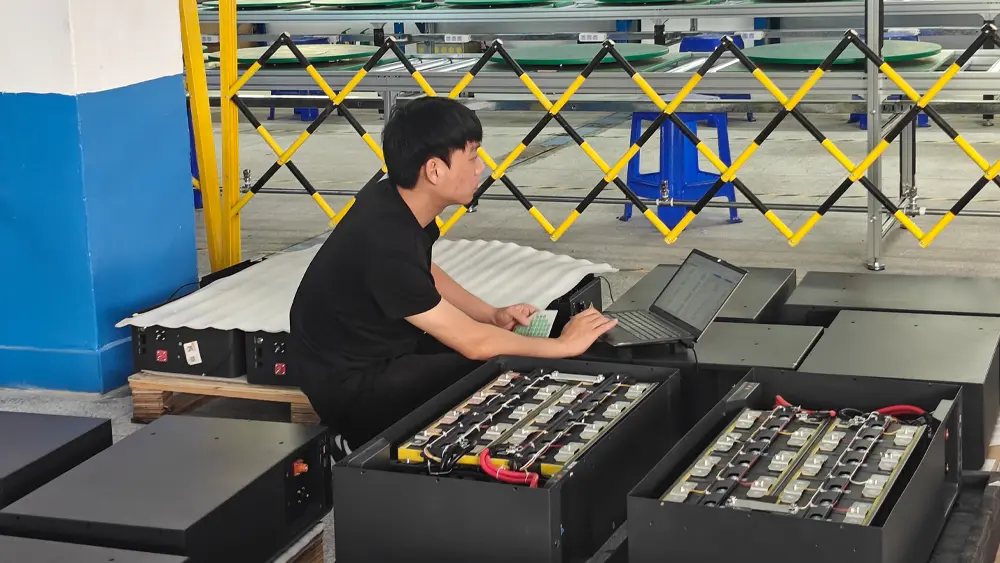
Compare the Right Configuration for Each Buyer
| Configuration | Best-fit customer | Capacity strategy | Main sales advantage | Key qualification question |
|---|---|---|---|---|
| TURSAN 16kWh wall-mounted battery | Home AI developer or single-workstation studio | One substantial storage unit paired with a compatible inverter | Saves floor space and suits inverter retrofits | What critical load must run, and for how many hours? |
| TURSAN 32kWh wall-mounted battery | Multi-GPU studio or small laboratory | Higher stored energy for longer backup or tariff shifting | Reduces the need to parallel several smaller enclosures | Can the mounting structure support the specified installed weight? |
| TURSAN 16kWh all-in-one system | Buyer seeking fast deployment and one coordinated package | Integrated battery and power-conversion approach | Reduces component matching and commissioning time | Does the grid mode, inverter output, and local approval match the site? |
| TURSAN 5kWh-class rack modules | Growing AI room, workshop, or larger project | Add approved modules to reach the project capacity | Serviceable and scalable for staged expansion | What are the BMS parallel limit and DC bus-current limit? |
The table works as a first filter, not a final design. Two customers with identical GPU counts may require different systems because one needs ten minutes of orderly shutdown while the other needs eight hours of autonomous operation. The distributor who asks about runtime, tariffs, solar production, expansion, and outage frequency will usually produce the more credible quote.
Avoid Four Common Sales and Installation Pitfalls
One selling kilowatt-hours without checking inverter power
A 32kWh battery states stored energy, not AC output. Confirm continuous and surge power on both the battery and inverter sides. Check whether the BMS can sustain the DC current required by the AI load and whether the inverter can start connected cooling equipment without overload.
Two treating every CAN port as compatible
The physical connector does not guarantee a shared protocol. Match the exact inverter model, protocol version, pinout, baud rate, and termination method. Bench-test the pair and verify state of charge, alarms, charge limits, and shutdown behavior before a volume shipment.
Three ignoring heat and low-temperature charging
GPU rooms already reject substantial heat. Do not place the battery in the workstation’s hot exhaust path or in a sealed cabinet unless the design specifically permits it. Confirm the model’s operating range and derating behavior. LFP batteries require charge protection at low cell temperatures; the BMS must block or control charging outside the approved window.
Four promising savings without tariff data
Flat-rate electricity can make battery arbitrage uneconomic if no solar surplus is available. Model the customer’s tariff, round-trip losses, cycle frequency, and usable capacity. Separate avoided downtime value from energy-bill savings so the buyer can see which part of the return comes from continuity and which part comes from shifting energy.
Frequently Asked Questions From Distributors
Measure the workstation, networking, storage, and necessary cooling at the AC input during a real workload. Multiply the critical load by the required backup hours, then divide by the planned depth of discharge and conversion efficiency. Add an engineering margin for load variation and battery ageing. Size inverter power separately from battery energy.
Use a wall battery when the customer already has a verified compatible inverter or when the installer needs flexibility in component placement. Use the 16kWh all-in-one option when faster commissioning, coordinated controls, and fewer field interfaces carry more value. Confirm local grid and electrical requirements in both cases.
Choose rack modules when the project needs staged expansion, module-level service access, or capacity beyond a single residential enclosure. Ask TURSAN for the approved parallel quantity, rack layout, master-slave BMS design, protection scheme, and inverter compatibility before fixing the final module count.
Request the current datasheet, installation manual, warranty terms, inverter compatibility list, model-specific UN38.3 test summary, safety data sheet, packing details, and applicable compliance certificates. For OEM or ODM orders, add approved label artwork, firmware revision, connector drawing, carton specification, and golden-sample signoff.
Commercial conclusion
The AI boom gives home energy storage distributors a useful new customer segment, but the winning pitch is not “buy a bigger battery.” It is a measured proposal that shows how much of the customer’s compute load will remain online, how quickly the system can be deployed, and where electricity savings can realistically occur.
TURSAN’s 16kWh and 32kWh wall-mounted batteries, 16kWh all-in-one system, and modular 5kWh-class rack units let channel partners serve projects from one home workstation to a growing GPU studio or small laboratory. The correct choice begins with actual power data and ends with verified inverter communication, installation conditions, and shipping documents.
Send TURSAN your 24-hour load profile, peak AC power, target backup time, inverter model, local tariff, installation country, and expected order volume. The team can use those inputs to return a preliminary configuration and OEM/ODM bill of materials for technical review.