FOOD TRUCK & COFFEE CART POWER

Power Your Food Truck

Anywhere

Without Generators

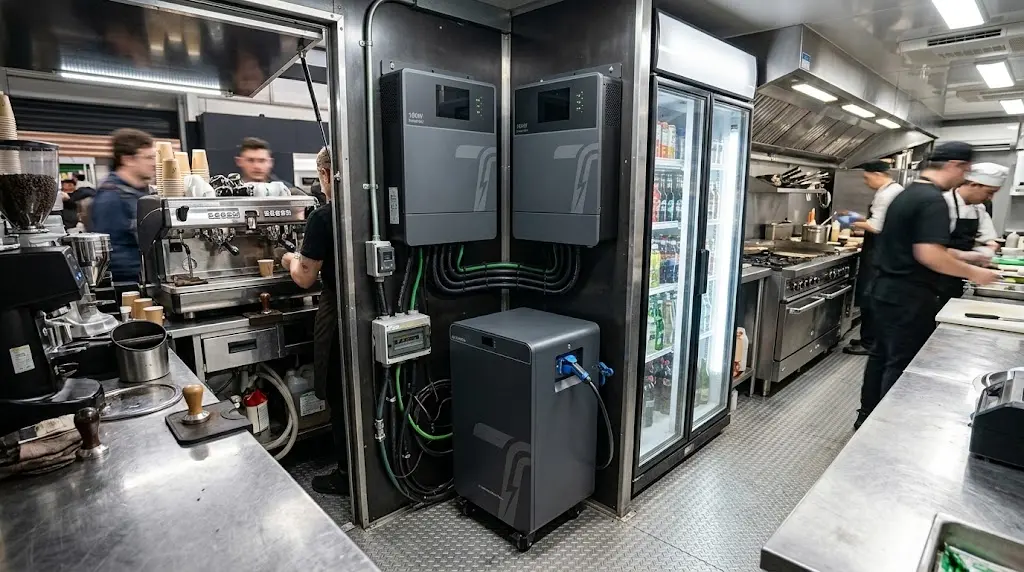
Run espresso machines, refrigerators, and full commercial cooking equipment silently. No fuel. No fumes. No noise complaints. Stable power output from morning prep to late-night service.

0
dB
Generator Noise Eliminated
0 -12
mo
Usable Depth of Discharge
0
+
Cycle Life (LiFePO4)
0
×
Surge for Motor Start

UL 1973 · CE · UN38.3

International Certifications

Vibration-Table Tested

10–500 Hz, 3G Road Shocks

Plug & Play Install

Under 2 Hours Setup

3× Surge Capacity

Commercial Equipment Start-Up

OEM / ODM Available

Private Label · MOQ 20 units

The Real Problem

Generators Are Costing You Business — Not Just Money

Every time you fire up a generator, you’re limiting where you can go, who you can serve, and how much you can earn. Here’s what food truck owners deal with every day:

Situation
Generator Problem
Battery Solution
Busy Lunch Rush (Downtown)
Noise complaints → kicked out of premium spots
Silent operation, access to noise-restricted zones
Premium City Square / Park
Generator banned — permit denied
100% generator-free, no fuel permit required
Rising Fuel Costs
$8–15/day diesel + weekend surcharges
~$1.20/day electricity cost, ROI in 6–12 months
Early Morning Prep (Residential Area)
Can't start generator before 7–8 AM noise ordinance
Instant-on at 4 AM, zero complaints
Night Markets & Evening Events
Generator fumes disturb diners, health violations
Zero fumes, fully compliant with food safety codes
Farmers Markets & Festivals
Generator-free event policy → can't attend
Attend any event, expand your revenue calendar
Maintenance & Reliability
Oil changes, spark plugs, carburetor failures mid-service
Zero maintenance, 4000+ cycle battery life
Startup Time
2–5 min warm-up, pull-start failures
Instant — <0.5 second power-on
Voltage Stability
Voltage fluctuations affect espresso quality
Pure sine wave, ±1% stable voltage
What You Need to Power

Know Your Load — Size It Right

These are the real wattage demands of commercial food truck equipment. Every system we design starts with your specific load profile.

Commercial Espresso Machine

1500–3000

Watts
Continuous draw · highest priority load

Coffee Grinder

300

Watts
On-demand · 2–3 min cycles

Commercial Refrigerator

~150

Watts avg
All-day continuous, compressor cycles

Ice Maker

500

Watts peak
Surge on start-up, 400W running

POS System & Lighting

100

Watts
Full shift · low draw, always on

Induction Cooker

2000

Watts
Cooking periods · peak load bursts

Quick Sizing Formula

(Peak active load × active hours) + (Standby load × total service hours) × 1.3 safety factor = Minimum battery capacity needed. Example: Espresso machine (3kW active, 0.8kW standby) runs 0.65h active (making 100 shots) + 7.35h standby; Fridge (0.15kW) and POS (0.1kW) run continuously for 8 service hours. Total = (3kW × 0.65h) + (0.8kW + 0.15kW + 0.1kW) × 8h × 1.3 = (1.95kWh) + (1.05kW × 8h) × 1.3 = (1.95 + 8.4) × 1.3 ≈ 13.5 kWh minimum for a coffee truck making 100 espressos per day. Get a free custom calculation →

Full Workday Power Flow

From First Brew to Last Sale — Uninterrupted

A TURSAN commercial system is designed around a real food truck operator’s day. Every phase is covered, every transition is seamless.

5:00 AM – 7:00 AM

Morning Prep & Setup

Instant power-on. Espresso machine warm-up, refrigerator running overnight charge. No generator noise before the neighborhood wakes up.

Battery fully charged from overnight
11:00 AM – 2:00 PM

Lunch Rush — Peak Demand

Maximum load: espresso, grinder, ice maker, induction cooker all running. Stable sine wave output prevents voltage sag, consistent drink quality.

Pure sine wave, no voltage fluctuation
2:30 PM – 4:30 PM

Relocate to Evening Spot

Drive to second location. Refrigerator stays running, cold chain unbroken. Vibration-resistant mounts protect battery during road transit.

Continuous refrigeration during transport
5:00 PM – 10:00 PM

Night Market / Evening Service

City square or park night market. Zero generator noise = premium location approved. Soft LED lighting powered from same unit, mood-perfect atmosphere.

Noise-restricted zones accessible
10:30 PM – Next Morning

Overnight Recharge

Plug into shore power at overnight lot or home garage. AC charger restores full capacity in 3–6 hours. Ready for tomorrow at full power.

Full charge by 4 AM
Power Supply for Mobile Coffee Trucks
Daily Energy Budget Example
  • Espresso Machine (3kW × 0.65h) 1.95 kWh + (0.8kW × 8h)
  • Refrigerator (0.15kW × 12h) 1.8 kWh
  • Ice Maker (0.5kW × 3h) 1.5 kWh
  • Grinder + POS + Lights 1.2 kWh
  • Total Daily Load ~12.85 kWh
Recommended system: 15 kWh / 20 kWh LiFePO4 (standard coffee truck). Add 400W solar for partial daytime top-up.
Recommended Power Setups

Match Your Business Size

Three system tiers designed around real food service business models — from solo coffee cart to high-volume truck fleet.

Coffee Cart / Small Trailer

The Starter Pack

For solo operators, weekend markets, and mobile espresso carts serving under 100 cups/day. Portable, easy to move, charges overnight.

Standard Food Truck

The Full-Day System

For food trucks serving 100–300 covers/day with full espresso bar, refrigeration, and cooking equipment. Our most popular configuration.

High-Volume Truck / Fleet

The Power Station

For high-volume events, festival fleets, and commercial kitchens on wheels. Parallel configuration supports 300+ covers/day with redundancy.

Built for Commercial Use

Why Recreational Stations Fail in Food Service

Consumer power stations are designed for weekend camping. Your food truck runs 10 hours a day, 6 days a week. That requires a completely different engineering standard.

Road Vibration Resistance

IEC 60068-2-6 vibration test: 10–500 Hz, 3G acceleration. Cell mounting isolators prevent internal damage on rough roads. Recreational units fail within months of daily driving.

High-Current Startup Loads

Commercial espresso machines, ice makers, and refrigerators draw 3–5× rated surge current on startup. Our BMS handles 3× surge without voltage collapse or protection trip.

Temperature Management

Summer service in 40°C hot-box truck conditions with active thermal management. Cold-start capability at -20°C for winter morning markets. Neither condition degrades capacity.

Daily Deep Cycle Design

6000+ cycles at 100% DoD — that's 11+ years of daily business use. Consumer stations rated at 500–800 cycles (1.5 years daily use) fail long before your loan is paid off.

Continuous-Duty Runtime

Commercial-duty rated for continuous 8–14 hour operation. Active cooling prevents thermal throttling. Recreational stations derate output after 30–60 min of heavy load.

Kitchen Environment IP Rating

IP55 sealed enclosure protects against steam, condensation, and water splashing from commercial kitchen operations — standard food-safe installation requirement.

Manufacturing Validation

Every Unit Tested for Commercial Duty

Not tested for camping. Tested for the commercial loads, environments, and daily cycles that food truck operators actually face.

Test 1 — Load Aging

500-Hour Continuous Load Test

Stable service, multi-year investment confidence
Test 2 — Cycle Life

4000+ Cycles at 100% DoD @ 25°C

11+ year battery life at daily business use
Test 3 — Surge Load Simulation

3× Rated Power Motor-Start Surge

Espresso machine, compressor, ice maker start reliably
Test 4 — Vibration & Road Shock

IEC 60068-2-6: 10–500 Hz, 3G

Safe relocation between service locations daily
Test 5 — High-Temp Chamber

Full Capacity Output at 50°C Ambient

Reliable summer operation, no thermal derating
Test 6 — Commercial Cycle Design

365-Day Yearly Business Cycle Simulation

Validated for everyday business, not weekend recreation
SolarBatteryManufacturer
Why TURSAN Manufacturer Control Matters

We Build It. We Own It. You Trust It.

Unlike distributors reselling white-label products, TURSAN designs every component in-house. When your coffee truck’s battery needs support, you talk to the engineers who built it.

In-House BMS Design

Our proprietary BMS firmware is tuned specifically for commercial load profiles — not adapted from EV or telecom designs. Over-charge protection calibrated for alternator charging scenarios.

Controlled Cell Sourcing

CATL, BYD, EVE, CALB Grade-A cells with <2% variance. Traceability from cell batch to finished unit. No mystery cells, no compromised supply chain.

Firmware Tuned for Commercial Loads

Surge tolerance, thermal management thresholds, and SoC algorithms calibrated for espresso machine and compressor motor start patterns.

Spare Parts & Serviceability

FRU (Field Replaceable Units): battery modules, BMS boards, inverter assemblies. Service kit and regional depot support. Don't lose a business day to sourcing parts.

Custom OEM Configurations

Voltage, capacity, enclosure form factor, display interface, connector types — all configurable. Minimum 20-unit OEM runs with your brand. CE, UL, FCC certification support included.

"We switched from a diesel generator to a TURSAN 20 kWh system in March. The city square market we'd been trying to get a spot at for two years finally approved us — generators are banned there. We now run 5 days a week at that location. Our morning setup starts at 5 AM without any noise complaints. The espresso quality improved because the voltage is rock-solid. Our daily revenue went up because customers linger longer without the generator noise."

— Mobile Coffee Operator, European Fleet Customer (switched from 3kW diesel to TURSAN 20 kWh system)

Result: Access to premium generator-banned location + quieter environment → higher daily revenue
Frequently Asked Questions

Questions From Real Food Truck Operators

Our lead engineers respond to technical inquiries within 4 business hours. Here are the questions we hear most from food service buyers.

Can I use a solar generator to run my food truck or coffee cart fully off-grid?

Yes. A commercial-grade LiFePO4 system (10–30 kWh depending on your load) paired with rooftop solar panels or overnight AC shore charging can fully power a coffee cart or food truck for an entire business day. TURSAN systems are specifically load-tested for commercial kitchen surge demands, including espresso machines and refrigeration compressors. Free load calculation provided with every inquiry.

A typical food truck consuming 15–25 kWh/day needs 4–8× 400W panels (1,600–3,200W array). With 5–6 peak sun hours, this generates 8–19 kWh/day. We recommend a hybrid approach: solar during the day + overnight AC shore charging for guaranteed next-day readiness regardless of weather. Our MPPT solar controller maximizes harvest efficiency.

For a 20 kWh TURSAN system, a 3–5 kW generator is sufficient for emergency backup charging (not primary power). The battery handles peak surge loads; the generator simply recharges at a steady rate. This means a much smaller, quieter, cheaper generator than you’d need for direct operation — or eliminate the generator entirely with solar + shore charging.

Yes — this is specifically why operators switch to battery systems. A 20+ kWh LiFePO4 system covers most single-day events. For multi-day festivals, overnight AC shore power or a compact solar array tops up the system. Our systems include auto-recharge scheduling and remote SoC monitoring via app so you always know your next-day capacity.

Common installation locations: under-counter, cargo floor-mount, or chassis underbody. Our compact modules fit in a 40×60 cm footprint (Tier 1). All units ship with adjustable mounting brackets and vibration-isolation padding certified for road travel. IP55 rating protects against kitchen steam and water splash. We provide installation guides and can connect you with regional installers.

Yes. MOQ starts at 20 units for branded enclosures. We offer custom voltage configurations (12V/24V/48V), display interfaces, power output levels (3–15 kW), enclosure form factors (under-counter, rackmount, portable), and full certification packages (UL 1973, CE, FCC, UN38.3). Sample lead time: 15 days. Production lead time: 25–35 days after sample approval. Contact our OEM team for a custom spec sheet.

Consumer power stations are built for occasional camping use (500–800 cycles) — not daily 8–14 hour commercial operation. TURSAN commercial systems feature:
• 4,000–6,000 cycles (11+ years daily use) vs 500–800 consumer cycles
• 3× surge capacity for motor startup vs consumer 1.5–2× surge
• Active thermal management preventing output derating under sustained load
• IP55 enclosure for commercial kitchen environments
• FRU serviceability — replaceable modules, not disposable units

Standard certifications: UL 1973, UN 38.3 (air/sea/ground transport), CE, FCC, IEC 62619, RoHS. EU market units include additional IEC safety standards. Custom certification packages available for OEM orders including AS/NZS (Australia/New Zealand), PSE (Japan), and BIS (India). All units include full documentation for customs clearance (DGR, MSDS/SDS, IATA-compliant).

Get Your Power Plan

Get a Power Plan Designed for Your Truck

Tell us your equipment, hours, and location. Our engineers will calculate your exact battery size requirement, recommend the right system tier, and send you a custom quote — typically within 24 hours.

Your info is secure. Response within 24 hours from our team.

Make Contact Now

Speak to Our Experts in 1 min
Got a Question? Contact me directly and l will help you quickly and directly.
Speak to Our Experts in 1 min
Got a Question? Contact me directly and l will help you quickly and directly.
WeChat Video
Use WeChat to Swipe and Watch our Videos!

Make Contact Now

Speak Directly with Our Boss!
Got a Question? Contact me directly and l will help you quickly and directly.
Speak Directly with Our Boss!
Got a Question? Contact me directly and l will help you quickly and directly.

Make Contact Now

Speak to Our Experts in 1 min
Got a Question? Contact me directly and l will help you quickly and directly.
TURSAN Smart Manufacturing
Witness how our batteries are made — from cells to finished packs — with complete quality control and rigorous testing. Submit your request and our tour coordinator will reach out.