 English
  العربية
  日本語
日本語  한국어
한국어  Tiếng Việt
  ไทย
ไทย  Bahasa Melayu
  فارسی
فارسی  Bahasa Indonesia
  ဗမာစာ
ဗမာစာ  简体中文
简体中文  香港中文
香港中文  繁體中文
繁體中文  Русский
  Deutsch
  Nederlands
  Italiano
  Français
  Español
  Português
  Afrikaans
  Azərbaycan dili
  Български
  ਪੰਜਾਬੀ
  हिन्दी
  اردو
اردو  বাংলা
বাংলা  Հայերեն
  Íslenska
  Қазақ тілі
  नेपाली
  Српски језик
  Kiswahili
  తెలుగు
  Basa Jawa
  தமிழ்
தமிழ்  मराठी
मराठी Voltage field note
How Many Volts Does a 51.2V Battery Reach When Fully Charged
The label is nominal. The charging window tells the real story: a standard 16S LiFePO4 pack normally reaches up to 58.4V.
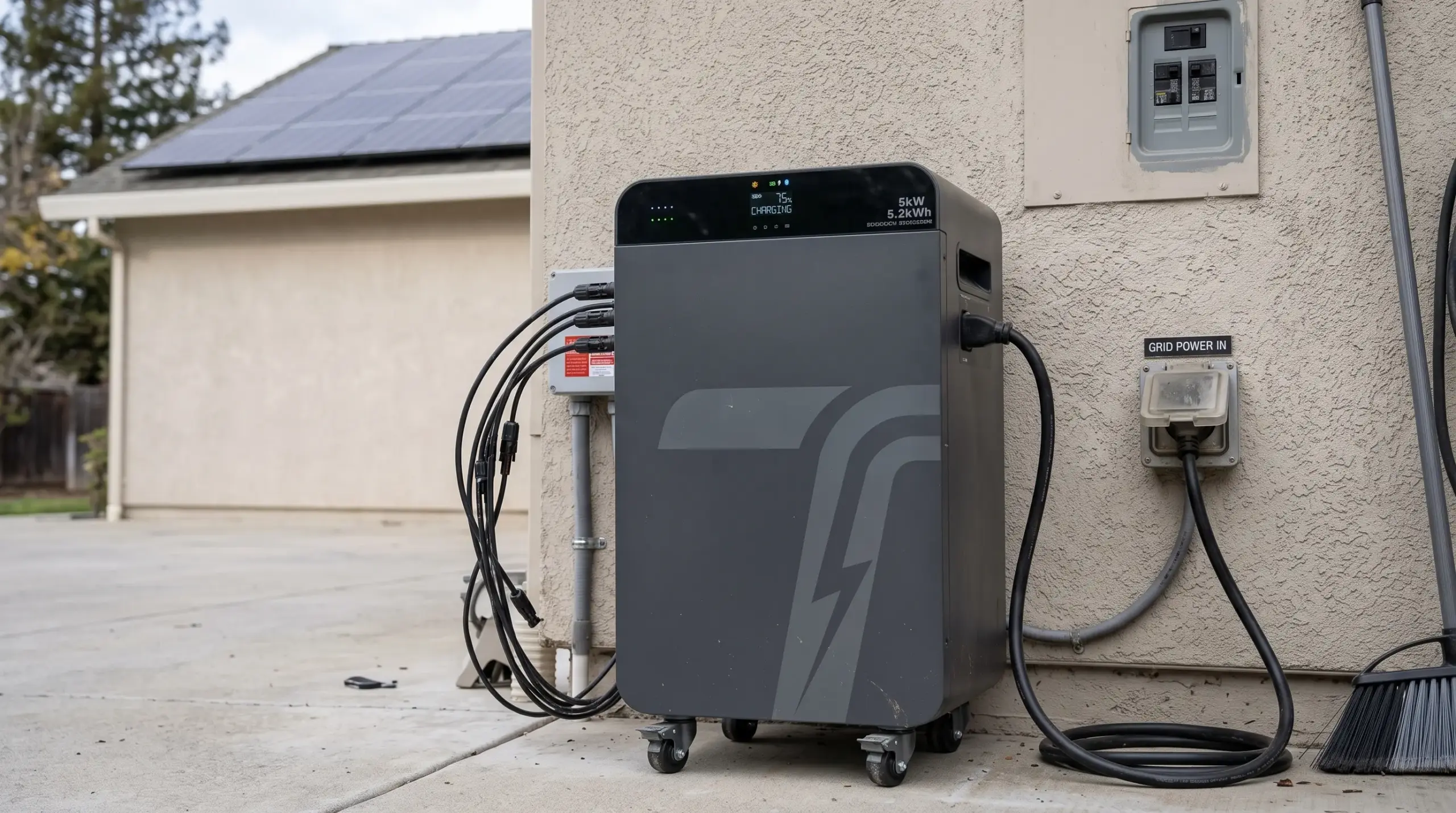
When a battery label says 51.2V, many installers expect the pack to stop at 51.2V after charging. That number is the nominal voltage, not the charging limit. For a standard 51.2V lithium iron phosphate battery, the full-charge voltage is usually 58.4V.
This distinction matters when you select an inverter, set charging parameters, or check whether a new battery is working correctly. A voltage reading near 51.2V can be normal during operation, while a reading close to 58.4V usually indicates that the pack has reached the top of its charging window.
The full-charge voltage comes from 16 LiFePO4 cells
Most 51.2V batteries use 16 LiFePO4 cells in series, often called a 16S battery. Each cell has a nominal voltage of 3.2V, so the pack rating is calculated as:
At the upper charging limit, each cell reaches about 3.65V. The pack therefore reaches:
The battery management system, or BMS, monitors every cell group rather than relying only on the total pack voltage. It can stop charging when one cell reaches its configured limit, even if the pack voltage has not settled exactly at 58.4V. A quality 16S BMS also balances cell groups near the top of charge and protects against overvoltage, excessive current, and high temperature.
In practical systems, the charger may hold the battery at 56.8V to 58.4V depending on the battery manufacturer’s settings. Some manufacturers choose a lower absorption voltage to reduce stress and extend cycle life. Always use the battery datasheet instead of copying a generic 58.4V value into an inverter.
Nominal voltage and measured voltage are different
LiFePO4 voltage stays relatively flat through much of its state-of-charge range. That makes voltage alone a weak fuel gauge. A 51.2V battery might show approximately 52V to 54V during much of its usable discharge range, then rise toward 56V or higher near full charge. The exact reading changes with charging current, temperature, cable resistance, and the time elapsed after charging stops.
The following values are useful reference points for a typical 16S LiFePO4 pack, not universal set points:
| Battery condition | Approximate pack voltage | What the reading usually means |
|---|---|---|
| Nominal rating | 51.2V | Rated voltage based on 16 cells at 3.2V each |
| Resting voltage at medium charge | About 52V to 53.5V | Normal operating range with little load or charge |
| High state of charge | About 54V to 56V | The pack is approaching the upper part of its range |
| Full-charge target | Up to 58.4V | 16 cells at a typical 3.65V upper limit |
The table should not replace the charge profile supplied with the battery. For example, a system integrator may configure a lower daily charge target than the absolute cell limit when the application prioritizes service life over maximum stored energy.
What the inverter should be set to
For a conventional 51.2V LiFePO4 battery, the inverter or charger commonly uses a charging voltage between 56.8V and 58.4V, with the exact value defined by the battery OEM. The charger should also respect the recommended charge current. A 100Ah pack may accept 50A at a 0.5C rate, while another model may have a different limit because of its cells, busbars, thermal design, or BMS firmware.
Do not use a lead-acid charging profile without checking the battery manual. Equalization functions and prolonged high-voltage charging can trigger BMS protection or shorten cell life. If the battery communicates over CAN or RS485, use the approved inverter protocol so the BMS can report charge limits and temperature alarms dynamically.
Three charging profiles buyers commonly compare
The right full-charge setting depends on the battery design and the operating objective. These examples show why two batteries carrying the same 51.2V label can use different settings.

| Configuration | Typical upper voltage | Typical use | Main consideration |
|---|---|---|---|
| Standard 16S LiFePO4 | 58.4V | Maximum charge within the cell specification | Confirm that the BMS and charger share the same limit |
| Life-priority daily profile | 56.8V to 57.6V | Frequent cycling in home or commercial storage | Leaves a small top-of-charge margin to reduce high-voltage dwell time |
| Custom OEM profile | Set by the battery maker | Branded systems with a specified inverter and warranty | Match firmware, CAN or RS485 data, and warranty conditions |
An OEM or ODM supplier should provide the charge voltage, float recommendation if applicable, current limit, low-voltage cutoff, and communication map together. Sample units should be tested with the intended inverter before a larger production order. Label branding alone does not guarantee that the firmware settings match the battery chemistry.
Four common mistakes with 51.2V batteries
- Treating 51.2V as the full-charge voltage
This can cause an inverter to stop charging too early and leave usable capacity unavailable. Check the 16S charge profile instead. - Assuming every 51.2V battery must use 58.4V
58.4V is a common upper limit, but the manufacturer may specify a lower daily target. Follow the battery’s tested charge window. - Reading voltage while a large load is running
A compressor, inverter, or long cable can create voltage sag. Measure at the battery terminals and compare readings under similar load conditions. - Ignoring cell-level imbalance
A normal total voltage can hide one cell group that is already near its upper limit. Review BMS data when available, especially during commissioning and after a protection event.
FAQ
Not when the battery is a correctly configured 16S LiFePO4 pack and the manufacturer specifies 58.4V as its upper charging voltage. It becomes unsafe when the battery chemistry, cell count, BMS settings, or charger does not match. Never raise the charger limit to solve a capacity problem without checking the datasheet.
The charger may use a life-priority profile, the BMS may have ended charging after one cell reached its limit, or the voltage may have fallen after the charging current stopped. Check the charge settings and cell data before treating the reading as a fault.
Many batteries support parallel operation, but they must use compatible voltage windows, BMS communication rules, cable lengths, and protection devices. Equalize the batteries according to the supplier’s commissioning procedure and confirm the maximum parallel count before installation.
The practical answer
A standard 51.2V LiFePO4 battery normally reaches up to 58.4V when fully charged, because it uses 16 series-connected cells with a typical upper limit of 3.65V per cell. The battery may display a lower value in daily operation, and that can be intentional.
For a reliable installation, use the battery maker’s charge profile, verify the BMS settings, and test the pack with the actual inverter. If you are sourcing an OEM or ODM battery, send the target inverter model, daily load profile, desired charge strategy, and communication interface. The supplier can then return a compatible voltage and firmware configuration instead of a nominal number alone.