
Aquaculture is scaling fast. Shrimp ponds, fish cages, and recirculating farms are everywhere now, and they all need one thing: reliable power. Pumps, blowers, and paddlewheels don’t forgive downtime—if aeration stops in the middle of the night, you lose oxygen, and you lose stock. That’s why more farms are turning to LiFePO4 battery systems. And here’s the point: going with an OEM manufacturer isn’t just a procurement choice, it’s the only way to make sure those systems fit the hard realities of salt, water, and nonstop loads.

This essay walks through real aquaculture energy challenges, what LiFePO4 batteries solve, why OEM partnerships matter, and how suppliers like TURSAN step in with scalable, certified solutions.
Why Aeration Drives the Energy Bill
Anyone who’s run shrimp ponds knows aeration is the beast. Studies put energy use for mechanical aeration between 11–41 GJ per ton of shrimp, with averages near 20 GJ/ton. That’s not a rounding error—it’s the main line item. At night, when photosynthesis stops, dissolved oxygen (DO) levels crash. Once DO dips under 2 mg/L, you’re staring at serious mortality risk; over 4 mg/L is where growth and feed conversion really perform.
So, the need is blunt: nonstop aeration, especially during the high-risk night hours. And it’s not just “keep the blowers on.” Farms need tiered backup, fast switching, and energy-dense storage to bridge outages.
LiFePO4 Batteries: Why They Fit the Aquaculture Farms
Lead-acid used to be the default, but let’s be real—it’s not cutting it anymore. Here’s where LiFePO4 steps ahead:
- Cycle life: over 6000 charge-discharge cycles under shallow cycling.
- Thermal stability: safer structure, less chance of thermal runaway.
- Efficiency: lower losses, faster recharge.
- Weight & footprint: easier to integrate in mobile or floating setups.
That’s why farms in Asia, the Middle East, and Africa are dropping old batteries and moving to LiFePO4 suppliers who understand their scene.

Check TURSAN’s 12V 204Ah LiFePO4 battery —compact, long-life, designed for integration. Or the wall-mounted 12V 306Ah model , which makes sense in control sheds where floor space is tight.
Table: Where the Power Goes in Aquaculture
| System | Energy Demand | Risk if Power Fails | Why Batteries Matter |
|---|---|---|---|
| Paddlewheel aerators | 2–6 kW per unit | Oxygen crash in 30–60 min | Backup sizing must cover night cycle |
| Air blowers | 3–10 kW | Biofilters starve, ammonia spikes | Needs smooth switchover |
| Water circulation pumps | 1–5 kW | Dead zones in pond/tank | Lower but steady reserve |
| Lighting & feeders | <1 kW | Growth delay, less feed uptake | Minor but continuous load |
Why OEM Partnerships Matter in Aquaculture
Buying batteries from a random catalog doesn’t solve farm problems. Partnering with an OEM LiFePO4 battery manufacturer does. Here’s why:
- Certifications are baked in Aquaculture investors now ask for compliance—IEC 62619 for industrial cells, UL 1973 for system safety, UN38.3 for transport. A proper OEM delivers these upfront so you’re not stuck chasing paperwork.
- Harsh environment engineering Salt spray kills gear. OEM suppliers can ship IP67 housings and components tested under ASTM B117 salt fog. That’s not marketing fluff—it’s the difference between a 2-year headache and a 10-year asset.
- Integration with BMS and sensors Good OEM partners let BMS talk to DO sensors and VFD motors. That means when oxygen dips, the system automatically prioritizes aeration loads, not lights or feeders.
Real World Examples of LiFePO₄ in Aquaculture
Theory is fine, but let’s look at how farms are already using LiFePO₄ storage in practice:
Floating PV + Battery in the Philippines
In island provinces where diesel was once the only option, cooperatives began installing floating PV with LiFePO₄ banks for tilapia cages. The results: not only did the batteries keep blowers running at night, but the salt-resistant IP67 enclosures passed the six-month salt spray test with no major corrosion. Operators noted maintenance dropped dramatically compared to older lead-acid batteries that often failed after a season.
Pacific Island Demonstration Farm
A demonstration farm in the Pacific built a microgrid with PV + LiFePO₄ batteries for shrimp hatcheries. Before, they relied on unstable diesel supply. After the switch, the hatchery recorded zero DO crashes in 12 months, even with frequent island-wide blackouts. The case showed how storage is not just backup—it’s core to reliable food supply in remote, off-grid aquaculture.
Table: OEM Checklist for Aquaculture LiFePO4
| OEM Deliverable | Why It Matters | Example |
|---|---|---|
| IEC/UL/UN certificates | Smooth insurance & project approval | UL 1973 battery rack |
| IP67 housing & salt spray proof | Farm survival in coastal climate | Coated terminals, gasket enclosures |
| Flexible pack formats | Fit ponds, tanks, central sheds | Wall-mount vs. stacked |
| Integrated BMS with DO priority | Protects biomass value | Auto-switch load to aeration |
| EVT-DVT-PVT process | Guarantees repeat quality | Scaled orders, zero surprises |
OEM vs. Generic: The Risk Gap
Let’s be blunt. A wholesale LiFePO4 battery from an unknown brand may look cheap, but:
- No guarantee it’s tested for corrosion.
- Cycle life claims may not match reality.
- After-sales is a black hole—no replacement parts, no local consultant.
Partnering with an OEM LiFePO4 battery manufacturer means fewer variables. You don’t fight failures pond by pond. You get predictable performance.
How Farms Size Their Backup
One thing integrators always ask: “How many kWh do I really need?” OEMs can walk you through horsepower to kW to kWh sizing.
Say you’ve got two 3 hp paddlewheels. Real load ≈ 3.8 kW. You want six hours of cover. That’s ~22.8 kWh. Add efficiency losses, keep DoD at 80%, and you’re looking at ~30 kWh packs. An OEM like TURSAN can design that into a modular rack.
Where TURSAN Fits
TURSAN isn’t just a LiFePO4 battery supplier. They bring:
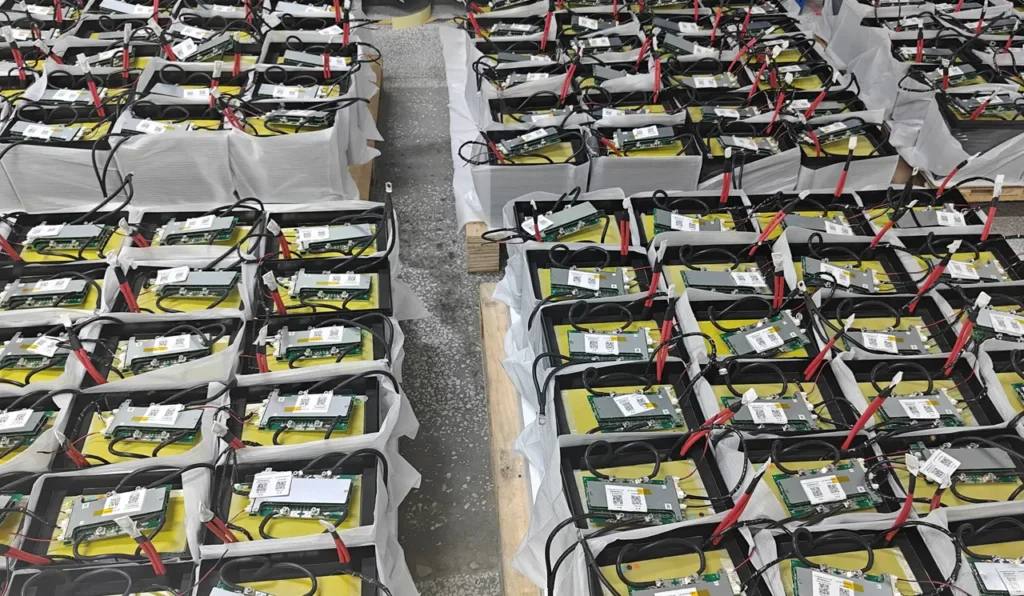
- BYD LiFePO4 core cells with GB/T and nail penetration testing.
- OEM/ODM options: plastic vs. sheet metal models, wall-mounted vs. rack stacked.
- Low MOQ for pilots (100 pcs), scaling to 15 production lines.
- One-stop service: English-speaking consultants, customs clearance, logistics.
If you’re comparing vendors, this is the kind of package that cuts project delays and reduces farm risk.
Check the 12V 102Ah wall-mounted LiFePO4 battery —practical for shed installs—or the larger 48V 300Ah home backup unit , which can handle multiple ponds together.
Business Value: Why B2B Buyers Care
For distributors and integrators, OEM LiFePO4 systems in aquaculture are not niche—they’re growth. Demand is global:
- Asia & Middle East: Shrimp and tilapia ponds, solar-diesel hybrids.
- Europe & Americas: RAS and off-grid hatcheries, higher certification needs.
- Africa: Remote operations, strong case for modular stacked batteries.
The wholesale LiFePO4 battery market ties into bigger trends: energy security, food supply, ESG compliance. When buyers see “Custom LiFePO4 Battery OEM/ODM,” they’re looking at futureproofing their entire supply chain.
Conclusion: Why Partner, Not Just Buy
Aquaculture isn’t forgiving. One blackout can undo months of work. By working with a LiFePO₄ battery supplier that understands both the chemistry and the farm’s rhythm, you get more than backup—you get peace of mind.
That’s the role of OEM partnerships: less guesswork, more uptime, better survival rates. Whether it’s a shrimp pond in Asia, a tilapia farm in Africa, or a high-tech RAS in Europe, custom LiFePO₄ battery systems keep the water moving and the oxygen steady.
And if you’re looking for a partner, TURSAN is already building for farms, factories, and energy distributors worldwide.


 English
  العربية
  日本語
日本語  한국어
한국어  Tiếng Việt
  ไทย
ไทย  Bahasa Melayu
  فارسی
فارسی  Bahasa Indonesia
  ဗမာစာ
ဗမာစာ  简体中文
简体中文  香港中文
香港中文  繁體中文
繁體中文  Русский
  Deutsch
  Nederlands
  Italiano
  Français
  Español
  Português
  Afrikaans
  Azərbaycan dili
  Български
  ਪੰਜਾਬੀ
  हिन्दी
  اردو
اردو  বাংলা
বাংলা  Հայերեն
  Íslenska
  Қазақ тілі
  नेपाली
  Српски језик
  Kiswahili
  తెలుగు
  Basa Jawa
  தமிழ்
தமிழ்  मराठी
मराठी