
Keeping frozen goods at the right temperature isn’t just about food safety. It’s about money. Cold chain operators know the electric bill hits harder than anything else. In many warehouses, refrigeration alone eats up 60–70% of total electricity use. Add demand charges, time-of-use rates, and fuel back-up costs, and you’ve got a real pain point.

That’s why more companies are looking at hybrid inverters — the brains that tie solar, batteries, and the grid into one smart system. Instead of wasting rooftop solar or running diesel gensets all day, hybrid inverters make every kilowatt count.
Why Energy Bills Hurt in Cold Chain
Refrigerated warehouses run 24/7. They can’t simply “switch off” compressors when the tariff jumps. But utilities don’t care. They bill you for two things:
- Kilowatt-hours (kWh) – how much you consume.
- Demand charges – your peak draw during a billing cycle.
Cold storage sites often get hammered on both. Compressors pull huge spikes at start-up. When summer peaks hit, utility demand fees explode. Even short peaks show up on the invoice for the whole month.
Add in unreliable grids in some regions, and operators are forced to install diesel gensets, which means more OPEX.
What Hybrid Inverters Actually Do
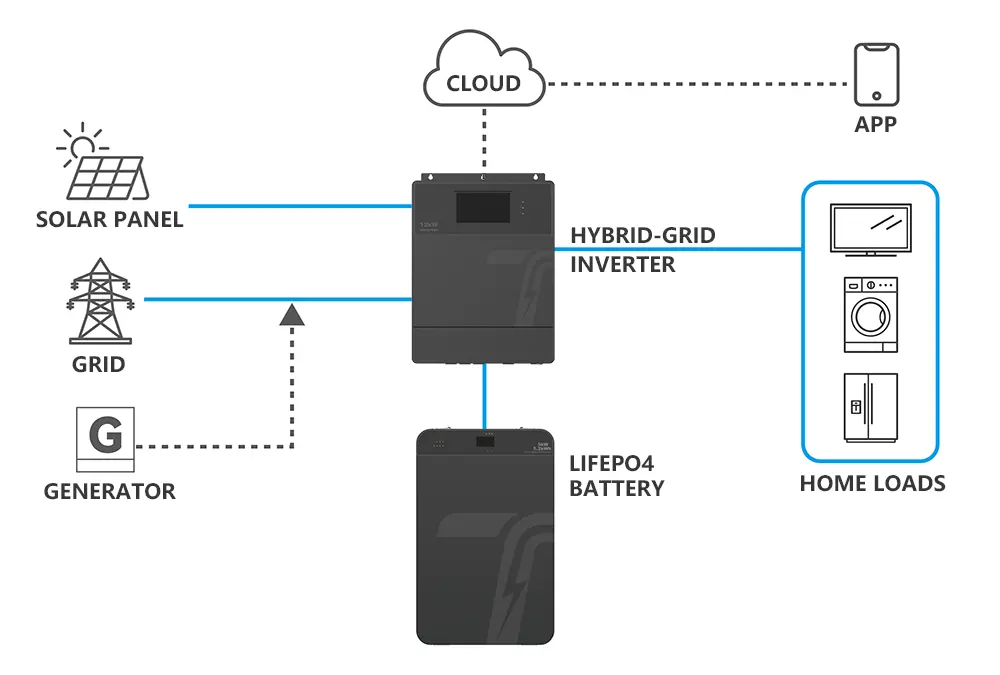
A hybrid inverter is more than a standard inverter. It connects solar panels, batteries, the grid, and even diesel generators. It decides, in real time, which source to pull from and where to send excess.
- On a sunny afternoon, it routes PV directly to compressors.
- At night, it discharges the battery bank to avoid peak tariffs.
- During a grid cut, it keeps freezers cold without diesel.
Think of it as an energy traffic cop. No human operator needed, no manual switchovers.
See specs here:
Data That Proves the Case
Here’s what recent studies and field projects show when hybrid inverters are paired with PV and batteries in cold chain settings:
| Strategy | Evidence from Case Studies | Impact |
|---|---|---|
| PV + Hybrid Inverter | Test system (4.5 kWp PV + 5 kW hybrid inverter + 600 Ah battery) delivered 70% of power from solar, covering 2 hours backup during outages. | Cuts grid draw, stabilizes compressor start-up. |
| Peak Shaving with Battery + Inverter | Refrigerated warehouses shifted 20–40% of load off peak hours using pre-cooling + storage. | Demand charges down, load profile flatter. |
| Thermal + Hybrid System | With thermal energy storage and inverter scheduling, sites cut 43% of peak kWh and 29% of peak demand for up to 13 hours. | Big drop in peak costs, stable temperature band. |
| Cold Truck Solar + Hybrid Charging | Adding PV to reefer trailers reduced diesel use by 0.09 gal/h, improved uptime, cut battery replacement. | Fuel savings, compliance with stricter air regs. |
This isn’t theory. These are live warehouses and fleets that cut bills by double-digit percentages.
Peak Shaving: The Hidden Gold
Ask any facility manager — demand charges are the silent killer. A short spike at 3 PM can add thousands to the invoice. Hybrid inverters, paired with lithium storage, tackle that head-on.
- Pre-cool at night when rates are low.
- Discharge battery during afternoon peaks.
- Clip compressor spikes by soft-starting loads.
This combo reduces exposure to the utility’s “needle peaks.” For operators in regions with $10–15/kW demand charges, savings stack up fast.
Cold Storage Load Shifting in Practice
Load shifting isn’t magic. It’s about knowing your facility’s thermal inertia. Frozen goods hold temperature for hours if you pre-cool properly. Hybrid inverters make the timing possible.
- They charge batteries at night when tariffs drop.
- They trigger discharge exactly when load hits the red zone.
- They integrate with building management systems (BMS) to stagger fans, pumps, and compressors.
In industry black talk, that’s called “dispatchable cold” — treating stored cooling as a resource.
Reefer Trailers and Solar Hybrids
Cold chain doesn’t stop at the warehouse. Reefer trucks burn diesel just to keep loads cool, even when parked. That fuel bill stacks up.

By adding small PV panels on the trailer roof and linking to a hybrid charging system:
- Diesel use fell by 0.09 gal/h
- Battery replacements were fewer
- Compliance with “no idling” and CARB clean-air regs improved
For fleet operators, that’s not just fuel savings — it’s regulatory insurance.
Where Business Value Shows Up
Hybrid inverters deliver value in three buckets:
- Lower bills – Less grid kWh, fewer demand spikes.
- Grid stability – Ride through outages without spoilage.
- Sustainability – Less diesel, lower Scope 2 emissions, better ESG reports.
For operators chasing export certifications or carbon targets, these points matter.
Choosing the Right Inverter Supplier
Here’s the trap: not every inverter on the market is built for 24/7 cold chain duty. You need:
- Pure sine wave output for sensitive compressor motors.
- Multi-protection BMS to keep LiFePO₄ packs safe.
- OEM/ODM flexibility if you want custom inverter specs.
- Fast lead times for project roll-outs.

That’s why global buyers look at TURSAN as both Inverter Supplier and Inverter Manufacturer. With OEM/ODM support, low MOQs, and production lines ready for B2B projects, it’s not just about hardware, it’s about trade and logistics services.
Explore options here: Custom Inverter OEM/ODM
Table: Cold Chain Pain Points vs. Hybrid Inverter Fix
| Pain Point | Industry Talk | Hybrid Inverter Fix |
|---|---|---|
| High demand charges | “needle peaks” | Battery discharge + load staggering |
| Rising tariffs | TOU penalty | Pre-cool off-peak, shift loads |
| Outages | Grid unreliability | Auto switch to battery/diesel |
| Diesel OPEX | Genset over-run | Solar + LiFePO₄ storage |
| Compliance pressure | Scope 2/air regs | Lower emissions footprint |
Real World Examples of Hybrid Inverters in Cold Chain
California Cold Storage Microgrid
In California, have a cold storage project combined solar PV, battery storage, and hybrid inverters into a microgrid design. The goal was twofold: lower the energy bill and keep operations stable in the face of California’s frequent grid outages. The microgrid provided resilience for blast freezers and packing lines, while shaving peaks that previously drove up demand charges. Operators highlighted that the inverter’s control system made the transition between grid, solar, and battery seamless.
Refrigeration Solution Case Study 2
Another case also comes from the United States, which integrated thermal energy storage with hybrid inverter systems in a U.S. warehouse. Results were clear: energy consumption dropped by 43% and peak demand fell by 29%. Hybrid inverters coordinated when the compressors ran and when batteries discharged, while thermal storage carried cooling loads into high-tariff evening hours. This combination showed how cold storage can cut costs without compromising food safety.

These real cases give credibility and show measurable outcomes. They prove hybrid inverters aren’t just theory — they’re already cutting energy costs and boosting resilience in cold chain logistics worldwide.
Final Word
Hybrid inverters are not just gadgets; they’re strategic tools for an industry under margin pressure. They make solar and storage practical in cold logistics, shave peaks that wreck bills, and give resilience when grids fail. From reefer trucks to mega-warehouses, the playbook is clear: route every cheap electron through the hybrid inverter before the meter spins.
If you’re sourcing for your next facility upgrade, look for an Inverter Supplier , who understands both the electrical specs and the B2B business pain points. With proven BYD LiFePO₄ packs, custom inverter options, and wholesale supply routes to over 30 countries, TURSAN
delivers not just gear, but project certainty.


 English
  العربية
  日本語
日本語  한국어
한국어  Tiếng Việt
  ไทย
ไทย  Bahasa Melayu
  فارسی
فارسی  Bahasa Indonesia
  ဗမာစာ
ဗမာစာ  简体中文
简体中文  香港中文
香港中文  繁體中文
繁體中文  Русский
  Deutsch
  Nederlands
  Italiano
  Français
  Español
  Português
  Afrikaans
  Azərbaycan dili
  Български
  ਪੰਜਾਬੀ
  हिन्दी
  اردو
اردو  বাংলা
বাংলা  Հայերեն
  Íslenska
  Қазақ тілі
  नेपाली
  Српски језик
  Kiswahili
  తెలుగు
  Basa Jawa
  தமிழ்
தமிழ்  मराठी
मराठी