
No Pumps, No Pressure, No Safe Water. Household Needs, Fire Safety, Garden Irrigation—All Depend on That Invisible Flow. That’s Why Homeowners and Installers Worldwide Are Turning to Home Battery Backup Systems. Buying in Bulk Makes Sense: You Cut Costs, Scale Quickly, and Meet Strict Uptime Demands.
This article breaks down why wholesale LiFePO₄ backup systems are gaining traction in residential water supply. We’ll examine reliability, cost, system design, policy drivers, and risk management—backed by real-world data and case comparisons. Configuration tables are included.
Resilience and Redundancy in Household Water Pumping
When a grid outage hits a home water system, every minute counts. Traditional diesel generators are cumbersome: they require fuel storage, produce high emissions, and start slowly. A Home Battery Backup kicks in instantly—no lag, no fumes.
Key resilience points:
- Instant switchover: Keeps critical pumps running during grid failure, preventing pressure drops and water interruption.
- Scalable runtime: Stacking 48V units like the 28.67kWh 48V560Ah Home Backup Battery provides hours of stable power.
- Grid-tie capability: Hybrid inverters allow pumps to draw power from both the battery and the grid during demand spikes.
Households in areas prone to hurricanes, wildfires, or rolling blackouts are especially interested. For them, resilience isn’t a buzzword—it’s a necessity.

Cost–Benefit and ROI Analysis
No one invests just for peace of mind. Homeowners want to see the numbers. While each household has different electricity rates and outage histories, studies clearly demonstrate savings:
| Factor | Battery Backup | Diesel Generator |
|---|---|---|
| Start-up response | Instant | 10–60 sec delay |
| Fuel / OpEx | Minimal (solar optional) | High, recurring |
| Maintenance | Low, modular replacement | High, regular professional servicing |
| Emissions | Zero on-site | CO₂, NOx, noise |
| ROI driver | Lower peak rates + avoided water outage | Rarely saves money |
Instead of one large battery bank, you can now deploy distributed “home-class” units in bulk. It’s cheaper per kWh, easier to maintain, and faster to ship. A Wholesale Home Battery Backup order from a reliable Home Battery Backup Manufacturer like TURSAN ships in weeks, not years.
System Design and Integration
Design isn’t just about “adding more batteries.” Water pumps draw significant power with fluctuating demand. Key considerations include:
- Voltage and current: Pairing 24V and 48V modules like the 7.68kWh 24V300Ah Backup Battery with 10–20 kW hybrid inverters.
- Stacking options: Using 10kW solar-compatible stacked lithium battery units for modular scaling.
- Household water demand: Backup systems must cover not only average usage but also surges from multiple faucets, irrigation, or pool pumps.
- Thermal management: LiFePO₄ packs with BYD-grade cells, like those used by TURSAN, handle deep cycles without overheating.
Good design integrates with a remote BMS (Battery Management System), providing users with real-time status monitoring, alerts, and simple maintenance cues.
Policy Drivers and Industry Standards
Household decisions are also influenced by policies and incentives:
- Government incentives: Many regions offer rebates or tax credits for installing solar + storage to enhance energy resilience and meet carbon neutrality goals.
- Insurance benefits: Some insurers offer premium discounts for homes with backup power, reducing the risk of property damage from water outages.
- Certifications & safety: Systems like TURSAN’s BYD LiFePO₄ meet safety standards such as GB/T 31485–2015 and GB 31241–2014 nail penetration tests. These safety marks are crucial for home installations.
For installers, sourcing from a certified Home Battery Backup Supplier reduces project delays—no retesting, no compliance issues.
Water Tank Expansion vs. Battery Backup
Homeowners often ask: “Why not just build a larger water tank instead of using batteries?”
The answer is balance. Tanks store water, not electricity. They help with short-term municipal pressure drops but can’t supply power during nighttime outages or pump operation. Batteries provide dynamic power control.
| Storage Mode | Pros | Cons |
|---|---|---|
| Water Tank | Low-tech, low maintenance | Requires space; can’t power pump or controls |
| Battery Backup | Flexible, scalable, powers all loads | Higher upfront CAPEX |
Homes with limited space (e.g., small yards) can’t easily expand tank volume. Batteries are often the more practical option.

Risks, Challenges, and Mitigation
No system is perfect. Batteries also come with risks:
- Cycle life: Frequent deep discharge shortens lifespan. LiFePO₄ chemistry helps but isn’t infinite.
- Temperature: Extreme heat or cold reduces performance. Proper ventilation or temperature control is necessary.
- Upfront investment: While wholesale pricing lowers unit cost, budgets must cover installation and smart inverters.
This is where B2B deals shine. Wholesale Home Battery Backup orders spread costs across multiple projects, simplify logistics, and give integrators leverage for after-sales support. TURSAN offers OEM/ODM options for utilities or large installers needing custom rack designs.
Case Examples from Global Markets
Suburban Home, Europe:
A household relying on well water integrated a wholesale 48V LiFePO₄ backup system. During a week-long heatwave that caused rolling blackouts, the pumps stayed online. The family avoided water shortages.
Coastal Residence, Americas:
After repeated hurricane-season outages, the homeowner bulk-ordered stacked 10kW lithium modules. When a Category-4 storm hit, the batteries powered the water pump for over 9 hours until grid restoration. This marked the region’s first “diesel-free emergency water supply.”
Urban Townhouse, Asia:
Facing rapid demand growth and frequent peak-load failures, the property installed multiple 24V and 48V modular battery packs. The system reduced peak electricity costs and ensured reliable nighttime water supply. Users praised the easy swap-out design and low maintenance.
These aren’t isolated experiments—they reflect a growing trend of bulk procurement and application.
Business Value for Installers & Distributors
Why should EPCs, distributors, or integrators care? Because this market is scaling. Wholesale procurement means:
- Lower landed cost: OEM/ODM bulk pricing beats one-off orders.
- Shorter lead times: Samples ship in 2 days; bulk orders in ~25 days from TURSAN’s factories.
- Flexibility: Distributors can resell to homeowners or bundle into full smart home upgrade packages.
- Support: Technical consulting, logistics assistance, and English-speaking engineers smooth cross-border trade.
For a Custom Home Battery Backup, buyers want more than a product—they want a partner who knows how to scale and certify.
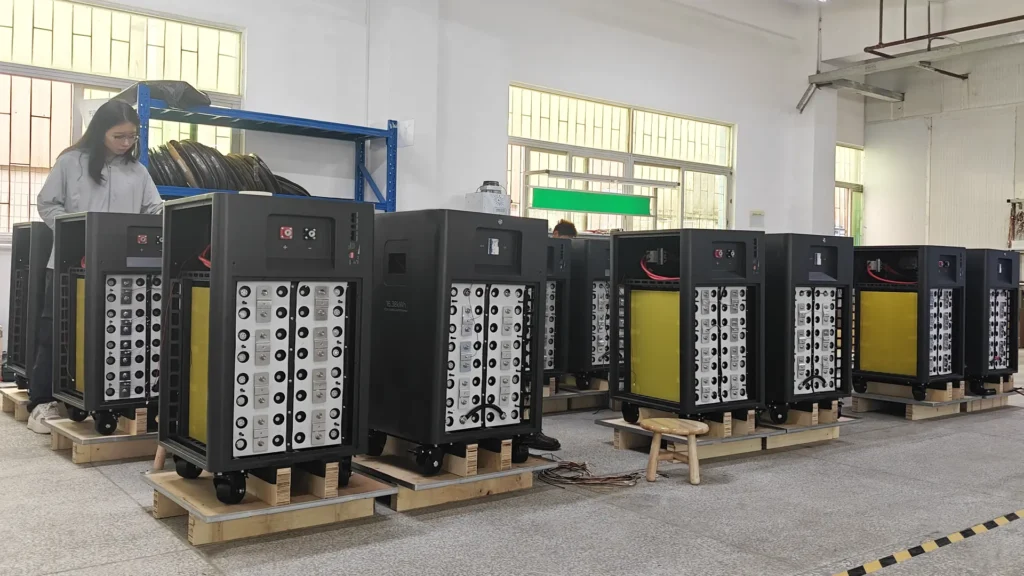
Recommended Configurations for Water Pump Systems
Based on industry data and real-world deployments, here are practical setup suggestions:
| Application Scenario | Recommended Battery Configuration | Target Runtime |
|---|---|---|
| Small Home/Villa | 24V200Ah or 48V200Ah unit + 5-10kW hybrid inverter | 2–4 hours |
| Medium Home (with pool/irrigation) | Stacked 10–20kW lithium modules + 48V350Ah packs | 4–6 hours |
| Large Estate/Multi-family Home | Bulk 48V560Ah units, modular racks, smart BMS integration | 6–12 hours |
Actual runtime depends on discharge depth, inverter sizing, and pump load profile. But the principle holds: stacking “home-class” batteries in wholesale lots makes household water systems highly resilient.
Conclusion: Why Wholesale Makes Sense
Household water systems can’t afford the risk of downtime. Wholesale Home Battery Backup solutions provide instant response, clean operation, and scalable runtime. Compared to diesel generators or simply expanding water tanks, they offer flexibility and compliance advantages.
For installers and distributors, the path is clear: partner with a Home Battery Backup Manufacturer that delivers certified LiFePO₄ systems, OEM/ODM flexibility, and global logistics. TURSAN checks all these boxes.
When the next blackout hits, the household water pump won’t stop. That’s the real value delivered.


 English
  العربية
  日本語
日本語  한국어
한국어  Tiếng Việt
  ไทย
ไทย  Bahasa Melayu
  فارسی
فارسی  Bahasa Indonesia
  ဗမာစာ
ဗမာစာ  简体中文
简体中文  香港中文
香港中文  繁體中文
繁體中文  Русский
  Deutsch
  Nederlands
  Italiano
  Français
  Español
  Português
  Afrikaans
  Azərbaycan dili
  Български
  ਪੰਜਾਬੀ
  हिन्दी
  اردو
اردو  বাংলা
বাংলা  Հայերեն
  Íslenska
  Қазақ тілі
  नेपाली
  Српски језик
  Kiswahili
  తెలుగు
  Basa Jawa
  தமிழ்
தமிழ்  मराठी
मराठी