 Kiswahili
  English
  العربية
  日本語
日本語  한국어
한국어  Tiếng Việt
  ไทย
ไทย  Bahasa Melayu
  فارسی
فارسی  Bahasa Indonesia
  ဗမာစာ
ဗမာစာ  简体中文
简体中文  香港中文
香港中文  繁體中文
繁體中文  Русский
  Deutsch
  Nederlands
  Italiano
  Français
  Español
  Português
  Afrikaans
  Azərbaycan dili
  Български
  ਪੰਜਾਬੀ
  हिन्दी
  اردو
اردو  বাংলা
বাংলা  Հայերեն
  Íslenska
  Қазақ тілі
  नेपाली
  Српски језик
  తెలుగు
  Basa Jawa
  தமிழ்
தமிழ்  मराठी
मराठी Nini Kiwango cha Kupunguza (DOD) na kwa nini kinamua uhakika wa betri yako
Msimamizi wa ununuzi katika Kenya analinganisha mawili betri za ukuta za 10 kWh for the same installer network. One datasheet promises 6,000 cycles at 80% DOD. The other promises 4,000 cycles at 100% DOD. Both brands claim to be “the longest-lasting battery on the market.” The manager has no idea which one actually lasts longer, because the answer is hiding inside a three-letter abbreviation neither sales rep bothered to explain.
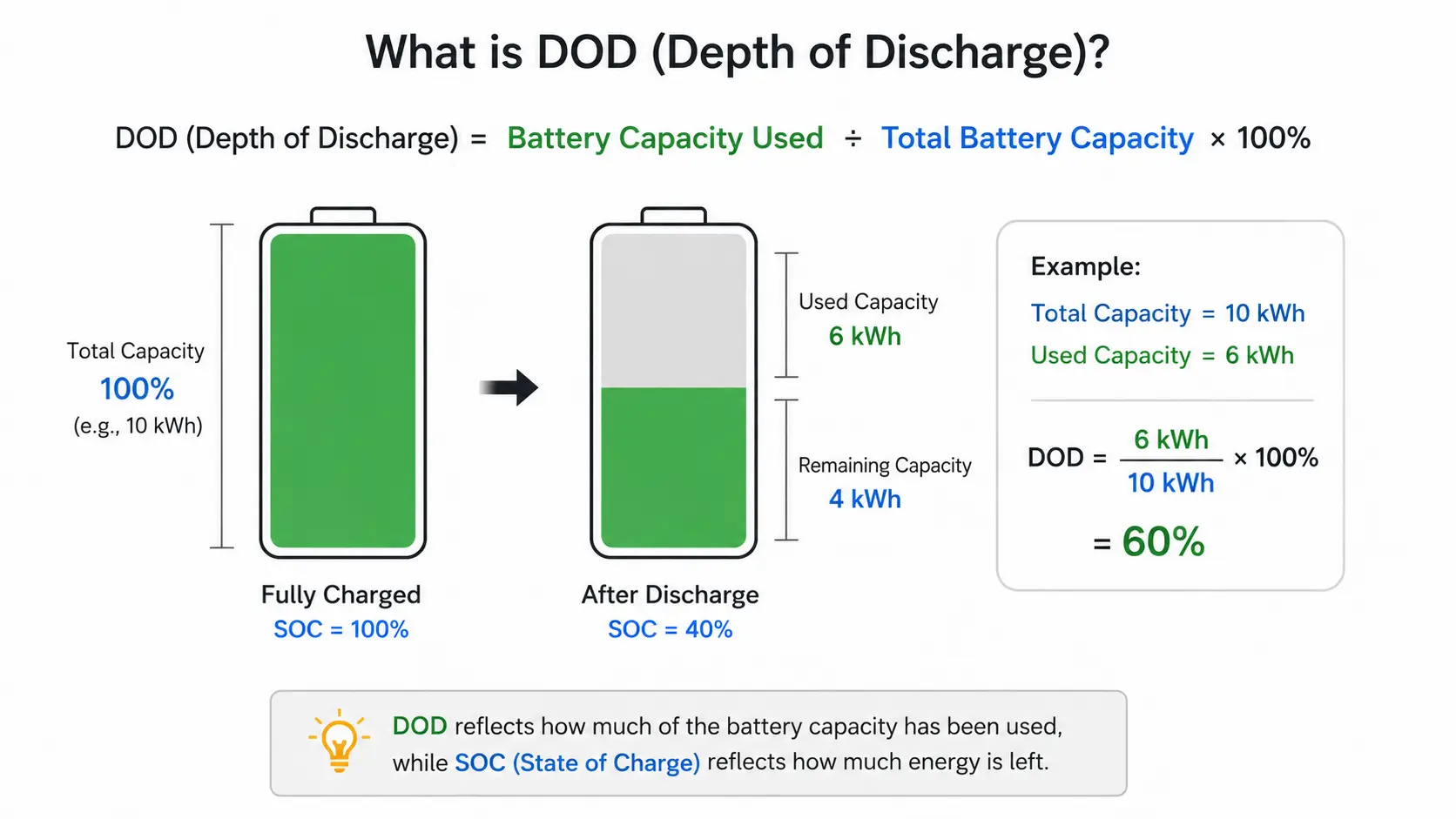
Depth of discharge – DOD – is the percentage of a battery’s stored energy you use before recharging it. Discharge a 10 kWh pack down to 5 kWh remaining and you’ve used 50% DOD. Run it until the BMS cuts off and you’ve hit 100% DOD. It sounds like a definition, but it’s actually the single most important number on the datasheet, because it sets the cycle life, the usable capacity and the warranty terms all at once.
Makala hii inaelezea nini DOD kweli ni, inakupa nambari zinazoamua unapaswa kutoa umeme kiasi gani, na inaonyesha jinsi mshirika wa OEM/ODM wa kweli anavyotumia DOD kutunga betri kwa soko lako.
Nambari inayoweka Uhai wa Mzunguko – Jinsi DOD inavyofanya kazi kwenye ngazi ya seli
DOD na hali ya kupokea malipo (SOC) ni pande mbili za sarafu hiyo hiyo. Betri yenye SOC ya 30% imeachiliwa hadi DOD ya 70%. BMS inafuatilia zote mbili, lakini ile inayohusika kwa uhai ni DOD, kwa sababu kila mzunguko wa discharges unaachunguza kemia ya seli kidogo, na discharges kwa kina zaidi zinaiweka kwenye hatari zaidi.
Take a grade-A LFP prismatic cell with a 3.2V nominal voltage and a 2.5–3.65V operating window. Discharging to 2.5V per cell is 100% DOD. At 0.5C and 25°C, that cell typically delivers 4,000–6,000 cycles before it drops to 80% of original capacity. Now limit the same cell to 80% DOD – stop at 3.2V instead of 2.5V – and the cycle count climbs to roughly 6,000–8,000. Cut it to 50% DOD and you’re looking at 10,000 cycles or more.
You’ll also notice how close 3.25V and 3.2V are. The LFP discharge curve is so flat between 3.3V and 3.2V that voltage alone can’t tell you the DOD – which is why the BMS counts coulombs instead of just watching voltage. A cheap BMS that guesses DOD from voltage will drift, and the drift shows up as premature cutoffs or over-discharge in the field.

Here’s the counter-intuitive part. A 10 kWh pack cycled at 100% DOD for 5,000 cycles delivers about 50,000 kWh over its life. The same pack cycled at 50% DOD for 12,000 cycles delivers 60,000 kWh – 20% more total energy from the same hardware, just by discharging it half as deep each time. Depth of discharge doesn’t just change how many cycles you get; it changes how much total energy the pack will ever move.
That’s why the two datasheets in the opening can’t be compared directly. 6,000 cycles at 80% DOD and 4,000 cycles at 100% DOD are the same cell, tested under different rules. The first battery will actually deliver more total kilowatt-hours over its life.
Nini mshirika halisi wa OEM/ODM afanya na DOD
Kampuni ya biashara inachapisha chochote namba ya DOD ambayo muuzaji wa seli alitoa. mtengenezaji anachukulia DOD kama uamuzi wa muundo, kwa sababu ni mmoja.
The DOD limit lives in the BMS firmware, not in the hardware. A genuine OEM/ODM partner will set the discharge cutoff voltage to match your market – 2.5V per cell for a 100% DOD product aimed at backup power, 3.2V for an 80% DOD product aimed at daily self-consumption – and they’ll tune the low-voltage warning thresholds to match. The same pack, the same cells, two different products, separated by a firmware parameter.
They’ll also align the warranty with the DOD setting. A serious manufacturer writes the warranty as a set of conditions – for example, 10 years or 6,000 cycles at 80% DOD, 0.5C, 25°C ambient – and they’ll tell you exactly what happens to the warranty if your installers run the pack deeper. If your market needs 100% DOD, they’ll spec a larger pack so the customer still gets the usable kilowatt-hours they paid for, instead of quietly voiding the warranty.
And they’ll handle the white-label side without blinking: your brand on the label, your connector variant, your firmware defaults, MOQ flexibility and sample lead times measured in weeks, not quarters. DOD is one of the parameters you get to own when you work with the factory directly.
50% vs 80% vs 100% DOD – Meza ya Uamuzi
Hapa kuna kulinganisha muhimu kwa pakiti ya nyumbani ya 10 kWh LFP, kwa seli za daraja-A katika 0.5C na 25°C.
| Vipimo | 50% DOD | 80% DOD | DOD ya 100% |
|---|---|---|---|
| Uwezo unaotumika kwa kila mzunguko | 5 kWh | 8 kWh | 10 kWh |
| Maisha ya kawaida ya mzunguko hadi 80% | 10,000+ | 6,000–8,000 | 4,000–6,000 |
| Mzunguko wa nishati ya maisha | ~60,000 kWh | ~56,000 kWh | ~50,000 kWh |
| Kuhifadhi toka kwa seli kwa njia ya uhamisho | ~3.25V | ~3.2V | 2.5V |
| Inafaa zaidi | Dhamini ya gridi, umeme mdogo kwa upesi | Mtumiaji wa nishati ya siku moja | Nje ya gridi, matumizi ya usiku mzima |
| Nafasi ya udhamini | Ndefu zaidi, rahisi kuheshimu | Kawaida | Fupi zaidi, requires larger pack |

Mfano ni wazi. Uchimbaji wa kina zaidi hukupa nishati inayoweza kutumika kwa kila mzunguko lakini mizunguko iko kidogo na jumla ya nishati katika maisha ya kifurushi ni ndogo zaidi. Uchimbaji wa ufupi zaidi huongeza udhamini lakini huharibu uwezo uliolipiwa. Kwa masoko ya makazi mengi, 80–90% DOD ni mahali pa tamu – na ndiyo maana watengenezaji wakali zaidi wanasafirisha bidhaa zao za uhifadhi wa nyumbani na DOD ya 80% au 90% kama chaguo msingi.
Njia Nne DOD Inakosea katika Uwanja
- Moja – Ukuaji wa mzunguko ukilinganisha bila DOD. Wa 6,000-mzunguko kwa DOD ya 80% na wa 4,000-mzunguko kwa DOD ya 100% huonyesha seli ile ile. Hitaji DOD, Kiwango cha C na joto nyuma ya kila nambari ya mzunguko, vinginevyo kulinganisha hakina maana.
- Mbili – Kutumia tabia za lead-acid kwa lithiamu. Betri za umeme za lithiamu-zinazalisha hupoteza nguvu haraka chini ya 50% DOD, ndicho sababu wapanaji wa asili wa zamani hutoa saizi za benki za risasi kwa uwezo wa matumizi mara mbili. LFP inashughulikia 80–100% DOD kwa kawaida. Ikiwa wapatishaji wako bado wanapima lithiamu kama betri ya kaboni, wanauza wateja betri mara mbili kuliko wanahitaji.
- Tatu – Kuharibu uwezo unaotumiwa na ule wa nominal. Pakiti ya 10 kWh katika 80% DOD inawasilisha 8 kWh kwa kila mzunguko, si 10. Ikiwa mzigo wa kila siku wa mteja ni 9 kWh, pakiti itafikia kikomo kila usiku na BMS italieleza. Taina pakiti kwa mzigo kwenye DOD unayokusudia kuendesha.
- Nne – Kupuuza DOD katika masharti ya udhamini. Baadhi ya udhamini huharibu kwa 80% DOD na kwa siri huathiri ikiwa pakiti inakwenda chini zaidi. Soma masharti ya udhamini kabla ya kutoa wateja maisha ya mzunguko, na uthibitisha mipangilio ya DOD kwa maandishi.
Maswali Wateja Huuliza Kuhusu DOD
Weka DOD ambayo Soko Lako Linaitaji Kweli
Kiwango cha uklavu si kiashirio cha kukatwa. Ni nambari inayoweka maisha ya mzunguko wako, uwezo unaoweza kutumika na upingaji wa dhamana katika mstari mmoja. Ikiwa utakaa sahihi, unauza betri inayotoa kile datasheet inaleta ahadi. Ikiwa utakosea, unakuwa unakabiliwa na madai ya dhamana katika mwaka wa tatu.
If you’re sourcing residential storage at volume, send us your daily load profile, your target warranty period and your market’s peak ambient temperature, and we’ll return a DOD recommendation with the cycle-life test conditions and warranty terms named in full within 24 hours.