 한국어
한국어  English
  العربية
  日本語
日本語  Tiếng Việt
  ไทย
ไทย  Bahasa Melayu
  فارسی
فارسی  Bahasa Indonesia
  ဗမာစာ
ဗမာစာ  简体中文
简体中文  香港中文
香港中文  繁體中文
繁體中文  Русский
  Deutsch
  Nederlands
  Italiano
  Français
  Español
  Português
  Afrikaans
  Azərbaycan dili
  Български
  ਪੰਜਾਬੀ
  हिन्दी
  اردو
اردو  বাংলা
বাংলা  Հայերեն
  Íslenska
  Қазақ тілі
  नेपाली
  Српски језик
  Kiswahili
  తెలుగు
  Basa Jawa
  தமிழ்
தமிழ்  मराठी
मराठी 방전 깊이(Depth of Discharge)란 무엇이며 이것이 배터리 보증을 결정하는 이유
남아프리카 공화국의 조달 관리자가 두 가지를 비교하고 있습니다 10 kWh 벽걸이형 배터리 for the same installer network. One datasheet promises 6,000 cycles at 80% DOD. The other promises 4,000 cycles at 100% DOD. Both brands claim to be “the longest-lasting battery on the market.” The manager has no idea which one actually lasts longer, because the answer is hiding inside a three-letter abbreviation neither sales rep bothered to explain.
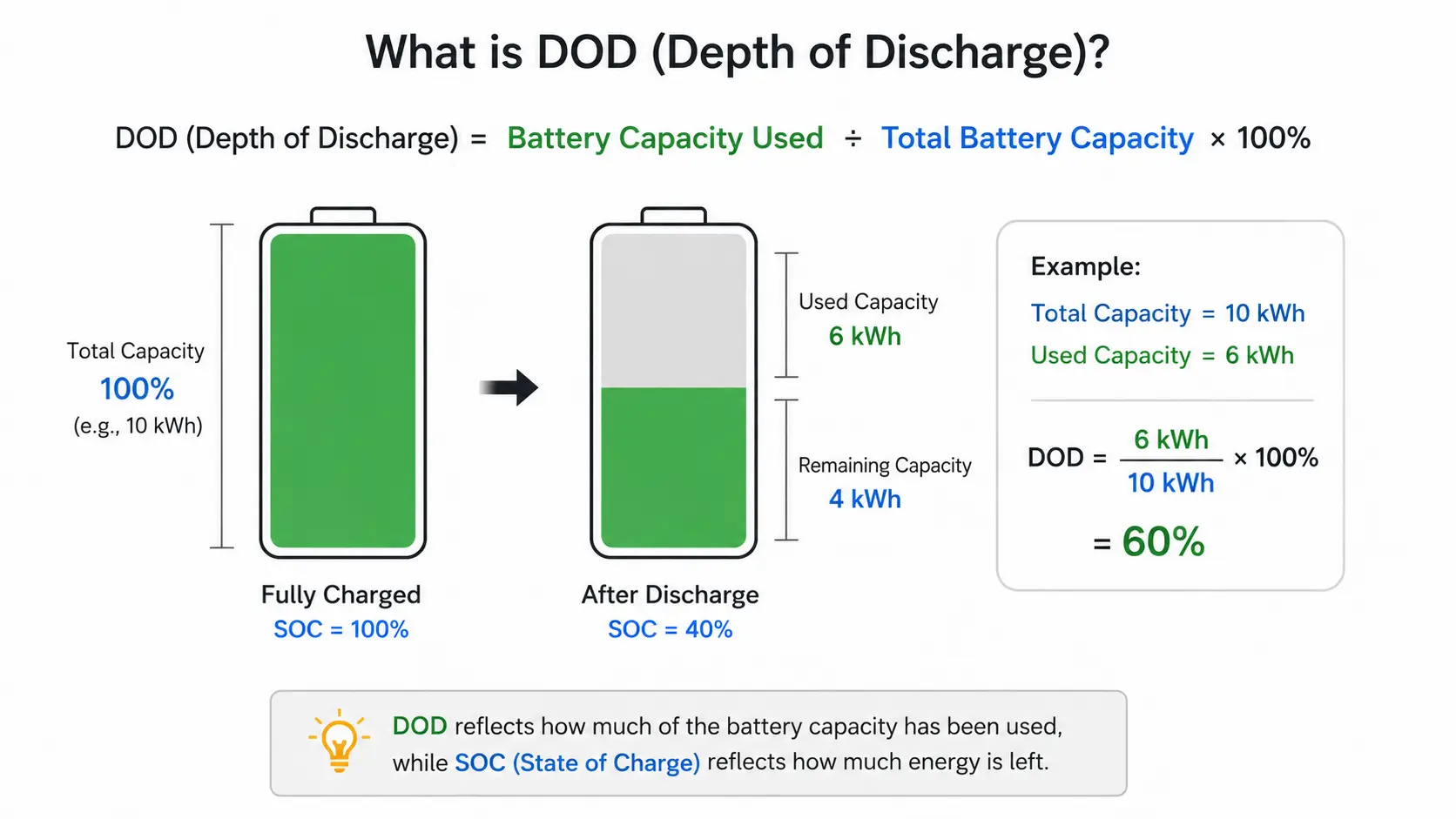
Depth of discharge – DOD – is the percentage of a battery’s stored energy you use before recharging it. Discharge a 10 kWh pack down to 5 kWh remaining and you’ve used 50% DOD. Run it until the BMS cuts off and you’ve hit 100% DOD. It sounds like a definition, but it’s actually the single most important number on the datasheet, because it sets the cycle life, the usable capacity and the warranty terms all at once.
이 글은 DOD가 실제로 무엇인지 설명하고, 얼마나 깊게 방전해야 하는지 결정하는 수치를 제시하며, 진지한 OEM/ODM 파트너가 DOD를 사용해 시장에 맞춰 배터리를 조정하는 방법을 보여줍니다.
주기를 결정하는 수치 – 셀 수준에서의 DOD 작동 방식
DOD와 충전 상태(SOC)는 같은 동전의 양면입니다. 30% SOC의 배터리는 70% DOD로 방전되었습니다. BMS는 둘 다 추적하지만, 수명이 중요한 것은 DOD이므로, 매 방전 사이클은 셀 화학의 손상을 조금씩 발생시키고, 더 깊은 방전일수록 손상이 더 빨리 진행됩니다.
Take a grade-A LFP prismatic cell with a 3.2V nominal voltage and a 2.5–3.65V operating window. Discharging to 2.5V per cell is 100% DOD. At 0.5C and 25°C, that cell typically delivers 4,000–6,000 cycles before it drops to 80% of original capacity. Now limit the same cell to 80% DOD – stop at 3.2V instead of 2.5V – and the cycle count climbs to roughly 6,000–8,000. Cut it to 50% DOD and you’re looking at 10,000 cycles or more.
You’ll also notice how close 3.25V and 3.2V are. The LFP discharge curve is so flat between 3.3V and 3.2V that voltage alone can’t tell you the DOD – which is why the BMS counts coulombs instead of just watching voltage. A cheap BMS that guesses DOD from voltage will drift, and the drift shows up as premature cutoffs or over-discharge in the field.

Here’s the counter-intuitive part. A 10 kWh pack cycled at 100% DOD for 5,000 cycles delivers about 50,000 kWh over its life. The same pack cycled at 50% DOD for 12,000 cycles delivers 60,000 kWh – 20% more total energy from the same hardware, just by discharging it half as deep each time. Depth of discharge doesn’t just change how many cycles you get; it changes how much total energy the pack will ever move.
That’s why the two datasheets in the opening can’t be compared directly. 6,000 cycles at 80% DOD and 4,000 cycles at 100% DOD are the same cell, tested under different rules. The first battery will actually deliver more total kilowatt-hours over its life.
실제 OEM/ODM 파트너가 DOD와 함께 하는 일
무역회사는 셀 공급자가 제공한 어떤 DOD 번호든 인쇄한다. 제조업체는 DOD를 하나의 설계 결정으로 간주한다, 왜냐하면 그것이 하나이기 때문이다.
The DOD limit lives in the BMS firmware, not in the hardware. A genuine OEM/ODM partner will set the discharge cutoff voltage to match your market – 2.5V per cell for a 100% DOD product aimed at backup power, 3.2V for an 80% DOD product aimed at daily self-consumption – and they’ll tune the low-voltage warning thresholds to match. The same pack, the same cells, two different products, separated by a firmware parameter.
They’ll also align the warranty with the DOD setting. A serious manufacturer writes the warranty as a set of conditions – for example, 10 years or 6,000 cycles at 80% DOD, 0.5C, 25°C ambient – and they’ll tell you exactly what happens to the warranty if your installers run the pack deeper. If your market needs 100% DOD, they’ll spec a larger pack so the customer still gets the usable kilowatt-hours they paid for, instead of quietly voiding the warranty.
And they’ll handle the white-label side without blinking: your brand on the label, your connector variant, your firmware defaults, MOQ flexibility and sample lead times measured in weeks, not quarters. DOD is one of the parameters you get to own when you work with the factory directly.
50% 대 80% 대 100% DOD – 의사결정 매트릭스
0.5C 및 25°C에서 등급-A 셀을 사용하는 10 kWh LFP 가정용 팩에 대해 중요한 비교는 여기 있습니다.
| 사양 | 50% DOD | 80% DOD | 100% DOD |
|---|---|---|---|
| 사이클당 사용 가능 용량 | 5kWh | 8kWh | 10kWh |
| 80%까지의 일반적인 사이클 수명 | 10,000+ | 6,000–8,000 | 4,000~6,000 |
| 평생 에너지 처리량 | ~60,000 kWh | ~56,000 kWh | ~50,000 kWh |
| 셀당 방전 한계 전압 | ~3.25V | ~3.2V | 2.5V |
| 가장 잘 맞는 | 그리드 백업, 드문 정전 | 일일 자체 소비 | 격리형, 완전 야간 사용 |
| 보증 위치 | 가장 길고, 가장 준수하게 이행 | 기준 | 가장 짧고, 더 큰 팩이 필요 |

패턴은 명확합니다. 가장 깊은 방전이 한 주기당 가장 많은 사용 가능 에너지를 제공하지만 주기를 가장 적게 수행하고 팩 수명 동안의 총 에너지는 가장 적습니다. 가장 얕은 방전은 보증을 연장하지만 지불한 용량을 낭비합니다. 대부분의 주거 시장에서 80–90/% DOD가 달콤한 지점이며, 이것이 바로 대부분의 진지한 제조업체가 가정 저장 제품을 80% 또는 90% DOD 기본으로 배송하는 이유입니다.
현장에서 DOD가 잘못 적용되는 네 가지 방법
- 하나 – DOD 없이 주기 수명만 비교하는 것. 80% DOD에서 6,000주기 주장과 100% DOD에서 4,000주기 주장은 같은 셀을 설명합니다. 모든 주기 수 뒤에 있는 DOD, C-속도 및 온도를 요구하십시오. 그렇지 않으면 비교는 의미가 없어집니다.
- 둘 – 납축전지 습관을 리튬에 적용하는 것. 납축전지는 50% DOD 이하에서 빨리 죽습니다. 이것이 구식 설치자들이 사용 가능 용량의 두 배로 납 배치를 크기 조정하는 이유입니다. LFP는 80–100% DOD를 일상적으로 처리합니다. 설치자가 여전히 리튬을 납처럼 크기 조정한다면, 고객에게 필요한 두 배의 배터리를 팔고 있는 겁니다.
- 셋 – 사용 가능 용량과 명목 용량을 혼동하는 것. 80% DOD의 10 kWh 팩은 매 주기 8 kWh를 제공합니다. 10 kWh가 아닙니다. 고객의 일일 부하가 9 kWh라면 매일 밤 컷오프에 도달하고 BMS가 이를 기록합니다. 실행하려는 DOD에서 부하에 맞춰 팩을 크기 조정하세요.
- 네 – 보증 조건에서 DOD를 무시합니다. 일부 보증은 80% DOD로 작성되며 팩의 깊이가 더 깊어지면 조용히 저하됩니다. 사이클 수명을 고객에게 인용하기 전에 보증 조건을 읽고, DOD 설정을 서면으로 확인받으십시오.
구매자가 묻는 DOD에 관한 질문
시장에 실제로 필요한 DOD를 설정하십시오
放電深度는 스펙을 대충 훑어봐서는 안 됩니다. 그것은 사이클 수명, 사용 가능한 용량, 보증 노출을 한 번에 좌지우지하는 수치입니다. 이를 정확히 파악하면 데이터시트가 약속하는 대로 성능을 제공하는 배터리를 판매하게 되고, 잘못 파악하면 3년 차에 보증 청구를 받게 됩니다.
If you’re sourcing residential storage at volume, send us your daily load profile, your target warranty period and your market’s peak ambient temperature, and we’ll return a DOD recommendation with the cycle-life test conditions and warranty terms named in full within 24 hours.