 Српски језик
  English
  العربية
  日本語
日本語  한국어
한국어  Tiếng Việt
  ไทย
ไทย  Bahasa Melayu
  فارسی
فارسی  Bahasa Indonesia
  ဗမာစာ
ဗမာစာ  简体中文
简体中文  香港中文
香港中文  繁體中文
繁體中文  Русский
  Deutsch
  Nederlands
  Italiano
  Français
  Español
  Português
  Afrikaans
  Azərbaycan dili
  Български
  ਪੰਜਾਬੀ
  हिन्दी
  اردو
اردو  বাংলা
বাংলা  Հայերեն
  Íslenska
  Қазақ тілі
  नेपाली
  Kiswahili
  తెలుగు
  Basa Jawa
  தமிழ்
தமிழ்  मराठी
मराठी Šta je Depth of Discharge (DOD) i zašto odlučuje o garanciji baterije
Istovarački menadžer u Južnoj Africi poredi dve 10 kWh baterije koje se montiraju na zid for the same installer network. One datasheet promises 6,000 cycles at 80% DOD. The other promises 4,000 cycles at 100% DOD. Both brands claim to be “the longest-lasting battery on the market.” The manager has no idea which one actually lasts longer, because the answer is hiding inside a three-letter abbreviation neither sales rep bothered to explain.
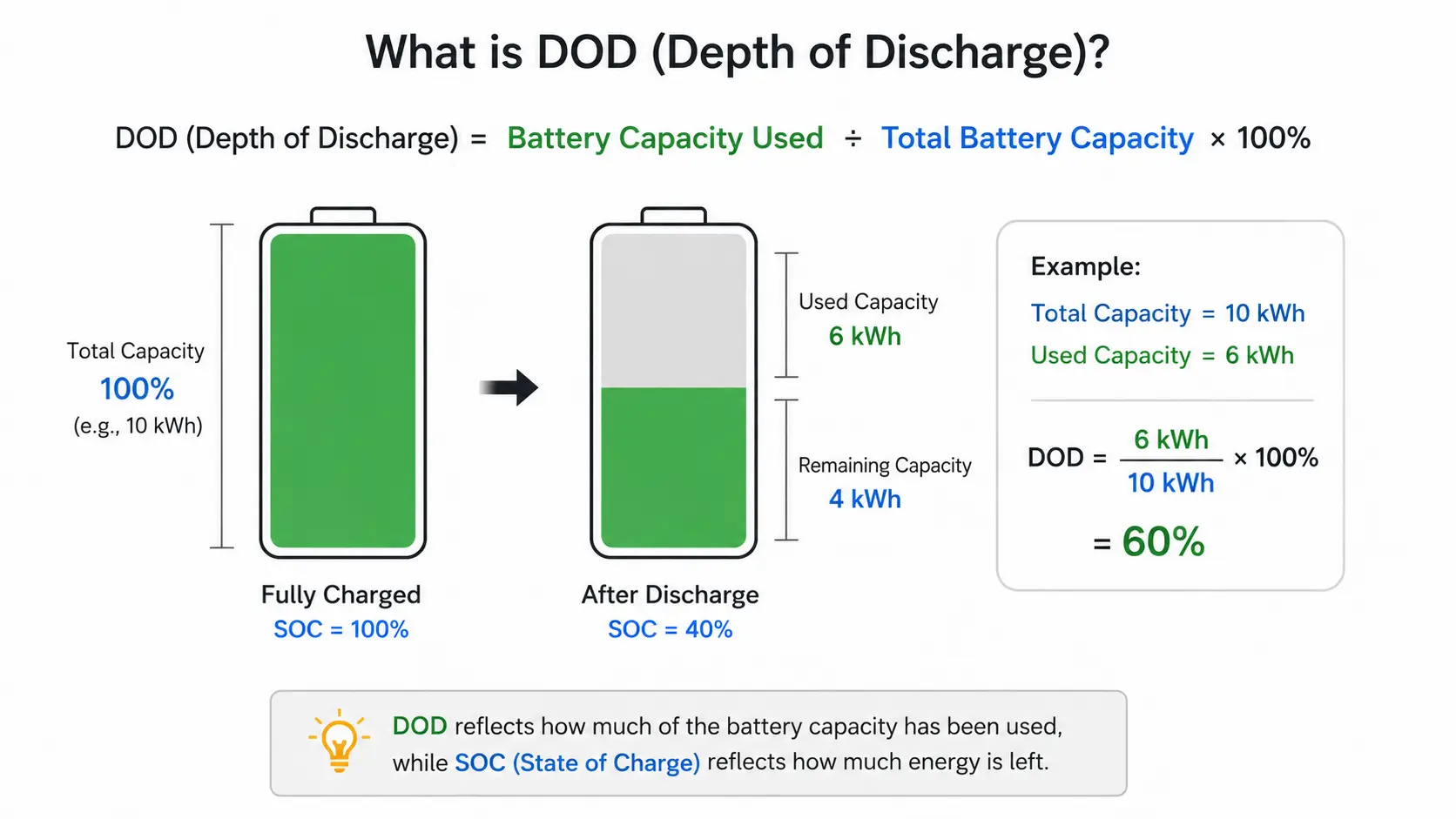
Depth of discharge – DOD – is the percentage of a battery’s stored energy you use before recharging it. Discharge a 10 kWh pack down to 5 kWh remaining and you’ve used 50% DOD. Run it until the BMS cuts off and you’ve hit 100% DOD. It sounds like a definition, but it’s actually the single most important number on the datasheet, because it sets the cycle life, the usable capacity and the warranty terms all at once.
Ovaj članak objašnjava šta DOD zapravo predstavlja, daje vam brojke koje odlučuju koliko duboko treba pražnjenje, i pokazuje kako ozbiljan OEM/ODM partner koristi DOD da prilagodi bateriju za vaš tržište.
Broj koji postavlja cikluski život – Kako DOD funkcioniše na nivou ćelije
DOD i stanje napunjenosti (SOC) su dve strane iste novčića. Baterija sa SOC 30% je pražnjena do DOD 70%. BMS prati oba, ali ono što utiče na dugovečnost jeste DOD, jer svako ispražnjavanje pomera hemiju ćelije malo, a dublje pražnjenja ubrzavaju trošenje.
Take a grade-A LFP prismatic cell with a 3.2V nominal voltage and a 2.5–3.65V operating window. Discharging to 2.5V per cell is 100% DOD. At 0.5C and 25°C, that cell typically delivers 4,000–6,000 cycles before it drops to 80% of original capacity. Now limit the same cell to 80% DOD – stop at 3.2V instead of 2.5V – and the cycle count climbs to roughly 6,000–8,000. Cut it to 50% DOD and you’re looking at 10,000 cycles or more.
You’ll also notice how close 3.25V and 3.2V are. The LFP discharge curve is so flat between 3.3V and 3.2V that voltage alone can’t tell you the DOD – which is why the BMS counts coulombs instead of just watching voltage. A cheap BMS that guesses DOD from voltage will drift, and the drift shows up as premature cutoffs or over-discharge in the field.

Here’s the counter-intuitive part. A 10 kWh pack cycled at 100% DOD for 5,000 cycles delivers about 50,000 kWh over its life. The same pack cycled at 50% DOD for 12,000 cycles delivers 60,000 kWh – 20% more total energy from the same hardware, just by discharging it half as deep each time. Depth of discharge doesn’t just change how many cycles you get; it changes how much total energy the pack will ever move.
That’s why the two datasheets in the opening can’t be compared directly. 6,000 cycles at 80% DOD and 4,000 cycles at 100% DOD are the same cell, tested under different rules. The first battery will actually deliver more total kilowatt-hours over its life.
Šta pravi pravi OEM/ODM partner radi sa DOD
Trgovačka kompanija štampa bilo koji DOD broj koji je dao dobavljač ćelija. Proizvođač tretira DOD kao dizajnersko rešenje, jer jeste jedno.
The DOD limit lives in the BMS firmware, not in the hardware. A genuine OEM/ODM partner will set the discharge cutoff voltage to match your market – 2.5V per cell for a 100% DOD product aimed at backup power, 3.2V for an 80% DOD product aimed at daily self-consumption – and they’ll tune the low-voltage warning thresholds to match. The same pack, the same cells, two different products, separated by a firmware parameter.
They’ll also align the warranty with the DOD setting. A serious manufacturer writes the warranty as a set of conditions – for example, 10 years or 6,000 cycles at 80% DOD, 0.5C, 25°C ambient – and they’ll tell you exactly what happens to the warranty if your installers run the pack deeper. If your market needs 100% DOD, they’ll spec a larger pack so the customer still gets the usable kilowatt-hours they paid for, instead of quietly voiding the warranty.
And they’ll handle the white-label side without blinking: your brand on the label, your connector variant, your firmware defaults, MOQ flexibility and sample lead times measured in weeks, not quarters. DOD is one of the parameters you get to own when you work with the factory directly.
50% vs 80% vs 100% DOD – Matriks odlučivanja
Evo poređenja koje je bitno za 10 kWh LFP stambeni paket, korišćenjem ćelija klase-A pri 0,5C i 25°C.
| Спецификација | 50% DOD | 80% DOD | 100% DOD |
|---|---|---|---|
| Iskorišćeni kapacitet po ciklusu | 5 kWh | 8 kWh | 10 kWh |
| Tipično vreme ciklusa do 80% | 10,000+ | 6.000–8.000 | 4.000–6.000 |
| Životni vek kroz energiju | ~60.000 kWh | ~56.000 kWh | ~50.000 kWh |
| Ispuštanje prilikom preseka po ćeliji | ~3.25V | ~3.2V | 2.5V |
| Најбоље пристајање | Backup mreže, retki prekidi | Dnevna samouslužba energije | Van mreže, potpuno noćno korišćenje |
| Pozicija garancije | Najduža, najsigurnija za poštovanje | Стандард | Najkraća, zahteva veći paket |

Wpattern je jasan. Najdublje pražnjenje daje najviše upotrebljive energije po ciklusu, ali najviše ciklusa i najmanje ukupne energije tokom života pakovanja. Najplitkije pražnjenje produžava garanciju, ali troši kapacitet koji ste platili. Za većinu stambenih tržišta, 80–90% DOD je sladak položaj – i to je upravo razlog zašto većina ozbiljnih proizvođača isporučuje njihove kućne skladišne proizvode sa podrazumevanim DOD od 80% ili 90%.
Četiri načina na koje DOD greši u terenu
- Jedan – upoređivanje životnog veka ciklusa bez DOD. Zahtev za 6.000 ciklusa pri 80% DOD i zahtev za 4.000 ciklusa pri 100% DOD opisuju istu ćeliju. Zahtevajte DOD, C-učestalost i temperaturu iza svakog broja ciklusa, inače je poređenje beskorisno.
- Dva – primena navika olovnih baterija na litijum. OL-olovne baterije brzo se gase ispod 50% DOD, zbog čega stari instalateri dimenzionišu olovne banke na duplu upotrebljivu kapacitet. LFP redovno podnosi 80–100% DOD. Ako vaši instalateri još uvek dimenzionišu litijum kao olovo, prodaju kupcima dva puta bateriju koliko im treba.
- Tri – Zbrka između korisnog i nominalnog kapaciteta. Baterija od 10 kWh na 80% DOD daje 8 kWh po ciklusu, a ne 10. Ako dnevna potrošnja kupca iznosi 9 kWh, baterija će dostići limit svakog noću i BMS će to zabeležiti. Dimenzioni bateriju prema potrošnji pri DOD-u koji nameravate da koristite.
- Četiri – Ignorisanje DOD-a u uslovima garancije. Neke garancije su napisane na 80% DOD i tiho degradiraju ako baterija radi dublje. Pročitajte uslove garancije pre nego što navedete ciklus života vašem kupcu i dobijte potvrđu DOD-a u pisanoj formi.
Pitanja koja kupci postavljaju o DOD-u
Postavite DOD koji Vaše tržište stvarno treba
Depth of discharge is not a spec to skim. It’s the number that sets your cycle life, your usable capacity and your warranty exposure in one stroke. Get it right and you sell a battery that delivers what the datasheet promises. Get it wrong and you’re fielding warranty claims in year three.
If you’re sourcing residential storage at volume, send us your daily load profile, your target warranty period and your market’s peak ambient temperature, and we’ll return a DOD recommendation with the cycle-life test conditions and warranty terms named in full within 24 hours.