 Español
  English
  العربية
  日本語
日本語  한국어
한국어  Tiếng Việt
  ไทย
ไทย  Bahasa Melayu
  فارسی
فارسی  Bahasa Indonesia
  ဗမာစာ
ဗမာစာ  简体中文
简体中文  香港中文
香港中文  繁體中文
繁體中文  Русский
  Deutsch
  Nederlands
  Italiano
  Français
  Português
  Afrikaans
  Azərbaycan dili
  Български
  ਪੰਜਾਬੀ
  हिन्दी
  اردو
اردو  বাংলা
বাংলা  Հայերեն
  Íslenska
  Қазақ тілі
  नेपाली
  Српски језик
  Kiswahili
  తెలుగు
  Basa Jawa
  தமிழ்
தமிழ்  मराठी
मराठी Qué es la profundidad de descarga y por qué decide la garantía de tu batería
Un gerente de adquisiciones en España está comparando dos baterías de pared de 10 kWh for the same installer network. One datasheet promises 6,000 cycles at 80% DOD. The other promises 4,000 cycles at 100% DOD. Both brands claim to be “the longest-lasting battery on the market.” The manager has no idea which one actually lasts longer, because the answer is hiding inside a three-letter abbreviation neither sales rep bothered to explain.
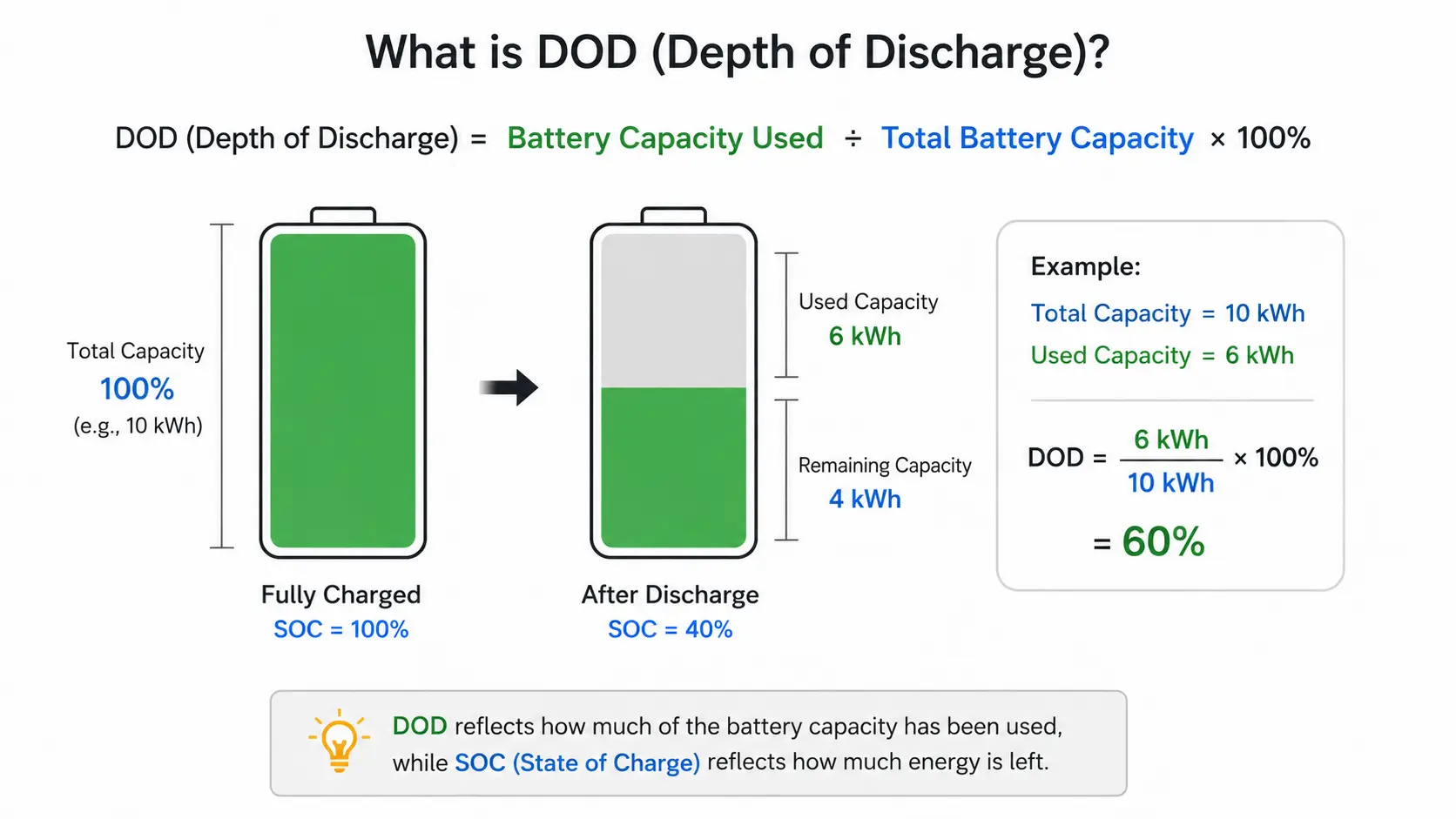
Depth of discharge – DOD – is the percentage of a battery’s stored energy you use before recharging it. Discharge a 10 kWh pack down to 5 kWh remaining and you’ve used 50% DOD. Run it until the BMS cuts off and you’ve hit 100% DOD. It sounds like a definition, but it’s actually the single most important number on the datasheet, because it sets the cycle life, the usable capacity and the warranty terms all at once.
Este artículo explica qué es realmente DOD, te da los números que determinan hasta qué punto debes descargarte y te muestra cómo un socio serio OEM/ODM utiliza DOD para ajustar una batería a tu mercado.
El número que determina la vida de ciclo: cómo funciona DOD a nivel de celda
DOD y el estado de carga (SOC) son dos caras de la misma moneda. Una batería con SOC de 30% se ha descargado hasta un DOD de 70%. El BMS realiza el seguimiento de ambos, pero lo que importa para la longevidad es el DOD, porque cada ciclo de descarga desgasta la química de la celda un poco, y las descargas más profundas la desgastan más rápido.
Take a grade-A LFP prismatic cell with a 3.2V nominal voltage and a 2.5–3.65V operating window. Discharging to 2.5V per cell is 100% DOD. At 0.5C and 25°C, that cell typically delivers 4,000–6,000 cycles before it drops to 80% of original capacity. Now limit the same cell to 80% DOD – stop at 3.2V instead of 2.5V – and the cycle count climbs to roughly 6,000–8,000. Cut it to 50% DOD and you’re looking at 10,000 cycles or more.
You’ll also notice how close 3.25V and 3.2V are. The LFP discharge curve is so flat between 3.3V and 3.2V that voltage alone can’t tell you the DOD – which is why the BMS counts coulombs instead of just watching voltage. A cheap BMS that guesses DOD from voltage will drift, and the drift shows up as premature cutoffs or over-discharge in the field.

Here’s the counter-intuitive part. A 10 kWh pack cycled at 100% DOD for 5,000 cycles delivers about 50,000 kWh over its life. The same pack cycled at 50% DOD for 12,000 cycles delivers 60,000 kWh – 20% more total energy from the same hardware, just by discharging it half as deep each time. Depth of discharge doesn’t just change how many cycles you get; it changes how much total energy the pack will ever move.
That’s why the two datasheets in the opening can’t be compared directly. 6,000 cycles at 80% DOD and 4,000 cycles at 100% DOD are the same cell, tested under different rules. The first battery will actually deliver more total kilowatt-hours over its life.
Qué hace un verdadero socio OEM/ODM con DOD
Una empresa comercial imprime cualquier número DOD que le dio el proveedor de celdas. Un fabricante trata DOD como una decisión de diseño, porque lo es.
The DOD limit lives in the BMS firmware, not in the hardware. A genuine OEM/ODM partner will set the discharge cutoff voltage to match your market – 2.5V per cell for a 100% DOD product aimed at backup power, 3.2V for an 80% DOD product aimed at daily self-consumption – and they’ll tune the low-voltage warning thresholds to match. The same pack, the same cells, two different products, separated by a firmware parameter.
They’ll also align the warranty with the DOD setting. A serious manufacturer writes the warranty as a set of conditions – for example, 10 years or 6,000 cycles at 80% DOD, 0.5C, 25°C ambient – and they’ll tell you exactly what happens to the warranty if your installers run the pack deeper. If your market needs 100% DOD, they’ll spec a larger pack so the customer still gets the usable kilowatt-hours they paid for, instead of quietly voiding the warranty.
And they’ll handle the white-label side without blinking: your brand on the label, your connector variant, your firmware defaults, MOQ flexibility and sample lead times measured in weeks, not quarters. DOD is one of the parameters you get to own when you work with the factory directly.
50% vs 80% vs 100% DOD – La Matriz de Decisión
Aquí está la comparación que importa para un pack residencial LFP de 10 kWh, usando celdas de grado A a 0,5C y 25°C.
| Especificación | DOD de 50% | DOD de 80% | DOD de 100% |
|---|---|---|---|
| Capacidad usable por ciclo | 5 kWh | 8 kWh | 10 kWh |
| Vida típica de ciclo hasta 80% | 10,000+ | 6,000–8,000 | 4.000–6.000 |
| Aprovechamiento de energía a lo largo de la vida útil | ~60,000 kWh | ~56,000 kWh | ~50,000 kWh |
| Descarga de corte por celda | ~3.25V | ~3.2V | 2.5V |
| Mejor ajuste | Respaldo de red, fallos ocasionales | Autoconsumo diario | Fuera de red, uso nocturno completo |
| Posición de garantía | El más largo, más fácil de cumplir | Estándar | El más corto, necesita paquete más grande |

El patrón es claro. La descarga más profunda te ofrece la mayor energía utilizable por ciclo, pero los pocos ciclos y la menor energía total durante la vida de la batería. La descarga menos profunda prolonga la garantía, pero desperdicia capacidad por la que pagaste. Para la mayoría de los mercados residenciales, 80–90% DOD es el punto óptimo, y eso es exactamente por qué la mayoría de fabricantes serios envían sus productos de almacenamiento doméstico con un valor predeterminado de DOD de 80% o 90%.
Cuatro maneras en que DOD sale mal en el campo
- Uno – Comparar la vida de ciclo sin el DOD. Una reclamación de 6,000 ciclos a 80% DOD y una reclamación de 4,000 ciclos a 100% DOD describen la misma celda. Exige el DOD, la tasa C y la temperatura detrás de cada número de ciclo, o la comparación carece de sentido.
- Dos – Aplicar hábitos de plomo-ácido a litio. Las baterías de plomo-ácido se mueren rápido por debajo de 50% DOD, por eso los instaladores a la antigua usan bancos de plomo con el doble de capacidad utilizable. LFP maneja rutinariamente 80–100% DOD. Si tus instaladores aún dimensionan el litio como el plomo, están vendiendo a los clientes el doble de la batería que necesitan.
- Tres – Confundir capacidad utilizable y nominal. Un paquete de 10 kWh a 80% DOD entrega 8 kWh por ciclo, no 10. Si la carga diaria del cliente es de 9 kWh, la batería alcanzará el umbral cada noche y el BMS lo registrará. Dimensiona el paquete para la carga en el DOD que piensas usar.
- Cuatro – Ignorar el DOD en los términos de la garantía. Algunas garantías están redactadas en 80% DOD y se degradan silenciosamente si la batería se descarga más de lo debido. Lea las condiciones de la garantía antes de citar la vida útil de ciclo a su cliente y confirme por escrito la configuración de DOD.
Preguntas que los compradores hacen sobre DOD
Establezca el DOD que su mercado realmente necesita
Depth of discharge is not a spec to skim. It’s the number that sets your cycle life, your usable capacity and your warranty exposure in one stroke. Get it right and you sell a battery that delivers what the datasheet promises. Get it wrong and you’re fielding warranty claims in year three.
If you’re sourcing residential storage at volume, send us your daily load profile, your target warranty period and your market’s peak ambient temperature, and we’ll return a DOD recommendation with the cycle-life test conditions and warranty terms named in full within 24 hours.