 Italiano
  English
  العربية
  日本語
日本語  한국어
한국어  Tiếng Việt
  ไทย
ไทย  Bahasa Melayu
  فارسی
فارسی  Bahasa Indonesia
  ဗမာစာ
ဗမာစာ  简体中文
简体中文  香港中文
香港中文  繁體中文
繁體中文  Русский
  Deutsch
  Nederlands
  Français
  Español
  Português
  Afrikaans
  Azərbaycan dili
  Български
  ਪੰਜਾਬੀ
  हिन्दी
  اردو
اردو  বাংলা
বাংলা  Հայերեն
  Íslenska
  Қазақ тілі
  नेपाली
  Српски језик
  Kiswahili
  తెలుగు
  Basa Jawa
  தமிழ்
தமிழ்  मराठी
मराठी Che cosa è la profondità di scarica e perché decide la garanzia della tua batteria
Un responsabile degli acquisti in Italia sta confrontando due batterie da 10 kWh da muro for the same installer network. One datasheet promises 6,000 cycles at 80% DOD. The other promises 4,000 cycles at 100% DOD. Both brands claim to be “the longest-lasting battery on the market.” The manager has no idea which one actually lasts longer, because the answer is hiding inside a three-letter abbreviation neither sales rep bothered to explain.
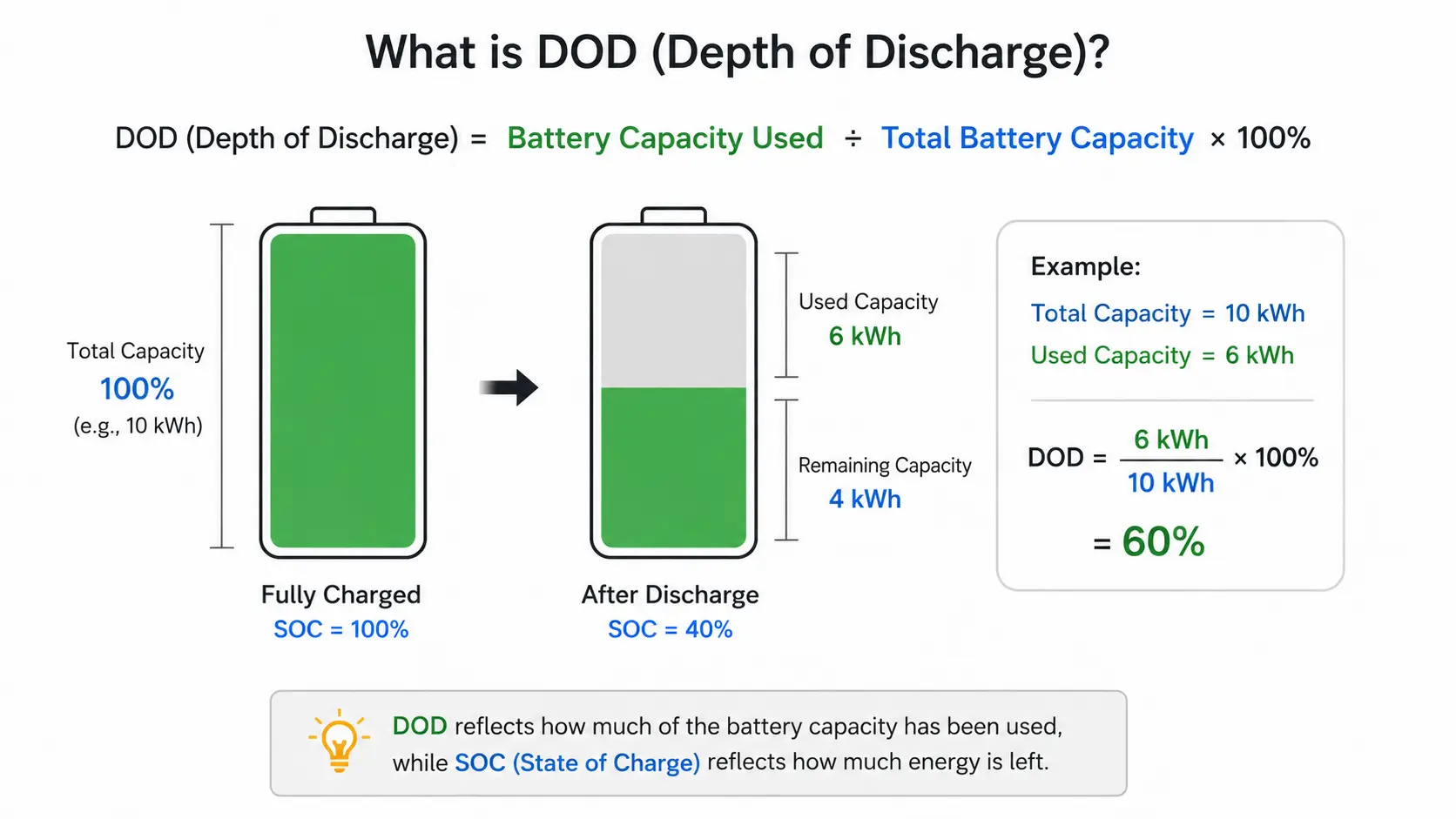
Depth of discharge – DOD – is the percentage of a battery’s stored energy you use before recharging it. Discharge a 10 kWh pack down to 5 kWh remaining and you’ve used 50% DOD. Run it until the BMS cuts off and you’ve hit 100% DOD. It sounds like a definition, but it’s actually the single most important number on the datasheet, because it sets the cycle life, the usable capacity and the warranty terms all at once.
Questo articolo spiega cosa sia davvero DOD, ti fornisce i numeri che determinano quanto profondamente dovresti scaricare e mostra come un serio partner OEM/ODM usa DOD per tarare una batteria per il tuo mercato.
Il numero che determina la vita del ciclo – Come funziona DOD a livello di cella
DOD e stato di carica (SOC) sono due facce della stessa medaglia. Una batteria al SOC 30% è stata scaricata al DOD 70%. Il BMS traccia entrambi, ma quello che conta per la longevità è il DOD, perché ogni ciclo di scarica consuma un po' la chimica della cella, e scariche più profonde la consumano più rapidamente.
Take a grade-A LFP prismatic cell with a 3.2V nominal voltage and a 2.5–3.65V operating window. Discharging to 2.5V per cell is 100% DOD. At 0.5C and 25°C, that cell typically delivers 4,000–6,000 cycles before it drops to 80% of original capacity. Now limit the same cell to 80% DOD – stop at 3.2V instead of 2.5V – and the cycle count climbs to roughly 6,000–8,000. Cut it to 50% DOD and you’re looking at 10,000 cycles or more.
You’ll also notice how close 3.25V and 3.2V are. The LFP discharge curve is so flat between 3.3V and 3.2V that voltage alone can’t tell you the DOD – which is why the BMS counts coulombs instead of just watching voltage. A cheap BMS that guesses DOD from voltage will drift, and the drift shows up as premature cutoffs or over-discharge in the field.

Here’s the counter-intuitive part. A 10 kWh pack cycled at 100% DOD for 5,000 cycles delivers about 50,000 kWh over its life. The same pack cycled at 50% DOD for 12,000 cycles delivers 60,000 kWh – 20% more total energy from the same hardware, just by discharging it half as deep each time. Depth of discharge doesn’t just change how many cycles you get; it changes how much total energy the pack will ever move.
That’s why the two datasheets in the opening can’t be compared directly. 6,000 cycles at 80% DOD and 4,000 cycles at 100% DOD are the same cell, tested under different rules. The first battery will actually deliver more total kilowatt-hours over its life.
Cosa Fa un vero partner OEM/ODM con DOD
Una società di commercio stampa qualsiasi numero DOD che il fornitore di celle ha dato loro. Un produttore considera DOD una decisione di progettazione, perché lo è.
The DOD limit lives in the BMS firmware, not in the hardware. A genuine OEM/ODM partner will set the discharge cutoff voltage to match your market – 2.5V per cell for a 100% DOD product aimed at backup power, 3.2V for an 80% DOD product aimed at daily self-consumption – and they’ll tune the low-voltage warning thresholds to match. The same pack, the same cells, two different products, separated by a firmware parameter.
They’ll also align the warranty with the DOD setting. A serious manufacturer writes the warranty as a set of conditions – for example, 10 years or 6,000 cycles at 80% DOD, 0.5C, 25°C ambient – and they’ll tell you exactly what happens to the warranty if your installers run the pack deeper. If your market needs 100% DOD, they’ll spec a larger pack so the customer still gets the usable kilowatt-hours they paid for, instead of quietly voiding the warranty.
And they’ll handle the white-label side without blinking: your brand on the label, your connector variant, your firmware defaults, MOQ flexibility and sample lead times measured in weeks, not quarters. DOD is one of the parameters you get to own when you work with the factory directly.
50% vs 80% vs 100% DOD – La matrice di decisione
Ecco la comparazione che conta per un pacco residenziale LFP da 10 kWh, utilizzando celle di grado A a 0,5C e 25°C.
| Specifica | 50% DOD | 80% DOD | 100% DOD |
|---|---|---|---|
| Capacità utilizzabile per ciclo | 5 kWh | 8 kWh | 10 kWh |
| Vita tipica del ciclo fino a 80% | 10,000+ | 6.000–8.000 | 4.000–6.000 |
| Energia disponibile nel ciclo di vita | ~60.000 kWh | ~56.000 kWh | ~50.000 kWh |
| Soglia di scarica per cella | ~3,25V | ~3,2V | 2,5V |
| La soluzione migliore | Backup della rete, interruzioni rare | Autoconsumo quotidiano | Fuori rete, uso completo durante la notte |
| Posizione in garanzia | La più lunga, la più facile da onorare | Standard | La più breve, necessita di pacco maggiore |

Il modello è chiaro. La scarica più profonda ti offre la maggiore energia utilizzabile per ciclo ma il minor numero di cicli e la minore energia totale nel ciclo di vita del pacco. La scarica meno profonda estende la garanzia ma spreca la capacità per cui hai pagato. Per la maggior parte dei mercati residenziali, l'80–90% DOD è la soglia ideale – ed è esattamente per questo motivo che la maggior parte dei produttori seri spedisce i propri prodotti di accumulo domestico con un valore predefinito DOD di 80% o 90%.
Quattro modi in cui il DOD va storto sul campo
- Uno – Confrontare la vita ciclica senza il DOD. Una rivendicazione di 6.000 cicli a 80% DOD e una rivendicazione di 4.000 cicli a 100% DOD descrivono la stessa cella. Richiedi il DOD, la C-rate e la temperatura dietro ogni numero di ciclo, o il confronto è inutile.
- Due – Applicare abitudini delle batterie al piombo‑acido al litio. Le batterie al piombo‑acido si esauriscono rapidamente al di sotto del 50% DOD, motivo per cui gli installatori dell’epoca dimensionano le banche di piombo al doppio della capacità utilizzabile. LFP gestisce regolarmente l’80–100% DOD. Se i tuoi installatori continuano a dimensionare il litio come il piombo, stanno vendendo ai clienti il doppio della batteria di cui hanno bisogno.
- Tre – Confondere la capacità utilizzabile e quella nominale. Un pacco da 10 kWh a 80% DOD eroga 8 kWh per ciclo, non 10. Se il carico quotidiano del cliente è di 9 kWh, il pacco raggiungerà la soglia ogni notte e il BMS lo registrerà. Dimensiona il pacco in base al carico al DOD che intendi utilizzare.
- Quattro – Ignorare il DOD nei termini di garanzia. Alcune garanzie sono redatte al 80% DOD e degradano silenziosamente se il pacco funziona a profondità maggiore. Leggi le condizioni di garanzia prima di presentare la vita a ciclo al tuo cliente e fai confermare per iscritto l’impostazione del DOD.
Domande che gli acquirenti fanno sul DOD
Imposta il DOD di cui il tuo mercato ha realmente bisogno
Depth of discharge is not a spec to skim. It’s the number that sets your cycle life, your usable capacity and your warranty exposure in one stroke. Get it right and you sell a battery that delivers what the datasheet promises. Get it wrong and you’re fielding warranty claims in year three.
If you’re sourcing residential storage at volume, send us your daily load profile, your target warranty period and your market’s peak ambient temperature, and we’ll return a DOD recommendation with the cycle-life test conditions and warranty terms named in full within 24 hours.