 Қазақ тілі
  English
  العربية
  日本語
日本語  한국어
한국어  Tiếng Việt
  ไทย
ไทย  Bahasa Melayu
  فارسی
فارسی  Bahasa Indonesia
  ဗမာစာ
ဗမာစာ  简体中文
简体中文  香港中文
香港中文  繁體中文
繁體中文  Русский
  Deutsch
  Nederlands
  Italiano
  Français
  Español
  Português
  Afrikaans
  Azərbaycan dili
  Български
  ਪੰਜਾਬੀ
  हिन्दी
  اردو
اردو  বাংলা
বাংলা  Հայերեն
  Íslenska
  नेपाली
  Српски језик
  Kiswahili
  తెలుగు
  Basa Jawa
  தமிழ்
தமிழ்  मराठी
मराठी Depth-дендірістің не екенін және ол неге сіздің батарея кепілдік шешімін анықтайтынын түсіну
Қазақстандағы сатып алу менеджері екі нәрсені салыстырып жатыр 10 кВт·сағат қабырғаға орнатылатын батареялар for the same installer network. One datasheet promises 6,000 cycles at 80% DOD. The other promises 4,000 cycles at 100% DOD. Both brands claim to be “the longest-lasting battery on the market.” The manager has no idea which one actually lasts longer, because the answer is hiding inside a three-letter abbreviation neither sales rep bothered to explain.
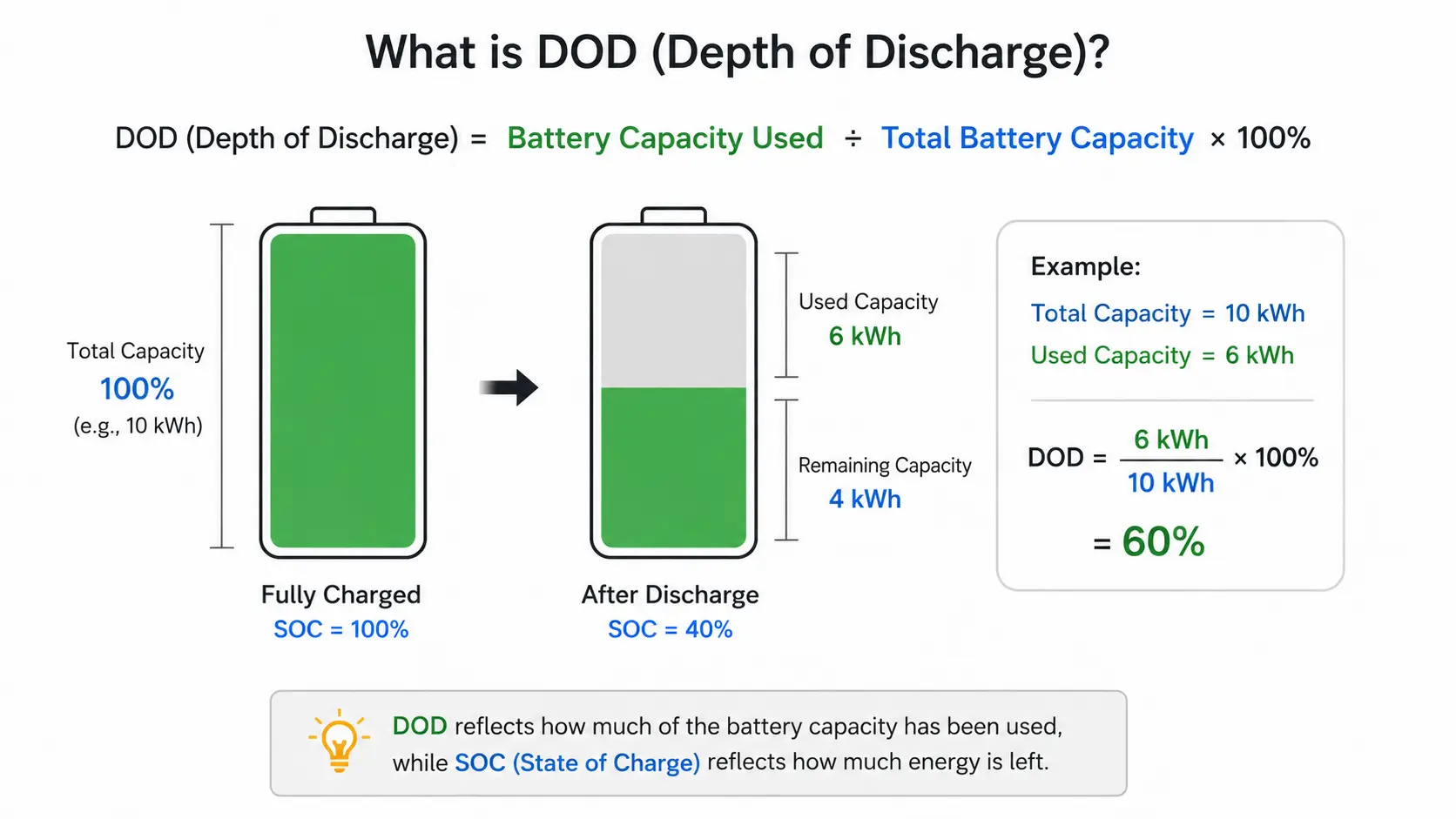
Depth of discharge – DOD – is the percentage of a battery’s stored energy you use before recharging it. Discharge a 10 kWh pack down to 5 kWh remaining and you’ve used 50% DOD. Run it until the BMS cuts off and you’ve hit 100% DOD. It sounds like a definition, but it’s actually the single most important number on the datasheet, because it sets the cycle life, the usable capacity and the warranty terms all at once.
Бұл мақала DOD не екенін нақтылайды, қаншалықты терең разрядтау керек екенін шешетін сандарды береді және неге шынайы OEM/ODM серіктесі нарыққа бейімдеу үшін DOD-ды пайдаланады көрсетеді.
Циклдік өмірді анықтайтын сан – DOD ұяшығында қалай жұмыс істейді
DOD және заряд күйі (SOC) бір монета екі жағы сияқты. 30% SOC күйіндегі батарея 70% DOD-ға дейін разрядталған. BMS екі түсінікті де бақылайды, бірақ ұзақ мерзім үшін маңыздысы DOD, өйткені әр разрядтау циклінде ұяшықтың химиясын аздап тоздырады, ал тереңірек разрядтар оны жылдамырақ тоздырады.
Take a grade-A LFP prismatic cell with a 3.2V nominal voltage and a 2.5–3.65V operating window. Discharging to 2.5V per cell is 100% DOD. At 0.5C and 25°C, that cell typically delivers 4,000–6,000 cycles before it drops to 80% of original capacity. Now limit the same cell to 80% DOD – stop at 3.2V instead of 2.5V – and the cycle count climbs to roughly 6,000–8,000. Cut it to 50% DOD and you’re looking at 10,000 cycles or more.
You’ll also notice how close 3.25V and 3.2V are. The LFP discharge curve is so flat between 3.3V and 3.2V that voltage alone can’t tell you the DOD – which is why the BMS counts coulombs instead of just watching voltage. A cheap BMS that guesses DOD from voltage will drift, and the drift shows up as premature cutoffs or over-discharge in the field.

Here’s the counter-intuitive part. A 10 kWh pack cycled at 100% DOD for 5,000 cycles delivers about 50,000 kWh over its life. The same pack cycled at 50% DOD for 12,000 cycles delivers 60,000 kWh – 20% more total energy from the same hardware, just by discharging it half as deep each time. Depth of discharge doesn’t just change how many cycles you get; it changes how much total energy the pack will ever move.
That’s why the two datasheets in the opening can’t be compared directly. 6,000 cycles at 80% DOD and 4,000 cycles at 100% DOD are the same cell, tested under different rules. The first battery will actually deliver more total kilowatt-hours over its life.
Нағыз OEM/ODM серігі DOD-пен не істейді
Сауда компаниясы батарея жеткізушілер берген қандай да бір DOD нөмірін басып шығарады. Құрастырушы DOD-ты дизайн шешімі ретінде қарастырады, себебі ол біреу.
The DOD limit lives in the BMS firmware, not in the hardware. A genuine OEM/ODM partner will set the discharge cutoff voltage to match your market – 2.5V per cell for a 100% DOD product aimed at backup power, 3.2V for an 80% DOD product aimed at daily self-consumption – and they’ll tune the low-voltage warning thresholds to match. The same pack, the same cells, two different products, separated by a firmware parameter.
They’ll also align the warranty with the DOD setting. A serious manufacturer writes the warranty as a set of conditions – for example, 10 years or 6,000 cycles at 80% DOD, 0.5C, 25°C ambient – and they’ll tell you exactly what happens to the warranty if your installers run the pack deeper. If your market needs 100% DOD, they’ll spec a larger pack so the customer still gets the usable kilowatt-hours they paid for, instead of quietly voiding the warranty.
And they’ll handle the white-label side without blinking: your brand on the label, your connector variant, your firmware defaults, MOQ flexibility and sample lead times measured in weeks, not quarters. DOD is one of the parameters you get to own when you work with the factory directly.
50% vs 80% vs 100% DOD – ШЕШІМ МАТРИЦАСЫ
0.5C және 25°C жылтыргылығы бар grade-A элементтерді пайдалана отырып, 10 kWh LFP тұрғын батареясына қатысты маңызды салыстыру осында.
| Техникалық сипаттама | 50% DOD | 80% DOD | 100% DOD |
|---|---|---|---|
| cycle бойынша жарамды сыйымдылық | 5 кВт/сағ | 8 кВт/сағ | 10 кВт/сағ |
| 80%-ге типтік циклдік қызметі | 10,000+ | 6 000–8 000 | 4000–6000 |
| өмір бойы энергия өткізуі | ~60 000 кВт⋅сағ | ~56 000 кВт⋅сағ | ~50 000 кВт⋅сағ |
| Ұяшық бойынша разрядтау тоқтату деңгейі | ~3,25 В | ~3,2 В | 2,5 В |
| Ең қолайлы | Желі резерві, сирек өшулер | Күнделікті өзін-өзі тұтыну | өшіру желісінен тыс, түнгі толығымен пайдалану |
| Гарантия мәртебесі | Ең ұзақ мерзім, ең оңай құрметтеу | Стандартты | Қысқа мерзім, үлкен үлгі қажет |

Үлгі айқын. Ең терең discharge айналымда сізге әр циклде ең пайдаланылатын энергияны береді, бірақ цикл саны аз және пакеттің жалпы энергиясы аз болады. Ең ізгісінің разряд деңгейі кепілдік мерзімін созады, бірақ сіз төлеген сыйымдылықты босқа жібереді. Көптеген тұрғын үй нарықтарында 80–90% TPDOD дәрежеі тәтті тұзақ болып табылады – және дәл осы себептен көп кәсіпқой өндірушілер үй сақтау өнімдерін 80%TP5T немесе 90%TP5T DOD әдепкісімен жеткізеді.
Өрістегі DOD үш қайдан бұрыс кетеді: төрт жол
- 1- DOD-сыз циклдік өмірді салыстыру. 80% DOD-да 6 000 цикл, ал 100% DOD-да 4 000 цикл туралы талап бір ұяшықты сипаттайды. Әр цикл санының артқы жағында тұрған DOD, C-қатынас және температураны талап етіңіз, әйтпесе салыстыру мағынасыз болады.
- 2- Қоюлатылған батареялар әдеттерін литийге қолдану. Күмістемелі батареялар 50% DOD төмен болғанда ерте өледі, сондықтан ескі жүйелі орнатушылар қолданыстағы сыйымды екі есе көбейтіп өлшейді. LFP әдетте 80–100% DOD тұрақты түрдеworks. Егер сіздің орнатушыларыңыз литийді әлі де литий емес деп ойласа, олар клиенттерге керекті батареяны екі есе сатады.
- 3- Қолданыстағы сыйымдылық пен номиналдық сыйымдылықты шатастыру. 80% DOD-дегі 10 кВт·ч қаптамасы әр циклде 8 кВт·ч береді, 10 кВт·ч емес. Егер тұтынушының күндік жүктемесі 9 кВт·ч болса, қаптаманың шегі әр түн сайын қолданылады және BMS оны тіркейді. Қаптаманы сіз жоспарлаған DOD-ға сай жүктемеге өлшемдеңіз.
- Төрт – кепілдік шарттарында DOD-ны елемеу. Кейбір кепілдіктер 80% DOD-де жазылады және қаптама тереңірек жұмыс істегенде жасырын түрде нашарлайды. Цикл өмірін тұтынушыға келтірер алдында кепілдік шарттарын оқып шығыңыз және DOD орнату жазбаша расталғанына көз жеткізіңіз.
ДОҒАНЫҢ КІЛТТЕРІН СҰРАЙТЫН САТЫП АЛУШЫЛАР
Сіздің нарығыңыз нақты қажет ететін DOD орнату
Depth of discharge is not a spec to skim. It’s the number that sets your cycle life, your usable capacity and your warranty exposure in one stroke. Get it right and you sell a battery that delivers what the datasheet promises. Get it wrong and you’re fielding warranty claims in year three.
If you’re sourcing residential storage at volume, send us your daily load profile, your target warranty period and your market’s peak ambient temperature, and we’ll return a DOD recommendation with the cycle-life test conditions and warranty terms named in full within 24 hours.