 日本語
日本語  English
  العربية
  한국어
한국어  Tiếng Việt
  ไทย
ไทย  Bahasa Melayu
  فارسی
فارسی  Bahasa Indonesia
  ဗမာစာ
ဗမာစာ  简体中文
简体中文  香港中文
香港中文  繁體中文
繁體中文  Русский
  Deutsch
  Nederlands
  Italiano
  Français
  Español
  Português
  Afrikaans
  Azərbaycan dili
  Български
  ਪੰਜਾਬੀ
  हिन्दी
  اردو
اردو  বাংলা
বাংলা  Հայերեն
  Íslenska
  Қазақ тілі
  नेपाली
  Српски језик
  Kiswahili
  తెలుగు
  Basa Jawa
  தமிழ்
தமிழ்  मराठी
मराठी 放電深度とは何か、それがあなたのバッテリー保証を決定づける理由
南アフリカの調達マネージャーが2つを比較しています 10 kWh 室内壁掛け型バッテリー for the same installer network. One datasheet promises 6,000 cycles at 80% DOD. The other promises 4,000 cycles at 100% DOD. Both brands claim to be “the longest-lasting battery on the market.” The manager has no idea which one actually lasts longer, because the answer is hiding inside a three-letter abbreviation neither sales rep bothered to explain.
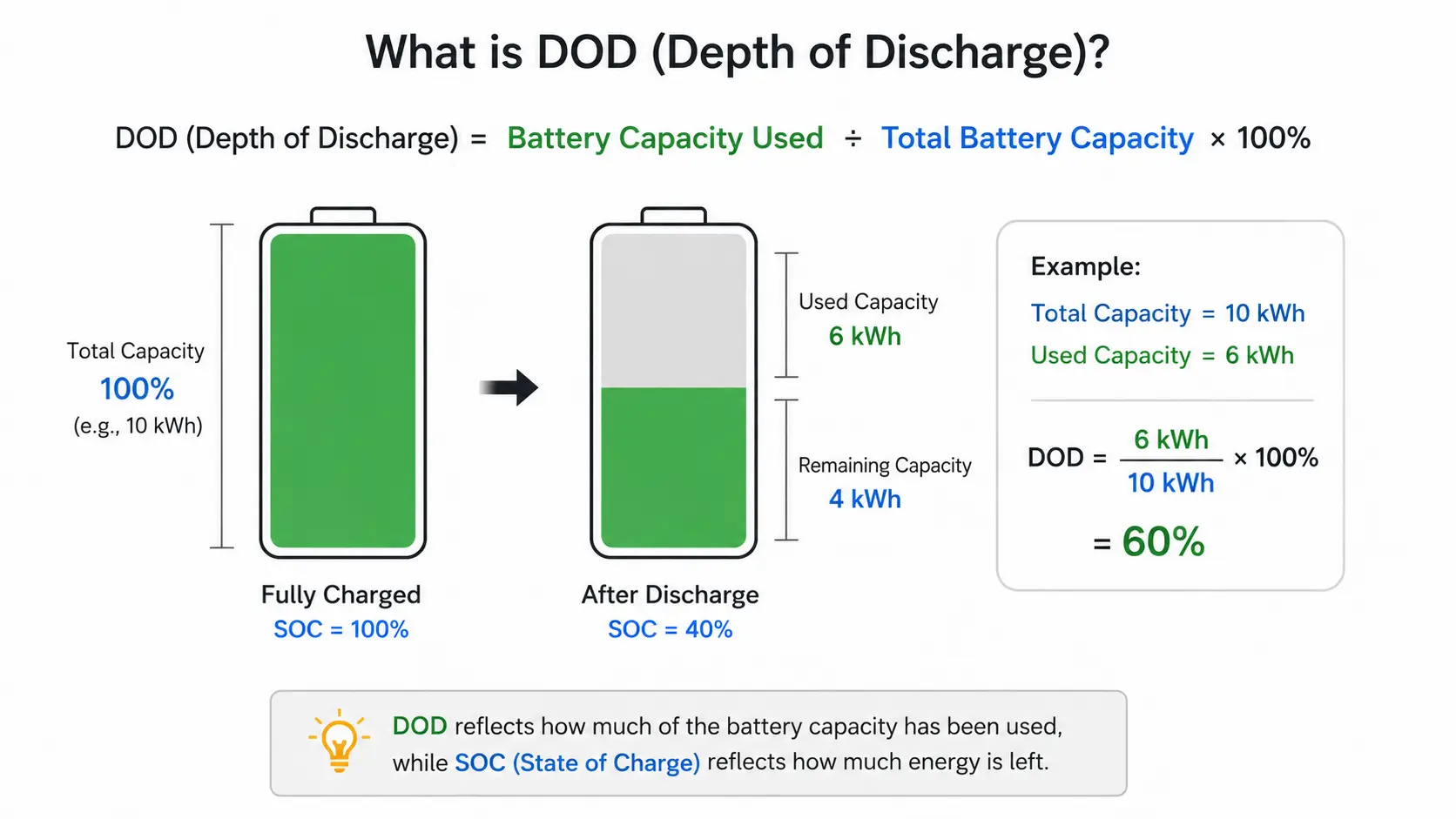
Depth of discharge – DOD – is the percentage of a battery’s stored energy you use before recharging it. Discharge a 10 kWh pack down to 5 kWh remaining and you’ve used 50% DOD. Run it until the BMS cuts off and you’ve hit 100% DOD. It sounds like a definition, but it’s actually the single most important number on the datasheet, because it sets the cycle life, the usable capacity and the warranty terms all at once.
この記事はDODが実際に何を意味するのかを説明し、放電深さを決定する数値を示し、信頼できるOEM/ODMパートナーが市場向けにバッテリーを調整する際にDODをどのように活用するかを示します。.
サイクル寿命を決定づける数値 – セルレベルでDODがどのように機能するか
DODと充電状態(SOC)は同じ硬貨の両面です。30% SOCのバッテリーは70% DODまで放電されています。BMSは両方を追跡しますが、長寿命にとって重要なのはDODであり、すべての放電サイクルがセル化学を少しずつ擦り減らし、より深い放電はそれをより速く擦り減らします。.
Take a grade-A LFP prismatic cell with a 3.2V nominal voltage and a 2.5–3.65V operating window. Discharging to 2.5V per cell is 100% DOD. At 0.5C and 25°C, that cell typically delivers 4,000–6,000 cycles before it drops to 80% of original capacity. Now limit the same cell to 80% DOD – stop at 3.2V instead of 2.5V – and the cycle count climbs to roughly 6,000–8,000. Cut it to 50% DOD and you’re looking at 10,000 cycles or more.
You’ll also notice how close 3.25V and 3.2V are. The LFP discharge curve is so flat between 3.3V and 3.2V that voltage alone can’t tell you the DOD – which is why the BMS counts coulombs instead of just watching voltage. A cheap BMS that guesses DOD from voltage will drift, and the drift shows up as premature cutoffs or over-discharge in the field.

Here’s the counter-intuitive part. A 10 kWh pack cycled at 100% DOD for 5,000 cycles delivers about 50,000 kWh over its life. The same pack cycled at 50% DOD for 12,000 cycles delivers 60,000 kWh – 20% more total energy from the same hardware, just by discharging it half as deep each time. Depth of discharge doesn’t just change how many cycles you get; it changes how much total energy the pack will ever move.
That’s why the two datasheets in the opening can’t be compared directly. 6,000 cycles at 80% DOD and 4,000 cycles at 100% DOD are the same cell, tested under different rules. The first battery will actually deliver more total kilowatt-hours over its life.
実際のOEM/ODMパートナーがDODで行うこと
取引会社はセルサプライヤーが提供したDOD番号を印刷する。製造業者はDODを設計判断として扱う、それが一つの理由だから。.
The DOD limit lives in the BMS firmware, not in the hardware. A genuine OEM/ODM partner will set the discharge cutoff voltage to match your market – 2.5V per cell for a 100% DOD product aimed at backup power, 3.2V for an 80% DOD product aimed at daily self-consumption – and they’ll tune the low-voltage warning thresholds to match. The same pack, the same cells, two different products, separated by a firmware parameter.
They’ll also align the warranty with the DOD setting. A serious manufacturer writes the warranty as a set of conditions – for example, 10 years or 6,000 cycles at 80% DOD, 0.5C, 25°C ambient – and they’ll tell you exactly what happens to the warranty if your installers run the pack deeper. If your market needs 100% DOD, they’ll spec a larger pack so the customer still gets the usable kilowatt-hours they paid for, instead of quietly voiding the warranty.
And they’ll handle the white-label side without blinking: your brand on the label, your connector variant, your firmware defaults, MOQ flexibility and sample lead times measured in weeks, not quarters. DOD is one of the parameters you get to own when you work with the factory directly.
50%対80%対100% DOD – 決定マトリクス
0.5C、25°Cで grade-Aセルを使用した10 kWh LFP住宅用パックに関して重要な比較はこちら。.
| 仕様 | 50% DOD | 80% DOD | 100% DOD |
|---|---|---|---|
| サイクルあたり使用容量 | 5kWh | 8kWh | 10kWh |
| 80%までの典型的なサイクル寿命 | 10,000+ | 6,000–8,000 | 4,000~6,000 |
| 生涯エネルギー処理量 | 約60,000 kWh | 約56,000 kWh | 約50,000 kWh |
| セルごとの放電カットオフ | 約3.25V | 約3.2V | 2.5V |
| 最適なフィット | グリッドバックアップ、稀な停電 | 日常の自己消費 | オフグリッド、完全な一晩利用 |
| 保証位置 | 最長、最も受領しやすい | 標準 | 最短、より大きなパックが必要 |

パターンは明確です。最も深い放電は1サイクルあたり最も使用可能なエネルギーを提供しますが、サイクル数が最も少なく、バッキング全体の総エネルギーは最も少なくなります。最も浅い放電は保証を延ばしますが、支払った容量を浪費します。ほとんどの住宅市場において、80–90%のDODが甘いスポットです – これは多くの真剣なメーカーが自宅用蓄電製品を80%または90% DODデフォルトで出荷する理由とちょうど同じです。.
現場でDODが間違いなくなる四つの方法
- 一 – DODを無視してサイクル寿命を比較すること。. 80% DODでの6000サイクルの主張と、100% DODでの4000サイクルの主張は同じセルを説明しています。サイクルごとのDOD、Cレート、温度を必ず要求してください。さもなくば比較は意味をなさなくなります。.
- 二 – 鉛蓄電池の習慣をリチウムに適用すること。. 鉛蓄電池は50% DOD以下で急速に死にます。これが古い施工者が有効容量の倍を容量としてサイズする理由です。LFPは80–100% DODを日常的に扱います。施工者がまだリチウムを鉛のようにサイズ付けしているなら、顧客に必要以上のバッテリーを売っていることになります。.
- 三 – 使用可能容量と公称容量を混同すること。. 80% DODでの10 kWhパックは1サイクルあたり8 kWhを供給し、10 kWhではありません。顧客の日間負荷が9 kWhの場合、パックは毎晩カットオフに達し、BMSがそれを記録します。運用するDODでの負荷に合わせてパックをサイズしてください。.
- 四つ目 – 保証条件においてDODを無視する。. 一部の保証は80% DODで記載され、パックが深く放電されると黙示的に劣化します。サイクル寿命を顧客に説明する前に保証条件を読み、DOD設定を書面で確認してください。.
購入者がDODについて尋ねる質問
市場が実際に必要とするDODを設定する
Depth of discharge is not a spec to skim. It’s the number that sets your cycle life, your usable capacity and your warranty exposure in one stroke. Get it right and you sell a battery that delivers what the datasheet promises. Get it wrong and you’re fielding warranty claims in year three.
If you’re sourcing residential storage at volume, send us your daily load profile, your target warranty period and your market’s peak ambient temperature, and we’ll return a DOD recommendation with the cycle-life test conditions and warranty terms named in full within 24 hours.