 ไทย
ไทย  English
  العربية
  日本語
日本語  한국어
한국어  Tiếng Việt
  Bahasa Melayu
  فارسی
فارسی  Bahasa Indonesia
  ဗမာစာ
ဗမာစာ  简体中文
简体中文  香港中文
香港中文  繁體中文
繁體中文  Русский
  Deutsch
  Nederlands
  Italiano
  Français
  Español
  Português
  Afrikaans
  Azərbaycan dili
  Български
  ਪੰਜਾਬੀ
  हिन्दी
  اردو
اردو  বাংলা
বাংলা  Հայերեն
  Íslenska
  Қазақ тілі
  नेपाली
  Српски језик
  Kiswahili
  తెలుగు
  Basa Jawa
  தமிழ்
தமிழ்  मराठी
मराठी อะไรคือความลึกของการปลดประจุ (DOD) และทำไมมันถึงกำหนดการรับประกันแบตเตอรี่ของคุณ
ผู้จัดการจัดซื้อในแอฟริกาใต้เปรียบเทียบสองรายการ แบตเตอรี่ติดผนังขนาด 10 kWh for the same installer network. One datasheet promises 6,000 cycles at 80% DOD. The other promises 4,000 cycles at 100% DOD. Both brands claim to be “the longest-lasting battery on the market.” The manager has no idea which one actually lasts longer, because the answer is hiding inside a three-letter abbreviation neither sales rep bothered to explain.
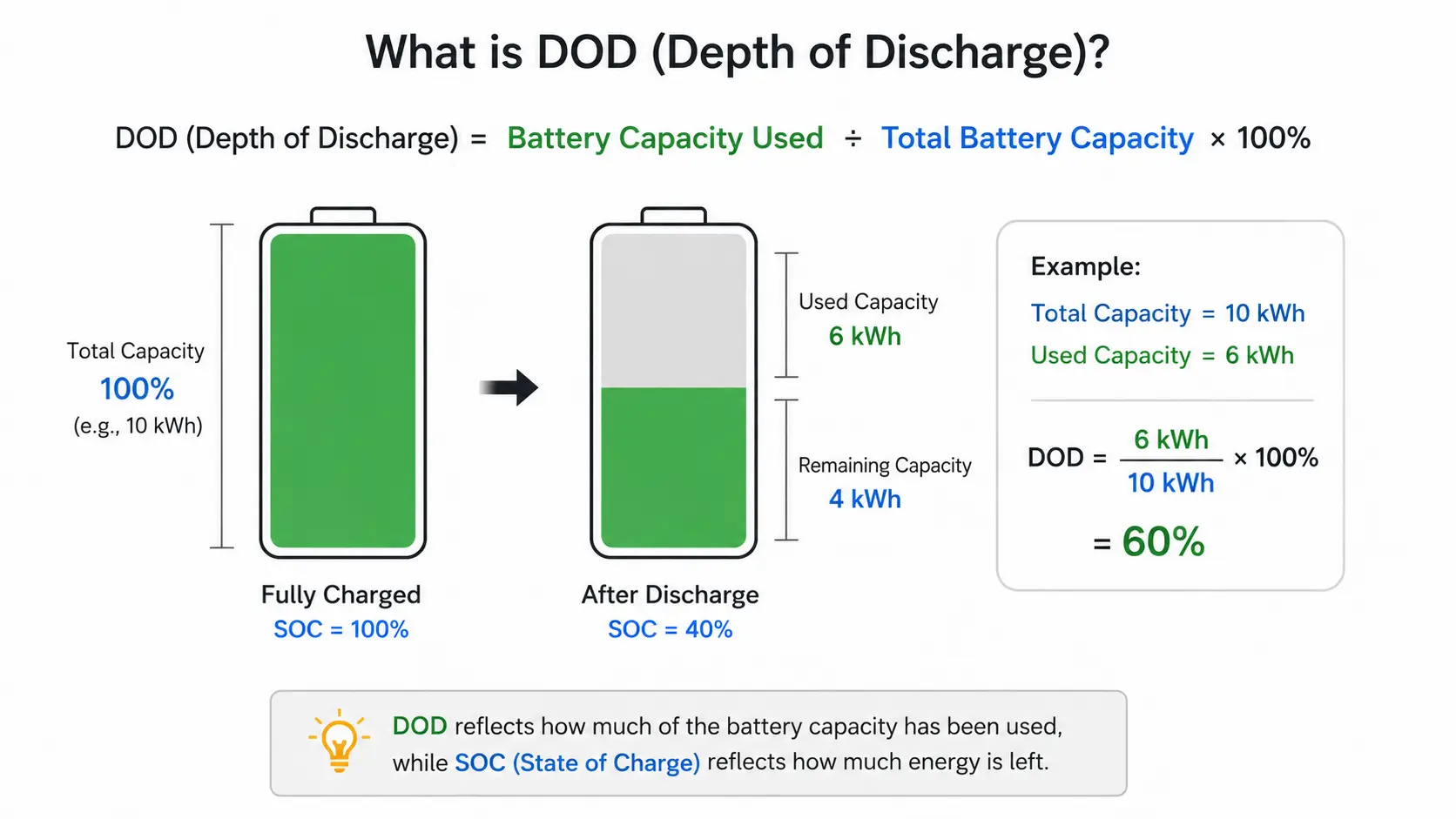
Depth of discharge – DOD – is the percentage of a battery’s stored energy you use before recharging it. Discharge a 10 kWh pack down to 5 kWh remaining and you’ve used 50% DOD. Run it until the BMS cuts off and you’ve hit 100% DOD. It sounds like a definition, but it’s actually the single most important number on the datasheet, because it sets the cycle life, the usable capacity and the warranty terms all at once.
บทความนี้อธิบายว่า DOD คืออะไรจริงๆ ให้ตัวเลขที่กำหนดลึกที่คุณควรถลายปลดประจุ และแสดงให้คุณเห็นว่า OEM/ODM ที่จริงจังใช้ DOD เพื่อปรับแต่งแบตเตอรี่ให้เหมาะกับตลาดของคุณ.
ตัวเลขที่กำหนดอายุการใช้งานรอบ – วิธีที่ DOD ทำงานที่ระดับเซลล์
DOD และสถานะการชาร์จ (SOC) เป็นสองด้านของเหรียญเดียวกัน แบตเตอรี่ที่มี SOC 30% ถูกปลดประจุถึง DOD 70% BMS ติดตามทั้งคู่ แต่สิ่งที่สำคัญสำหรับอายุการใช้งานคือ DOD เพราะทุกรอบการปลดประจุทำให้เคมีของเซลล์สึกหรอเล็กน้อย และการปลดปล่อยลึกกว่าจะสึกหรอมากกว่า.
Take a grade-A LFP prismatic cell with a 3.2V nominal voltage and a 2.5–3.65V operating window. Discharging to 2.5V per cell is 100% DOD. At 0.5C and 25°C, that cell typically delivers 4,000–6,000 cycles before it drops to 80% of original capacity. Now limit the same cell to 80% DOD – stop at 3.2V instead of 2.5V – and the cycle count climbs to roughly 6,000–8,000. Cut it to 50% DOD and you’re looking at 10,000 cycles or more.
You’ll also notice how close 3.25V and 3.2V are. The LFP discharge curve is so flat between 3.3V and 3.2V that voltage alone can’t tell you the DOD – which is why the BMS counts coulombs instead of just watching voltage. A cheap BMS that guesses DOD from voltage will drift, and the drift shows up as premature cutoffs or over-discharge in the field.

Here’s the counter-intuitive part. A 10 kWh pack cycled at 100% DOD for 5,000 cycles delivers about 50,000 kWh over its life. The same pack cycled at 50% DOD for 12,000 cycles delivers 60,000 kWh – 20% more total energy from the same hardware, just by discharging it half as deep each time. Depth of discharge doesn’t just change how many cycles you get; it changes how much total energy the pack will ever move.
That’s why the two datasheets in the opening can’t be compared directly. 6,000 cycles at 80% DOD and 4,000 cycles at 100% DOD are the same cell, tested under different rules. The first battery will actually deliver more total kilowatt-hours over its life.
สิ่งที่ Real OEM/ODM Partner ทำกับ DOD
บริษัทค้าส่งพิมพ์หมายเลข DOD ที่ผู้ผลิตเซลล์ให้มาเท่านั้น ผู้ผลิตถือ DOD ว่าคือการตัดสินใจในการออกแบบ เพราะมันคือหนึ่ง.
The DOD limit lives in the BMS firmware, not in the hardware. A genuine OEM/ODM partner will set the discharge cutoff voltage to match your market – 2.5V per cell for a 100% DOD product aimed at backup power, 3.2V for an 80% DOD product aimed at daily self-consumption – and they’ll tune the low-voltage warning thresholds to match. The same pack, the same cells, two different products, separated by a firmware parameter.
They’ll also align the warranty with the DOD setting. A serious manufacturer writes the warranty as a set of conditions – for example, 10 years or 6,000 cycles at 80% DOD, 0.5C, 25°C ambient – and they’ll tell you exactly what happens to the warranty if your installers run the pack deeper. If your market needs 100% DOD, they’ll spec a larger pack so the customer still gets the usable kilowatt-hours they paid for, instead of quietly voiding the warranty.
And they’ll handle the white-label side without blinking: your brand on the label, your connector variant, your firmware defaults, MOQ flexibility and sample lead times measured in weeks, not quarters. DOD is one of the parameters you get to own when you work with the factory directly.
50% เทียบกับ 80% เทียบกับ 100% DOD – แมทริกซ์การตัดสินใจ
นี่คือการเปรียบเทียบที่สำคัญสำหรับชุดสำรอง LFP บ้านเรือนขนาด 10 kWh โดยใช้เซลล์เกรด-A ที่ 0.5C และ 25°C.
| ข้อมูลจำเพาะ | DOD ของ 50% | 80% DOD | 100% DOD |
|---|---|---|---|
| ความจุที่ใช้งานได้ต่อรอบ | 5 กิโลวัตต์ชั่วโมง | 8 กิโลวัตต์ชั่วโมง | 10 กิโลวัตต์ชั่วโมง |
| อายุรอบการทำงานตามค่าเฉลี่ยถึง 80% | 10,000+ | 6,000–8,000 | 4,000–6,000 |
| Throughput พลังงานตลอดอายุการใช้งาน | ประมาณ 60,000 kWh | ประมาณ 56,000 kWh | ประมาณ 50,000 kWh |
| การตัดการปล่อยไฟต่อเซลล์ | ประมาณ 3.25V | ประมาณ 3.2V | 2.5V |
| พอดีที่สุด | การสำรองข้อมูลกริด, ความถี่การขัดข้องน้อย | การบริโภคเองรายวัน | ไม่เชื่อมต่อกริด, ใช้เต็มสำหรับกลางคืน |
| ตำแหน่งการรับประกัน | นานที่สุด, ง่ายต่อการเคารพ | มาตรฐาน | สั้นที่สุด, ต้องการแบตแพ็กที่ใหญ่ขึ้น |

แบบแผนชัดเจน. การปลดประจุลึกที่สุดให้พลังงาน usable ต่อรอบมากที่สุด แต่จำนวนรอบน้อยที่สุด และพลังงานรวมต่ำสุดตลอดอายุการใช้งานของแพ็ค การปลดประจุตื้นที่สุดจะยืดอายุการรับประกันแต่เปลืองความจุที่คุณจ่ายไป สำหรับตลาดที่อยู่อาศัยส่วนมาก การ DOD 80–90% เป็นช่วงที่ดีที่สุด – และนั่นคือเหตุผลที่ผู้ผลิตรายจริงส่วนใหญ่จัดส่งผลิตภัณฑ์เก็บพลังงานภายในบ้านด้วยการตั้งค่า DOD 80% หรือ 90% เป็นค่าเริ่มต้น.
สี่วิธีที่ DOD พลาดในสนาม
- หนึ่ง – เปรียบเทียบอายุการใช้งานโดยไม่มี DOD. การอ้างสิทธิ์ 6,000 รอบที่ DOD 80% และการอ้างสิทธิ์ 4,000 รอบที่ DOD 100% อธิบายเซลล์เดียวกัน ต้องขอ DOD, อัตรา C และอุณหภูมิเบื้องหลังแต่ละหมายเลขรอบ มิฉะนั้นการเปรียบเทียบจะไม่มีความหมาย.
- สอง – นำแนวปฏิบัติของตะกั่วกรดไปใช้กับลิเธียม. แบตเตอรี่ลิเกท-ฟอสเฟตตายเร็วเมื่อมี DOD ต่ำกว่า 50% ซึ่งเป็นเหตุให้ช่างติดตั้งสมัยก่อนตีขนาดแผงแบตเตอรี่ตับเป็นสองเท่าของความจุที่ใช้งานได้ LFP รองรับ DOD 80–100% เป็นประจำ หากช่างติดตั้งของคุณยังคutur ลิเธียมเหมือนตะกั่ว พวกเขาจะขายลูกค้าบแบตเตอรี่สองเท่าที่พวกเขาต้องการ.
- สามส่วน – สับสนระหว่างความจุที่ใช้งานได้กับความจุ nominal. ชุดแบตเตอรี่ 10 kWh ที่ DOD 80% ให้พลังงาน 8 kWh ต่อรอบการใช้งาน ไม่ใช่ 10 หากการใช้งานประจำวันของลูกค้ามีโหลด 9 kWh ชุดจะถึงจุดตัดทุกคืนและ BMS จะบันทึกไว้ กำหนดขนาดชุดให้สอดคล้องกับโหลดที่คุณตั้งใจใช้งานใน DOD ที่ต้องการ.
- สี่ส่วน – ละเว้น DOD ในเงื่อนไขการรับประกัน. บางส่วนของการรับประกันถูกเขียนไว้ที่ DOD 80% และค่อยๆ ลดทอนลงถ้าชุดดำเนินการลึกขึ้น อ่านเงื่อนไขการรับประกันก่อนที่คุณจะบอกอายุการใช้งานรอบต่อรอบให้กับลูกค้า และให้ขอการยืนยันการตั้งค่า DOD เป็นลายลักษณ์อักษร.
คำถามที่ผู้ซื้อมักถามเกี่ยวกับ DOD
กำหนดตลาดที่ DOD ของคุณจริงๆ ต้องการ
Depth of discharge ไม่ใช่สเปคที่ควรลอกช่องทาง มันคือจำนวนที่กำหนดอายุรอบการใช้งาน ความจุที่ใช้งานได้ และความเสี่ยงในการรับประกันของคุณในหนึ่งครั้ง ถ้าทำถูกคุณจะขายแบตเตอรี่ที่มอบตามที่ datasheet สัญญาไว้ หากทำผิดคุณจะต้องรับเคลมการรับประกันในปีที่สาม.
If you’re sourcing residential storage at volume, send us your daily load profile, your target warranty period and your market’s peak ambient temperature, and we’ll return a DOD recommendation with the cycle-life test conditions and warranty terms named in full within 24 hours.