 繁體中文
繁體中文  English
  العربية
  日本語
日本語  한국어
한국어  Tiếng Việt
  ไทย
ไทย  Bahasa Melayu
  فارسی
فارسی  Bahasa Indonesia
  ဗမာစာ
ဗမာစာ  简体中文
简体中文  香港中文
香港中文  Русский
  Deutsch
  Nederlands
  Italiano
  Français
  Español
  Português
  Afrikaans
  Azərbaycan dili
  Български
  ਪੰਜਾਬੀ
  हिन्दी
  اردو
اردو  বাংলা
বাংলা  Հայերեն
  Íslenska
  Қазақ тілі
  नेपाली
  Српски језик
  Kiswahili
  తెలుగు
  Basa Jawa
  தமிழ்
தமிழ்  मराठी
मराठी 什麼是放電深度以及為何它決定你的電池保固
南非的採購經理正在比較兩者 10 kWh 墙掛式電池 for the same installer network. One datasheet promises 6,000 cycles at 80% DOD. The other promises 4,000 cycles at 100% DOD. Both brands claim to be “the longest-lasting battery on the market.” The manager has no idea which one actually lasts longer, because the answer is hiding inside a three-letter abbreviation neither sales rep bothered to explain.
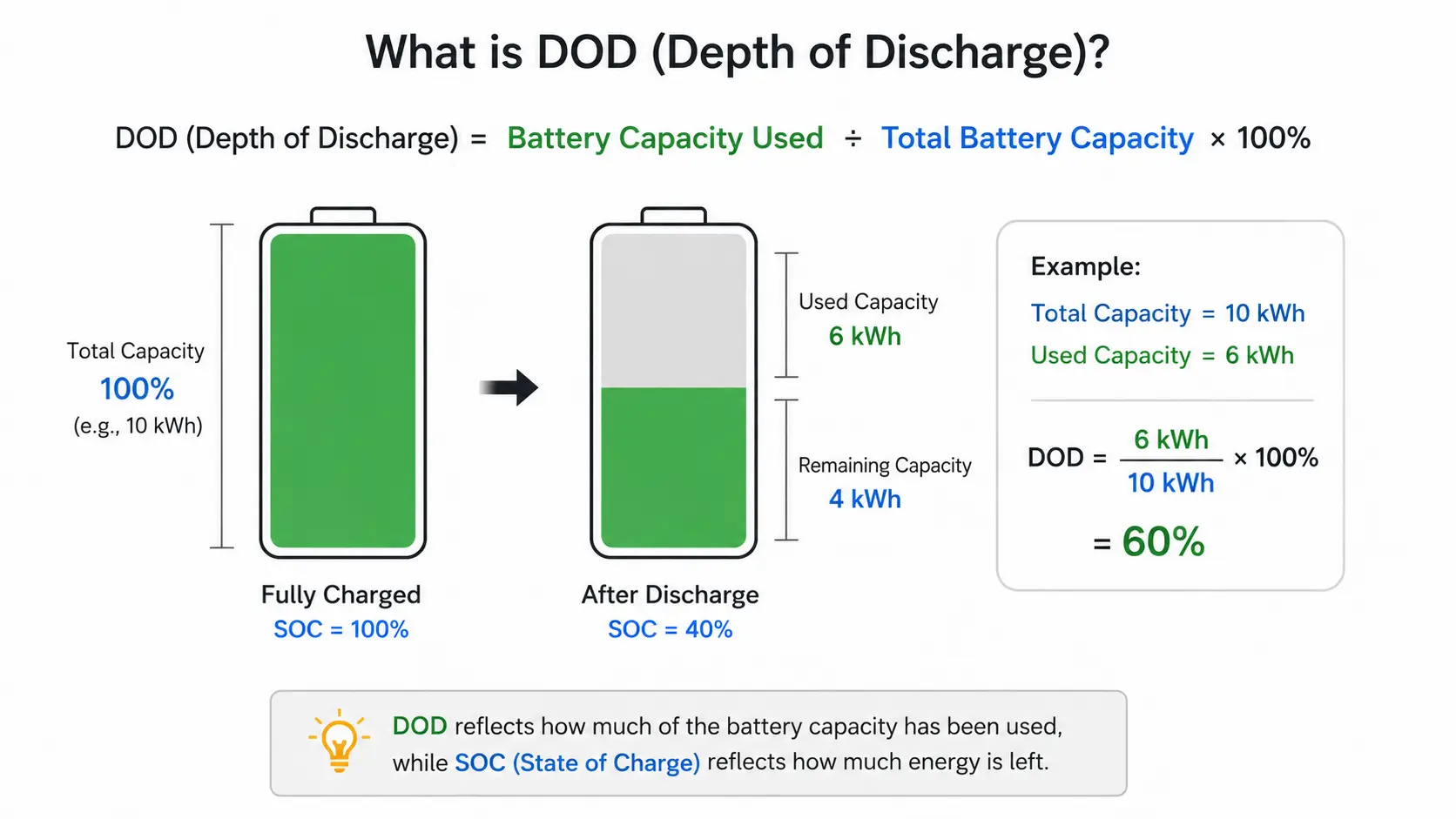
Depth of discharge – DOD – is the percentage of a battery’s stored energy you use before recharging it. Discharge a 10 kWh pack down to 5 kWh remaining and you’ve used 50% DOD. Run it until the BMS cuts off and you’ve hit 100% DOD. It sounds like a definition, but it’s actually the single most important number on the datasheet, because it sets the cycle life, the usable capacity and the warranty terms all at once.
本文解釋什麼是實際的 DOD,提供決定應該放電到多深的數字,並示範一個認真的原廠/代工合作夥伴如何運用 DOD 來為您的市場調整電池。.
決定循環壽命的數字——DOD 如何在單電芯層面運作
DOD 與充電狀態 (SOC) 是同一枚硬幣的兩面。當電池的 SOC 為 30%,已放電至 70% DOD。BMS 同時追蹤兩者,但對壽命而言重要的是 DOD,因為每一次放電都會略微耗損電池化學組成,且放電越深耗損越快。.
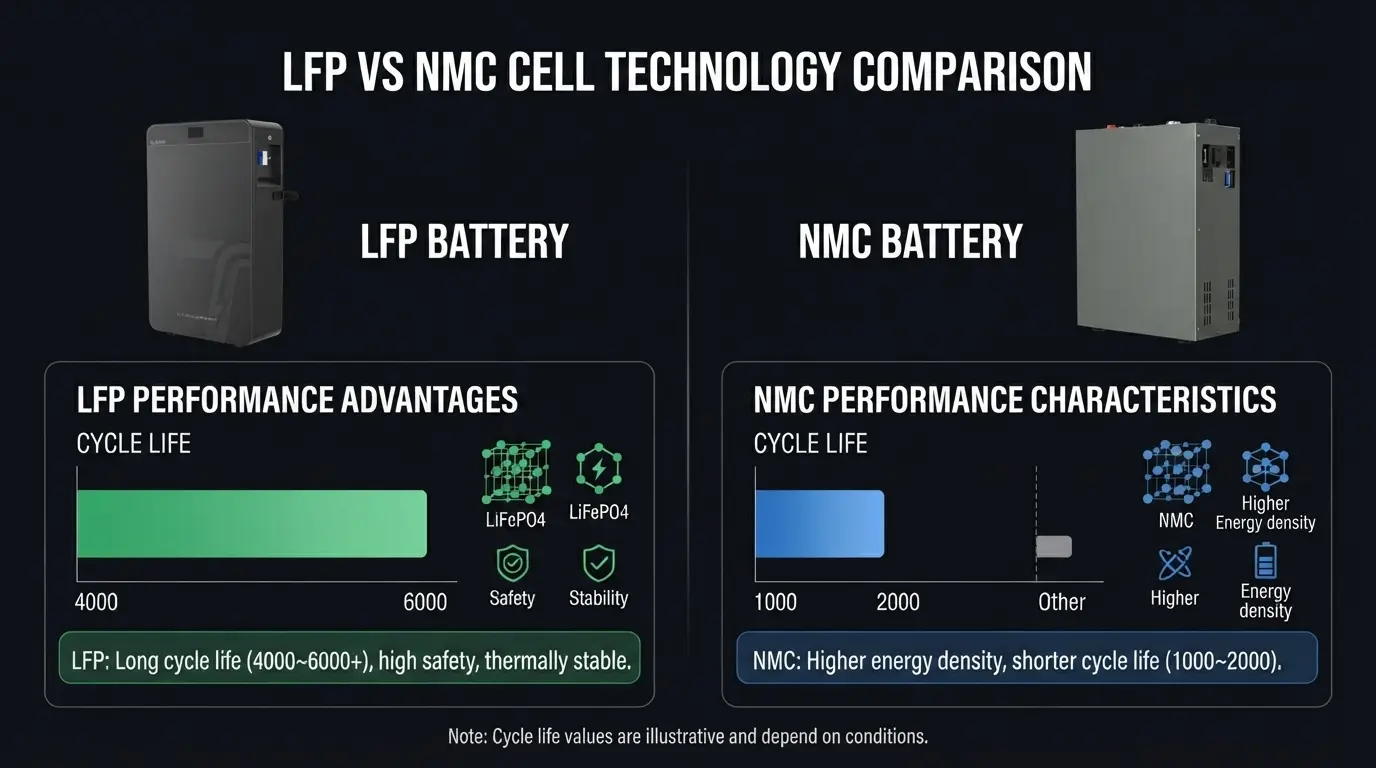
Take a grade-A LFP prismatic cell with a 3.2V nominal voltage and a 2.5–3.65V operating window. Discharging to 2.5V per cell is 100% DOD. At 0.5C and 25°C, that cell typically delivers 4,000–6,000 cycles before it drops to 80% of original capacity. Now limit the same cell to 80% DOD – stop at 3.2V instead of 2.5V – and the cycle count climbs to roughly 6,000–8,000. Cut it to 50% DOD and you’re looking at 10,000 cycles or more.
You’ll also notice how close 3.25V and 3.2V are. The LFP discharge curve is so flat between 3.3V and 3.2V that voltage alone can’t tell you the DOD – which is why the BMS counts coulombs instead of just watching voltage. A cheap BMS that guesses DOD from voltage will drift, and the drift shows up as premature cutoffs or over-discharge in the field.

Here’s the counter-intuitive part. A 10 kWh pack cycled at 100% DOD for 5,000 cycles delivers about 50,000 kWh over its life. The same pack cycled at 50% DOD for 12,000 cycles delivers 60,000 kWh – 20% more total energy from the same hardware, just by discharging it half as deep each time. Depth of discharge doesn’t just change how many cycles you get; it changes how much total energy the pack will ever move.
That’s why the two datasheets in the opening can’t be compared directly. 6,000 cycles at 80% DOD and 4,000 cycles at 100% DOD are the same cell, tested under different rules. The first battery will actually deliver more total kilowatt-hours over its life.
真正的原始裝備製造商/ ODM 合作夥伴 使用 DOD 的方式
貿易公司會印出任何電池供應商給的 DOD 編號。製造商將 DOD 視為設計決策,因為它就是一個決策。.
The DOD limit lives in the BMS firmware, not in the hardware. A genuine OEM/ODM partner will set the discharge cutoff voltage to match your market – 2.5V per cell for a 100% DOD product aimed at backup power, 3.2V for an 80% DOD product aimed at daily self-consumption – and they’ll tune the low-voltage warning thresholds to match. The same pack, the same cells, two different products, separated by a firmware parameter.
They’ll also align the warranty with the DOD setting. A serious manufacturer writes the warranty as a set of conditions – for example, 10 years or 6,000 cycles at 80% DOD, 0.5C, 25°C ambient – and they’ll tell you exactly what happens to the warranty if your installers run the pack deeper. If your market needs 100% DOD, they’ll spec a larger pack so the customer still gets the usable kilowatt-hours they paid for, instead of quietly voiding the warranty.
And they’ll handle the white-label side without blinking: your brand on the label, your connector variant, your firmware defaults, MOQ flexibility and sample lead times measured in weeks, not quarters. DOD is one of the parameters you get to own when you work with the factory directly.
50% vs 80% vs 100% DOD – 決策矩陣
以下是針對 10 kWh LFP 住宅用電池組、以 0.5C、25°C 使用 A 等級電池時,最相關的比較。.
| 規格 | 50% DOD | 80% DOD | 100% DOD |
|---|---|---|---|
| 每個循環可用容量 | 5度 | 8度 | 10千瓦時 |
| 典型循環壽命至80% | 10,000+ | 6,000–8,000 | 4,000–6,000 |
| 壽命能量吞吐量 | ~60,000 kWh | ~56,000 kWh | ~50,000 kWh |
| 每節放電截止電壓 | ~3.25V | ~3.2V | 2.5V |
| 最佳擬合 | 電網備援,罕見停電 | 每日自我消耗 | 離網,整夜使用 |
| 保固定位 | 最長、最容易履約 | 標準 | 最短、需要更大的包 |

模式很清楚。最深放電在每個循環中為你提供最多的可用能量,但循環次數最少且在組件壽命期內的總能量最少。最淺的放電延長保固,但浪費你支付的容量。對於大多數住宅市場,80–90TP5T DOD 是甜蜜點——這正是為什麼大多數認真製造商在其家用儲存產品的默認 DOD 為 80% 或 90% 的原因。.
現場中 DOD 失敗的四種方式
- 一、在沒有 DOD 的情況下比較循環壽命。. 在 80% DOD 下宣稱 6,000 次循環,在 100% DOD 下宣稱 4,000 次循環描述的是同一顆電池。要求背後的 DOD、C-速率與溫度,否則比較毫無意義。.
- 二、把鉛酸的習慣套用到鋰電池。. 鉛酸電池在低於 50% DOD 時就會快速衰竭,因此老派安裝人員會把鉛電池組容量標成可用容量的兩倍。鋰鐵磷電池常態可承受 80–100% DOD。若你的安裝人員仍像對待鉛電池那樣規格鋰電池,他們就是在賣給客戶雙倍於其實需要的電池。.
- 三、混淆可用容量與名義容量。. 以 80% DOD 的 10 kWh 電池組來看,每個循環只能提供 8 kWh,而不是 10 kWh。如果客戶每日負載為 9 kWh,該電池組將每晚都達到臨界值,BMS 會記錄。請根據你打算運行的 DOD 設定,讓電池組的容量與負載相匹配。.
- 四 - 在保固條款中忽略 DOD(放電深度)。. 某些保固條款寫明在 80% DOD,若包裝放電深度過深就會悄悄降級。在向客戶報價循環壽命之前,閱讀保固條件,並取得書面確認的 DOD 設定。.
買家對 DOD 的提問
設定市場實際需要的 DOD
Depth of discharge is not a spec to skim. It’s the number that sets your cycle life, your usable capacity and your warranty exposure in one stroke. Get it right and you sell a battery that delivers what the datasheet promises. Get it wrong and you’re fielding warranty claims in year three.
If you’re sourcing residential storage at volume, send us your daily load profile, your target warranty period and your market’s peak ambient temperature, and we’ll return a DOD recommendation with the cycle-life test conditions and warranty terms named in full within 24 hours.