 Basa Jawa
  English
  العربية
  日本語
日本語  한국어
한국어  Tiếng Việt
  ไทย
ไทย  Bahasa Melayu
  فارسی
فارسی  Bahasa Indonesia
  ဗမာစာ
ဗမာစာ  简体中文
简体中文  香港中文
香港中文  繁體中文
繁體中文  Русский
  Deutsch
  Nederlands
  Italiano
  Français
  Español
  Português
  Afrikaans
  Azərbaycan dili
  Български
  ਪੰਜਾਬੀ
  हिन्दी
  اردو
اردو  বাংলা
বাংলা  Հայերեն
  Íslenska
  Қазақ тілі
  नेपाली
  Српски језик
  Kiswahili
  తెలుగు
  தமிழ்
தமிழ்  मराठी
मराठी Apa Depth of Discharge lan kenapa nangani Garansi Baterei sampeyan
Manajer pengadaan ing Indonesia mbandingake loro baterei dinding 10 kWh for the same installer network. One datasheet promises 6,000 cycles at 80% DOD. The other promises 4,000 cycles at 100% DOD. Both brands claim to be “the longest-lasting battery on the market.” The manager has no idea which one actually lasts longer, because the answer is hiding inside a three-letter abbreviation neither sales rep bothered to explain.
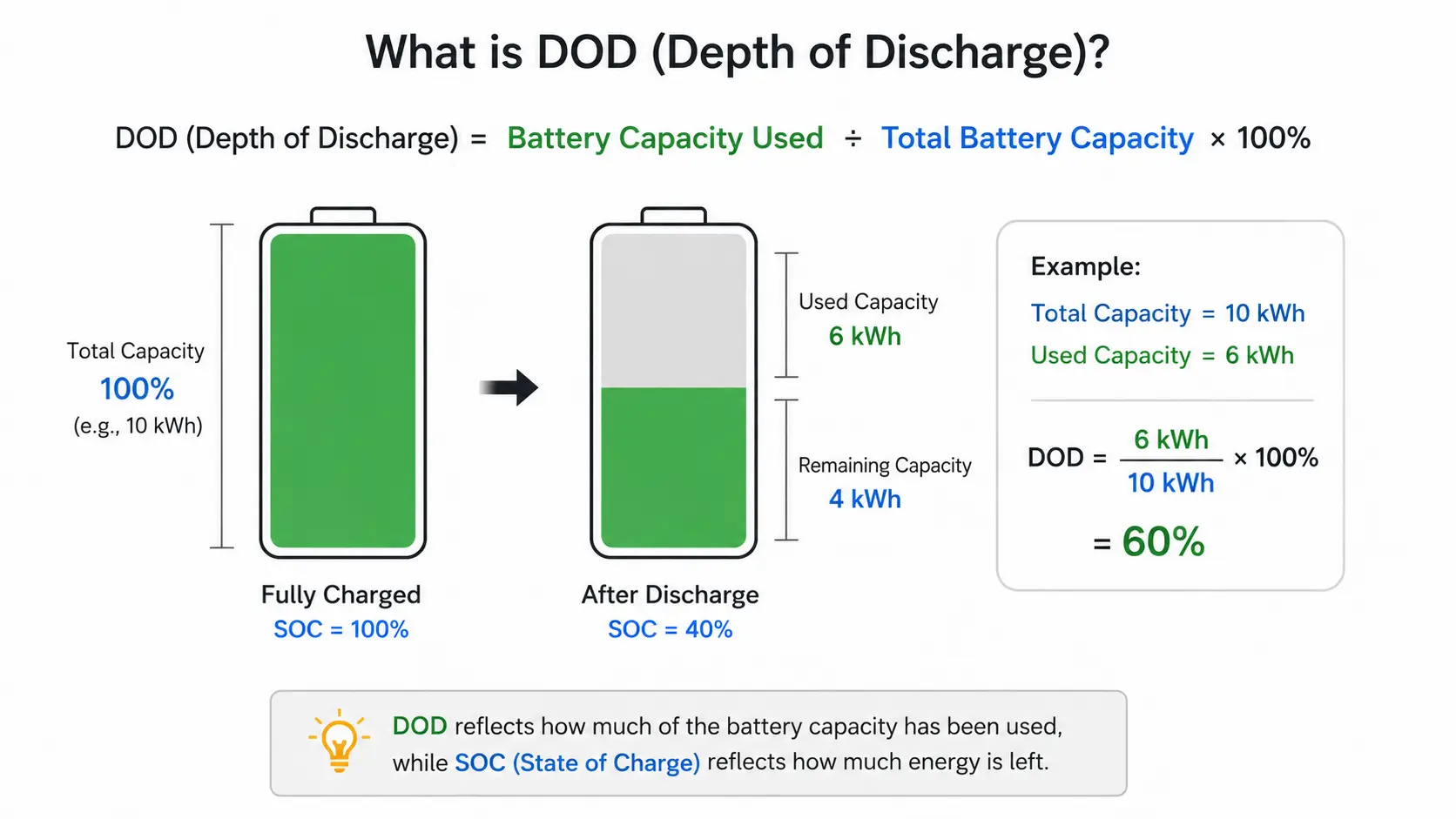
Depth of discharge – DOD – is the percentage of a battery’s stored energy you use before recharging it. Discharge a 10 kWh pack down to 5 kWh remaining and you’ve used 50% DOD. Run it until the BMS cuts off and you’ve hit 100% DOD. It sounds like a definition, but it’s actually the single most important number on the datasheet, because it sets the cycle life, the usable capacity and the warranty terms all at once.
Artikel iki nerangake apa sejatine DOD, menehi nomer-nomer sing nemtokake sampeyan kudu ngedischarge pira jero, lan nuduhake carane partner OEM/ODM sing serius nggunakake DOD kanggo ngatur baterei kanggo pasar sampeyan.
Nomer sing ngatur umur siklus – Carane DOD bisa digunakake ing tingkat sel
DOD lan status pengisian (SOC) loro-lorone minangka loro sisih saka koin sing padha. Baterei kanthi SOC 30% wis dibusak nganti DOD 70%. BMS nglacak loro-lorone, nanging sing penting kanggo umur awet yaiku DOD, amarga saben siklus pambusuran ng lendhut kimia sel sethithik, lan pambusuran sing luwih jero bakal ngilangake kimia kasebut luwih cepet.
Take a grade-A LFP prismatic cell with a 3.2V nominal voltage and a 2.5–3.65V operating window. Discharging to 2.5V per cell is 100% DOD. At 0.5C and 25°C, that cell typically delivers 4,000–6,000 cycles before it drops to 80% of original capacity. Now limit the same cell to 80% DOD – stop at 3.2V instead of 2.5V – and the cycle count climbs to roughly 6,000–8,000. Cut it to 50% DOD and you’re looking at 10,000 cycles or more.
You’ll also notice how close 3.25V and 3.2V are. The LFP discharge curve is so flat between 3.3V and 3.2V that voltage alone can’t tell you the DOD – which is why the BMS counts coulombs instead of just watching voltage. A cheap BMS that guesses DOD from voltage will drift, and the drift shows up as premature cutoffs or over-discharge in the field.

Here’s the counter-intuitive part. A 10 kWh pack cycled at 100% DOD for 5,000 cycles delivers about 50,000 kWh over its life. The same pack cycled at 50% DOD for 12,000 cycles delivers 60,000 kWh – 20% more total energy from the same hardware, just by discharging it half as deep each time. Depth of discharge doesn’t just change how many cycles you get; it changes how much total energy the pack will ever move.
That’s why the two datasheets in the opening can’t be compared directly. 6,000 cycles at 80% DOD and 4,000 cycles at 100% DOD are the same cell, tested under different rules. The first battery will actually deliver more total kilowatt-hours over its life.
Apa sing Dilakoni Partner OEM/ODM Sejati Kanthi DOD
Salah siji perusahaan perdagangan nyetak apa wae nomer DOD sing diwenehake dening pemasok sel. Pabrikan nganggep DOD minangka kaputusan desain, amarga iku minangka siji.
The DOD limit lives in the BMS firmware, not in the hardware. A genuine OEM/ODM partner will set the discharge cutoff voltage to match your market – 2.5V per cell for a 100% DOD product aimed at backup power, 3.2V for an 80% DOD product aimed at daily self-consumption – and they’ll tune the low-voltage warning thresholds to match. The same pack, the same cells, two different products, separated by a firmware parameter.
They’ll also align the warranty with the DOD setting. A serious manufacturer writes the warranty as a set of conditions – for example, 10 years or 6,000 cycles at 80% DOD, 0.5C, 25°C ambient – and they’ll tell you exactly what happens to the warranty if your installers run the pack deeper. If your market needs 100% DOD, they’ll spec a larger pack so the customer still gets the usable kilowatt-hours they paid for, instead of quietly voiding the warranty.
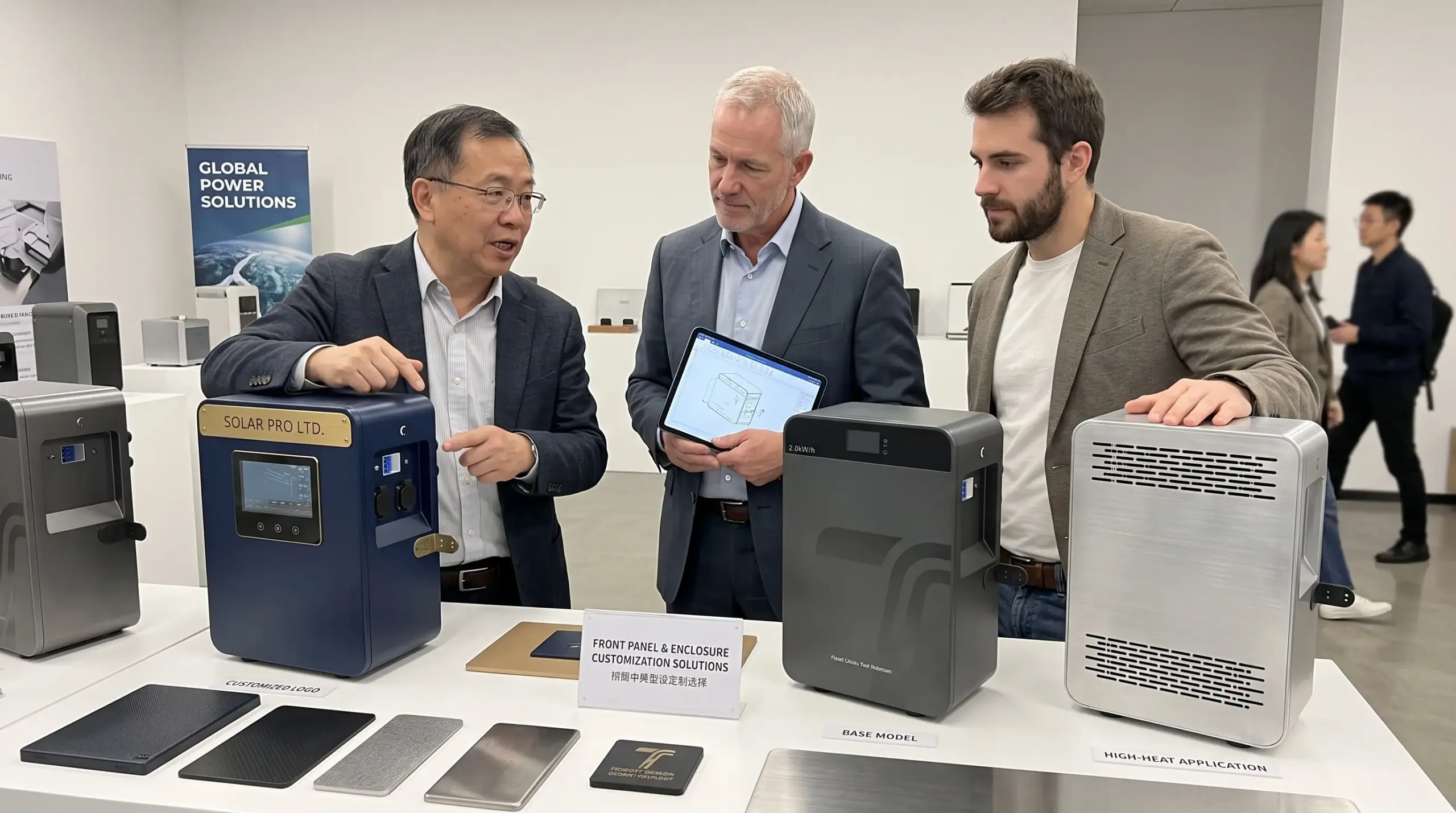
And they’ll handle the white-label side without blinking: your brand on the label, your connector variant, your firmware defaults, MOQ flexibility and sample lead times measured in weeks, not quarters. DOD is one of the parameters you get to own when you work with the factory directly.
50% vs 80% vs 100% DOD – Matriks Kaputusan
Mangkene perbandingan sing penting kanggo paket LFP omahan 10 kWh, nggunakake sel grade-A ing 0.5C lan 25°C.
| Spesifikasi | DOD 50% | DOD 80% | DOD 100% |
|---|---|---|---|
| Kapastasan bisa digunakake saben siklus | 5 kWh | 8 kWh | 10 kWh |
| Umur siklus tipikal nganti 80% | 10,000+ | 6.000–8.000 | 4.000–6.000 |
| Litre energi sajrone urip | ~60.000 kWh | ~56.000 kWh | ~50.000 kWh |
| Pemutusan discharge per sel | ~3,25V | ~3,2V | 2,5V |
| Paling pas | Cadangan grid, gangguan langka | Kahuripan harian dhéwé-él | Off-grid, maksimum kagungan kanggo spanjang wengi |
| Posisi garansi | Panjang, paling gampang ditrima | Standar | Paling cekak, mbutuhake paket luwih gedhe |

pola kasebut jelas. Discharge paling jero menehi energi sing paling bisa digunakake saben siklus nanging paling sithik siklus lan total energi sing paling sithik sajrone umur paké. Discharge sing paling cekak ngluwihi garansi nanging mbuwang kapasitas sing wis mbayar. Kanggo mayoritas pasar residensial, 80–90% DOD iku titik manis – lan kuwi persis sebabé mayoritas pabrikan sing serius ngirim produk panyimpenan omah kanthi DOD default 80% utawa 90%.
Papat cara DOD kelakon salah ing lapangan
- Siji – Mbandhingake umur siklus tanpa DOD. Tuduhan 6.000 siklus kanthi DOD 80% lan tuduhan 4.000 siklus kanthi DOD 100% nerangake sel sing padha. Tape DOD, laju-C lan suhu ing balik saben nomer siklus, utawa perbandingan kasebut ora duwe teges.
- Loro – Nggunakake kabiasan timbal-asam kanggo litium. Baterei timbal-asam mati cepet ing ngisor 50% DOD, yaiku sebab instalator lawas ngukur bank timbal kanthi kapasitas sing bisa digunakake kaping pindho. LFP ngidini 80–100% DOD kanthi rutin. Yen instalator sampeyan isih ngukur litium kaya timbal, dheweke adol pelanggan loro baterei sing dibutuhake.
- Telu – Bingung antarané kapasitas bisa digunakake lan nominal. Paket 10 kWh ing 80% DOD ngasilake 8 kWh saben siklus, ora 10. Yen beban saben dina pelanggan yaiku 9 kWh, paket bakal nggayuh ambang batas saben dinane lan BMS bakal nyathet. Ukur paket miturut beban ing DOD sing arep sampeyan lakoni.
- Papat – Ngabahe DOD ing syarat garansi. Sawetara garansi ditulis ing 80% DOD lan kanthi diam-diam ngalor-ngidul yen paket kasebut luwih jero. Waca syarat garansi sadurunge sampeyan ngutip umur siklus marang pelanggan lan konfirmasi setelan DOD sacara tertulis.
Pitakon Pambelian sing Biasane Ditakoni Babagan DOD
Setel DOD sing Parsaingan Pasar Panjenengan Kabutuhake
Depth of discharge is not a spec to skim. It’s the number that sets your cycle life, your usable capacity and your warranty exposure in one stroke. Get it right and you sell a battery that delivers what the datasheet promises. Get it wrong and you’re fielding warranty claims in year three.
If you’re sourcing residential storage at volume, send us your daily load profile, your target warranty period and your market’s peak ambient temperature, and we’ll return a DOD recommendation with the cycle-life test conditions and warranty terms named in full within 24 hours.