 Nederlands
  English
  العربية
  日本語
日本語  한국어
한국어  Tiếng Việt
  ไทย
ไทย  Bahasa Melayu
  فارسی
فارسی  Bahasa Indonesia
  ဗမာစာ
ဗမာစာ  简体中文
简体中文  香港中文
香港中文  繁體中文
繁體中文  Русский
  Deutsch
  Italiano
  Français
  Español
  Português
  Afrikaans
  Azərbaycan dili
  Български
  ਪੰਜਾਬੀ
  हिन्दी
  اردو
اردو  বাংলা
বাংলা  Հայերեն
  Íslenska
  Қазақ тілі
  नेपाली
  Српски језик
  Kiswahili
  తెలుగు
  Basa Jawa
  தமிழ்
தமிழ்  मराठी
मराठी Wat is diepte van ontlading en waarom bepaalt dit uw batterijketen
Een inkoopmanager in with South Africa comparing two 10 kWh wandmontagebatterijen for the same installer network. One datasheet promises 6,000 cycles at 80% DOD. The other promises 4,000 cycles at 100% DOD. Both brands claim to be “the longest-lasting battery on the market.” The manager has no idea which one actually lasts longer, because the answer is hiding inside a three-letter abbreviation neither sales rep bothered to explain.
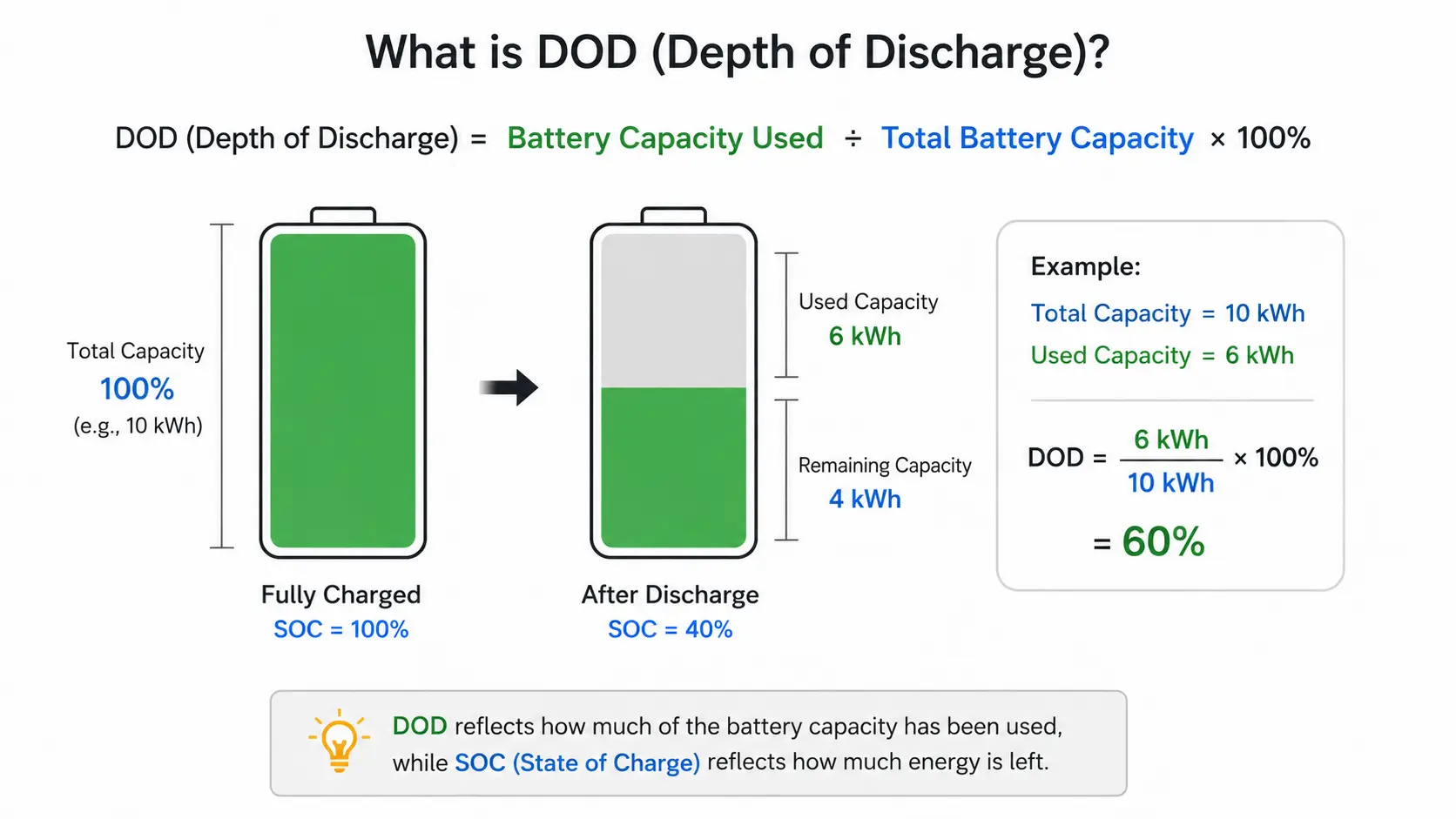
Depth of discharge – DOD – is the percentage of a battery’s stored energy you use before recharging it. Discharge a 10 kWh pack down to 5 kWh remaining and you’ve used 50% DOD. Run it until the BMS cuts off and you’ve hit 100% DOD. It sounds like a definition, but it’s actually the single most important number on the datasheet, because it sets the cycle life, the usable capacity and the warranty terms all at once.
Dit artikel legt uit wat DOD echt is, geeft je de cijfers die bepalen hoe diep je moet ontladen, en laat zien hoe een serieuze OEM/ODM-partner DOD gebruikt om een batterij af te stemmen op jouw markt.
Het Getal dat de Cyclische Levensduur Bepaalt – Hoe DOD Werkt op Celniveau
DOD en staat van lading (SOC) zijn twee kanten van dezelfde munt. Een batterij bij 30% SOC is ontladen tot 70% DOD. De BMS volgt beide, maar degene die belangrijk is voor de levensduur is DOD, want elke ontlaadcyclus verstoort de cellulaire chemie een beetje, en diepere ontladingen doen dit sneller.
Take a grade-A LFP prismatic cell with a 3.2V nominal voltage and a 2.5–3.65V operating window. Discharging to 2.5V per cell is 100% DOD. At 0.5C and 25°C, that cell typically delivers 4,000–6,000 cycles before it drops to 80% of original capacity. Now limit the same cell to 80% DOD – stop at 3.2V instead of 2.5V – and the cycle count climbs to roughly 6,000–8,000. Cut it to 50% DOD and you’re looking at 10,000 cycles or more.
You’ll also notice how close 3.25V and 3.2V are. The LFP discharge curve is so flat between 3.3V and 3.2V that voltage alone can’t tell you the DOD – which is why the BMS counts coulombs instead of just watching voltage. A cheap BMS that guesses DOD from voltage will drift, and the drift shows up as premature cutoffs or over-discharge in the field.

Here’s the counter-intuitive part. A 10 kWh pack cycled at 100% DOD for 5,000 cycles delivers about 50,000 kWh over its life. The same pack cycled at 50% DOD for 12,000 cycles delivers 60,000 kWh – 20% more total energy from the same hardware, just by discharging it half as deep each time. Depth of discharge doesn’t just change how many cycles you get; it changes how much total energy the pack will ever move.
That’s why the two datasheets in the opening can’t be compared directly. 6,000 cycles at 80% DOD and 4,000 cycles at 100% DOD are the same cell, tested under different rules. The first battery will actually deliver more total kilowatt-hours over its life.
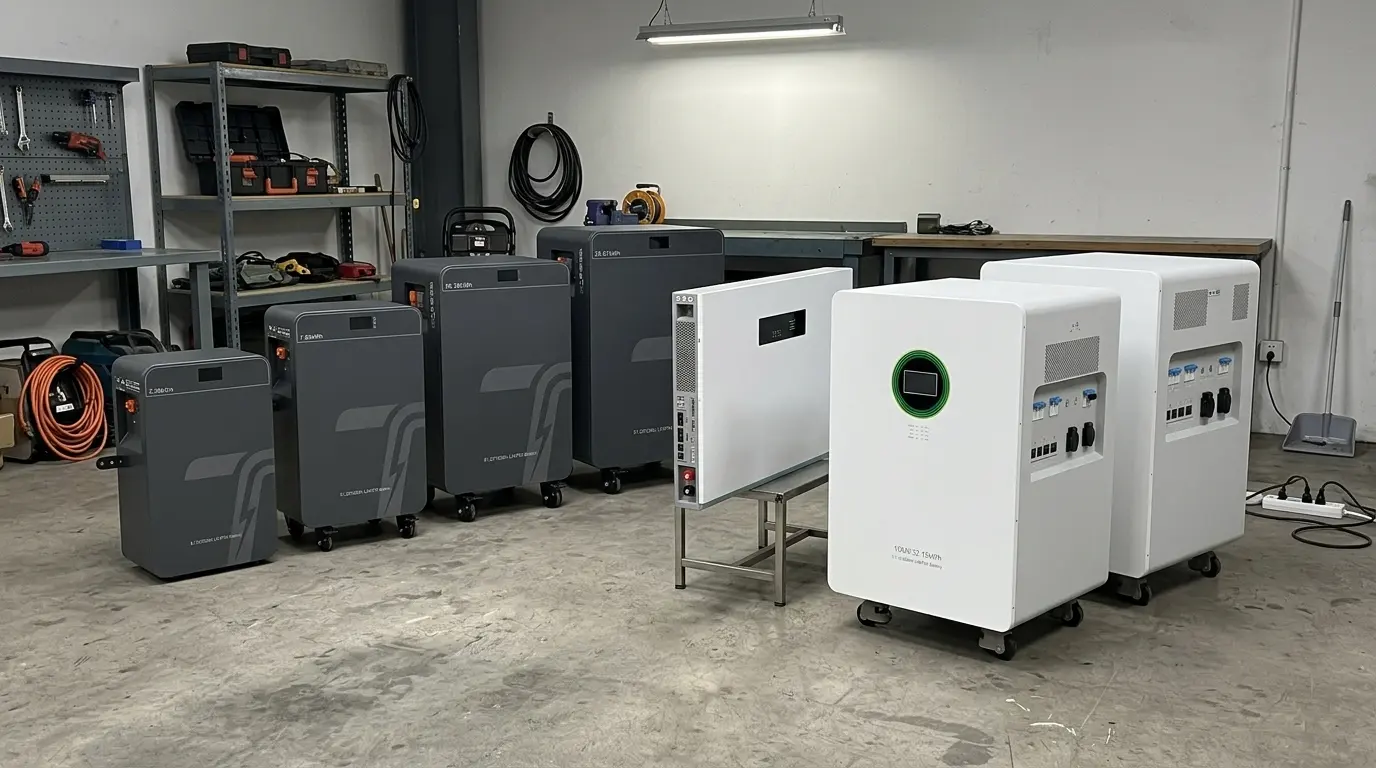
Wat een echte OEM/ODM-partner met DOD doet
Een handelsonderneming drukt wat voor DOD-nummer de cell leverancier heeft meegegeven. Een fabrikant behandelt DOD als een ontwerpbepaling, omdat het er een is.
The DOD limit lives in the BMS firmware, not in the hardware. A genuine OEM/ODM partner will set the discharge cutoff voltage to match your market – 2.5V per cell for a 100% DOD product aimed at backup power, 3.2V for an 80% DOD product aimed at daily self-consumption – and they’ll tune the low-voltage warning thresholds to match. The same pack, the same cells, two different products, separated by a firmware parameter.
They’ll also align the warranty with the DOD setting. A serious manufacturer writes the warranty as a set of conditions – for example, 10 years or 6,000 cycles at 80% DOD, 0.5C, 25°C ambient – and they’ll tell you exactly what happens to the warranty if your installers run the pack deeper. If your market needs 100% DOD, they’ll spec a larger pack so the customer still gets the usable kilowatt-hours they paid for, instead of quietly voiding the warranty.
And they’ll handle the white-label side without blinking: your brand on the label, your connector variant, your firmware defaults, MOQ flexibility and sample lead times measured in weeks, not quarters. DOD is one of the parameters you get to own when you work with the factory directly.
50% vs 80% vs 100% DOD – De Decision Matrix
Hier is de vergelijking die er toe doet voor een 10 kWh LFP-woonpakket, met cellen van klasse-A bij 0,5C en 25°C.
| Specificatie | 50% DOD | 80% DOD | 100% DOD |
|---|---|---|---|
| bruikbare capaciteit per cyclus | 5 kWh | 8 kWh | 10 kWh |
| Typische cyclusduur tot 80% | 10,000+ | 6.000–8.000 | 4.000–6.000 |
| Levensduur energieverwerking | ~60.000 kWh | ~56.000 kWh | ~50.000 kWh |
| Ontlaadgrens per cel | ~3,25 V | ~3,2 V | 2,5 V |
| Beste pasvorm | Netwerkbackup, zeldzame uitval | Dagelijkse zelfconsumptie | Netstroomlossing, volledig ’s nachts gebruik |
| Garantiestand | Langste, gemakkelijkste om te honoreren | Standaard | Kortste, grotere accu benodigd |

Het patroon is duidelijk. De diepste ontlading levert per cyclus de meeste bruikbare energie op, maar het minste aantal cycli en de minste totale energie over de levensduur van de accu. De minst diepe ontlading verlengt de garantie, maar verspilt capaciteit waarvoor je hebt betaald. Voor de meeste residentiële markten is 80–90% DOD de zoete plek – en daarom leveren de meeste serieuze fabrikanten hun thuisopslagproducten standaard met een 80% of 90% DOD.
Vier manieren waarop DOD in het veld misgaat
- Één – cycli als levensduur vergelijken zonder DOD. Een claim van 6.000 cycli bij 80% DOD en een claim van 4.000 cycli bij 100% DOD beschrijven dezelfde cel. Vraag naar de DOD, C-rate en temperatuur achter elk cyclenummer, anders is de vergelijking betekenisloos.
- Twee – loodzuurgewoonten toepassen op lithium. Loodzuurbatterijen gaan snel dood bij 50–% DOD, daarom kiezen oude installateurs loodbanken op het dubbele van de bruikbare capaciteit. LFP kan routinematig 80–100% DOD aan. Als jouw installateurs lithium nog steeds op lood baseren, verkopen ze klanten het dubbele aan accu’s dat ze niet nodig hebben.
- Drie – bruikbare en nominale capaciteit verwarren. Een 10 kWh-pack bij 80% DOD levert 8 kWh per cyclus op, niet 10. Als de dagelijkse belasting van de klant 9 kWh is, bereikt de pack elke nacht de ondergrens en zal de BMS dit registreren. Dimensioneer de pack op de belasting bij de gewenste DOD.
- Vier – De DOD negeren in de garantievoorwaarden. Sommige garanties zijn geschreven bij 80% DOD en degraderen stilletjes als de pack dieper draait. Lees de garantievoorwaarden voordat je de cycluslevensduur aan je klant opgeeft en laat de DOD-instelling schriftelijk bevestigen.
Vragen die Kopers Stellen Over DOD
Stel de DOD in die uw markt daadwerkelijk nodig heeft
Depth of discharge is not a spec to skim. It’s the number that sets your cycle life, your usable capacity and your warranty exposure in one stroke. Get it right and you sell a battery that delivers what the datasheet promises. Get it wrong and you’re fielding warranty claims in year three.
If you’re sourcing residential storage at volume, send us your daily load profile, your target warranty period and your market’s peak ambient temperature, and we’ll return a DOD recommendation with the cycle-life test conditions and warranty terms named in full within 24 hours.