 Bahasa Melayu
  English
  العربية
  日本語
日本語  한국어
한국어  Tiếng Việt
  ไทย
ไทย  فارسی
فارسی  Bahasa Indonesia
  ဗမာစာ
ဗမာစာ  简体中文
简体中文  香港中文
香港中文  繁體中文
繁體中文  Русский
  Deutsch
  Nederlands
  Italiano
  Français
  Español
  Português
  Afrikaans
  Azərbaycan dili
  Български
  ਪੰਜਾਬੀ
  हिन्दी
  اردو
اردو  বাংলা
বাংলা  Հայերեն
  Íslenska
  Қазақ тілі
  नेपाली
  Српски језик
  Kiswahili
  తెలుగు
  Basa Jawa
  தமிழ்
தமிழ்  मराठी
मराठी Apa itu Kedalaman Pendaratan dan Mengapa Ia Menentukan Jaminan Bateri Anda
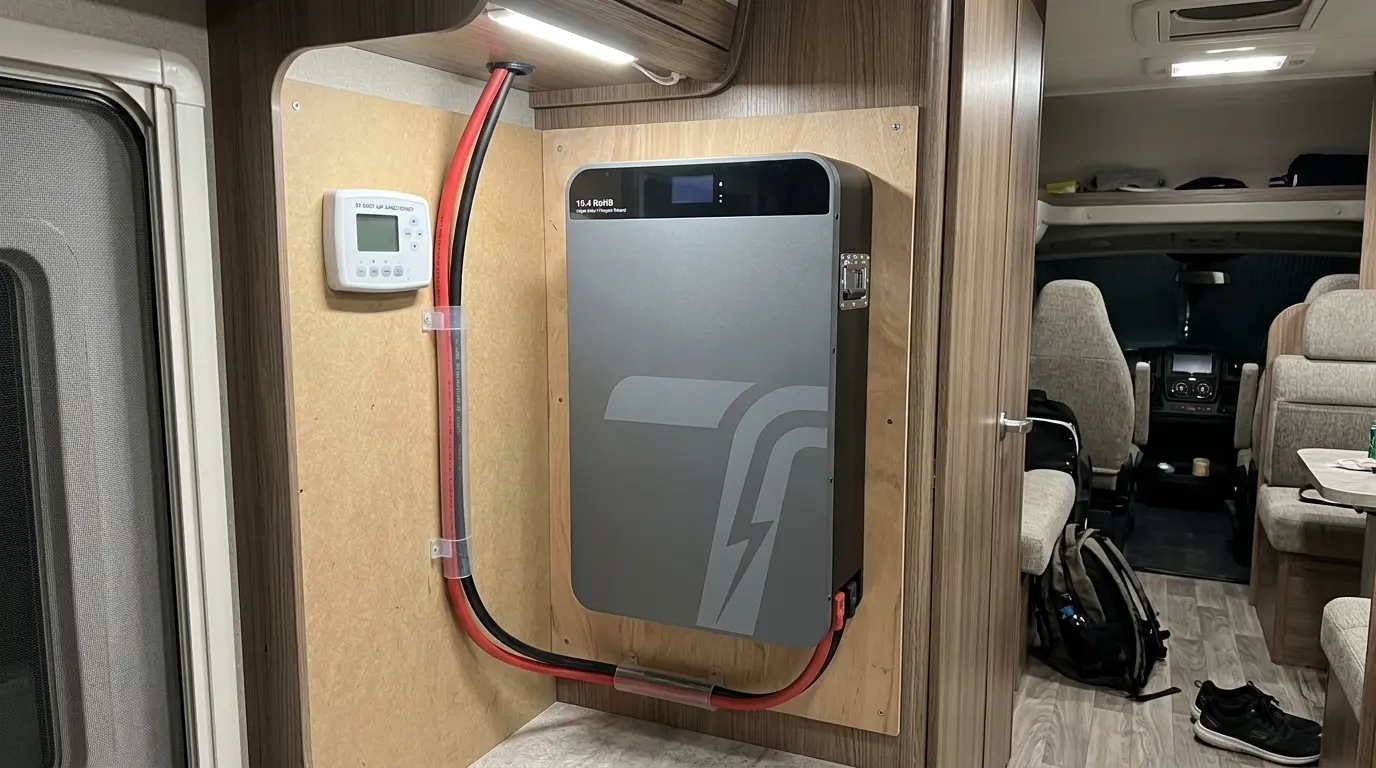
Pengurus pembelian di Malaysia membandingkan dua 2000 W•h bateri dinding pasang for the same installer network. One datasheet promises 6,000 cycles at 80% DOD. The other promises 4,000 cycles at 100% DOD. Both brands claim to be “the longest-lasting battery on the market.” The manager has no idea which one actually lasts longer, because the answer is hiding inside a three-letter abbreviation neither sales rep bothered to explain.
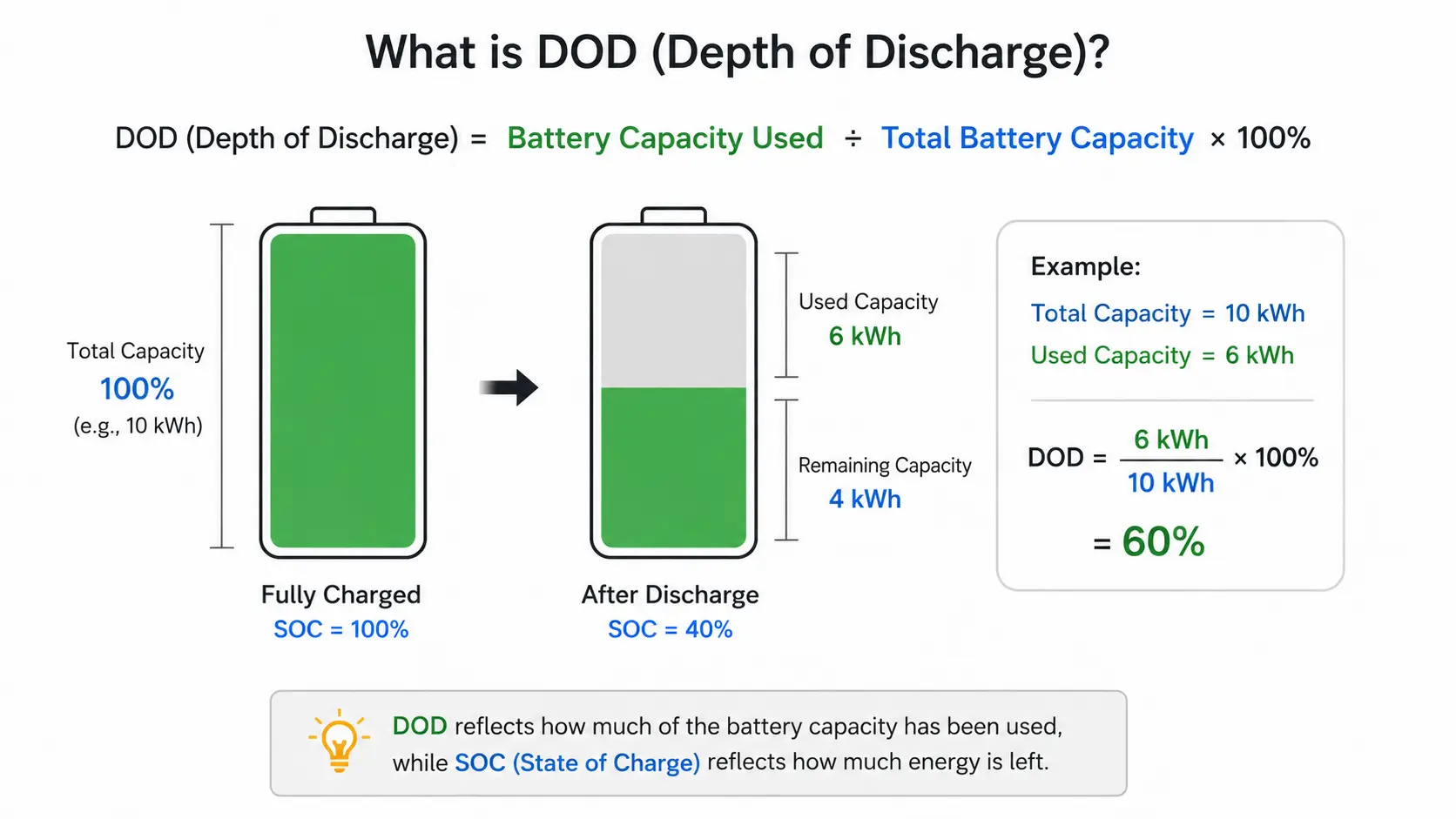
Depth of discharge – DOD – is the percentage of a battery’s stored energy you use before recharging it. Discharge a 10 kWh pack down to 5 kWh remaining and you’ve used 50% DOD. Run it until the BMS cuts off and you’ve hit 100% DOD. It sounds like a definition, but it’s actually the single most important number on the datasheet, because it sets the cycle life, the usable capacity and the warranty terms all at once.
Artikel ini menjelaskan apa sebenar DOD, memberikan anda nombor-nombor yang menentukan sejauh mana anda perlu mendaratkan, dan menunjukkan kepada anda bagaimana rakan OEM/ODM yang serius menggunakan DOD untuk menala bateri bagi pasaran anda.
Nombor yang Menyebabkan Purata Ciklus — Bagaimana DOD Berfungsi pada Peringkat Sel
DOD dan keadaan caj (SOC) adalah dua sisi mata wang yang sama. Bateri pada SOC 30% telah dicas sehingga DOD 70%. BMS menjejaki keduanya, tetapi yang penting untuk ketahanan adalah DOD, kerana setiap kitaran pengecasan merosakkan kimia sel sedikit, dan pendaratan yang lebih dalam akan merosakkannya lebih pantas.
Take a grade-A LFP prismatic cell with a 3.2V nominal voltage and a 2.5–3.65V operating window. Discharging to 2.5V per cell is 100% DOD. At 0.5C and 25°C, that cell typically delivers 4,000–6,000 cycles before it drops to 80% of original capacity. Now limit the same cell to 80% DOD – stop at 3.2V instead of 2.5V – and the cycle count climbs to roughly 6,000–8,000. Cut it to 50% DOD and you’re looking at 10,000 cycles or more.
You’ll also notice how close 3.25V and 3.2V are. The LFP discharge curve is so flat between 3.3V and 3.2V that voltage alone can’t tell you the DOD – which is why the BMS counts coulombs instead of just watching voltage. A cheap BMS that guesses DOD from voltage will drift, and the drift shows up as premature cutoffs or over-discharge in the field.

Here’s the counter-intuitive part. A 10 kWh pack cycled at 100% DOD for 5,000 cycles delivers about 50,000 kWh over its life. The same pack cycled at 50% DOD for 12,000 cycles delivers 60,000 kWh – 20% more total energy from the same hardware, just by discharging it half as deep each time. Depth of discharge doesn’t just change how many cycles you get; it changes how much total energy the pack will ever move.
That’s why the two datasheets in the opening can’t be compared directly. 6,000 cycles at 80% DOD and 4,000 cycles at 100% DOD are the same cell, tested under different rules. The first battery will actually deliver more total kilowatt-hours over its life.
Apa yang Dilakukan Rakan Kongsi OEM/ODM Sebenar Dengan DOD
Sebuah syarikat perdagangan mencetak nombor DOD apa sahaja yang diberikan pembekal sel tersebut. Pengilang menganggap DOD sebagai keputusan reka bentuk, kerana ia adalah satu.
The DOD limit lives in the BMS firmware, not in the hardware. A genuine OEM/ODM partner will set the discharge cutoff voltage to match your market – 2.5V per cell for a 100% DOD product aimed at backup power, 3.2V for an 80% DOD product aimed at daily self-consumption – and they’ll tune the low-voltage warning thresholds to match. The same pack, the same cells, two different products, separated by a firmware parameter.
They’ll also align the warranty with the DOD setting. A serious manufacturer writes the warranty as a set of conditions – for example, 10 years or 6,000 cycles at 80% DOD, 0.5C, 25°C ambient – and they’ll tell you exactly what happens to the warranty if your installers run the pack deeper. If your market needs 100% DOD, they’ll spec a larger pack so the customer still gets the usable kilowatt-hours they paid for, instead of quietly voiding the warranty.
And they’ll handle the white-label side without blinking: your brand on the label, your connector variant, your firmware defaults, MOQ flexibility and sample lead times measured in weeks, not quarters. DOD is one of the parameters you get to own when you work with the factory directly.
50% berbanding 80% berbanding 100% DOD – Matrik Keputusan
Berikut ialah perbandingan yang penting untuk pek kediaman LFP 10 kWh, menggunakan sel gred-A pada 0.5C dan 25°C.
| Spesifikasi | 50% DOD | 80% DOD | 100% DOD |
|---|---|---|---|
| Kapasiti boleh guna setiap kitaran | 5 kWh | 8 kWh | 10 kWj |
| Hayat kitaran biasa sehingga 80% | 10,000+ | 6,000–8,000 | 4,000–6,000 |
| Tenaga melalui seumur hidup | ~60,000 kWh | ~56,000 kWh | ~50,000 kWh |
| Pengekalan pelepasan per sel | ~3.25V | ~3.2V | 2.5V |
| Paling sesuai | sandaran grid, gangguan jarang berlaku | Penggunaan sendiri harian | Luar grid, penggunaan sepanjang malam sepenuhnya |
| Kedudukan jaminan | Panjang umur, paling mudah untuk ditunaikan | Standard | Terpendek, perlu paket lebih besar |

Corak adalah jelas. Pelepasan terdalam memberikan anda tenaga yang paling boleh guna setiap kitaran tetapi paling sedikit kitaran dan jumlah tenaga keseluruhan terhad sepanjang hayat pek. Pelepasan terdalam melanjutkan jaminan tetapi membazir kapasiti yang anda bayar. Untuk kebanyakan pasaran kediaman, DOD 80–90%TP5T adalah titik manisan – dan itulah sebabnya kebanyakan pengeluar serius menghantar produk penyimpanan rumah mereka dengan tetapan lalai DOD 80% atau 90%.
Empat Cara DOD Tersalah di Lapangan
- Satu – Membandingkan hayat kitaran tanpa DOD. Tebusan 6,000 kitaran pada DOD 80% dan tuntutan 4,000 kitaran pada DOD 100% menggambarkan sel yang sama. Hale DOD, kadar C dan suhu di sebalik setiap nombor kitaran, atau perbandingan itu tidak bermakna.
- Dua – Menerapkan tabiat asid plumbum kepada litium. Bateri asid plumbum mati cepat di bawah DOD 50–%, itulah sebab pemasangan lama biasanya saiz bank plumbum dua kali kapasiti boleh guna. LFP mengendalikan DOD 80–100% secara rutin. Jika pemasang anda masih saiz litium seperti plumbum, mereka menjual pelanggan dua kali ganda bateri yang mereka perlukan.
- Tiga – Mengelirukan kapasiti boleh guna dan nominal. Pakej 10 kWh pada 80% DOD menghasilkan 8 kWh per kitaran, bukan 10. Jika beban harian pelanggan ialah 9 kWh, pakej akan mencapai had pada setiap malam dan BMS akan mencatatnya. Tetapkan saiz pakej mengikut beban pada DOD yang anda hendak jalankan.
- Empat – Mengabaikan DOD dalam syarat jaminan. Sesetengah jaminan ditulis pada DOD 80% dan secara senyap berkurangan jika pakej berjalan lebih dalam. Baca syarat jaminan sebelum anda sebutkan hayat kitaran kepada pelanggan anda, dan dapatkan pengesahan tetapan DOD secara bertulis.
Soalan yang Pembeli Tanyakan Tentang DOD
Tetapkan Keperluan Pasaran Anda Yang Sebenarnya
Depth of discharge bukan spesifikasi untuk diambil ringan. Ia adalah nombor yang menetapkan hayat kitaran anda, kapasiti boleh guna anda dan pendedahan jaminan anda dalam satu langkah. Betulkan ia dan anda menjual bateri yang memberikan apa yang dijanjikan oleh lembar data. Salah langkah dan anda akan menghadapi tuntutan jaminan pada tahun ketiga.
If you’re sourcing residential storage at volume, send us your daily load profile, your target warranty period and your market’s peak ambient temperature, and we’ll return a DOD recommendation with the cycle-life test conditions and warranty terms named in full within 24 hours.