 Íslenska
  English
  العربية
  日本語
日本語  한국어
한국어  Tiếng Việt
  ไทย
ไทย  Bahasa Melayu
  فارسی
فارسی  Bahasa Indonesia
  ဗမာစာ
ဗမာစာ  简体中文
简体中文  香港中文
香港中文  繁體中文
繁體中文  Русский
  Deutsch
  Nederlands
  Italiano
  Français
  Español
  Português
  Afrikaans
  Azərbaycan dili
  Български
  ਪੰਜਾਬੀ
  हिन्दी
  اردو
اردو  বাংলা
বাংলা  Հայերեն
  Қазақ тілі
  नेपाली
  Српски језик
  Kiswahili
  తెలుగు
  Basa Jawa
  தமிழ்
தமிழ்  मराठी
मराठी Hvað er afflóð dýptars og af hverju ákvarðar hún batteríávöxtun þín
Innskipunarstjórinn í Íslandi ber saman tvo 10 kWh vegghleðslubattería for the same installer network. One datasheet promises 6,000 cycles at 80% DOD. The other promises 4,000 cycles at 100% DOD. Both brands claim to be “the longest-lasting battery on the market.” The manager has no idea which one actually lasts longer, because the answer is hiding inside a three-letter abbreviation neither sales rep bothered to explain.
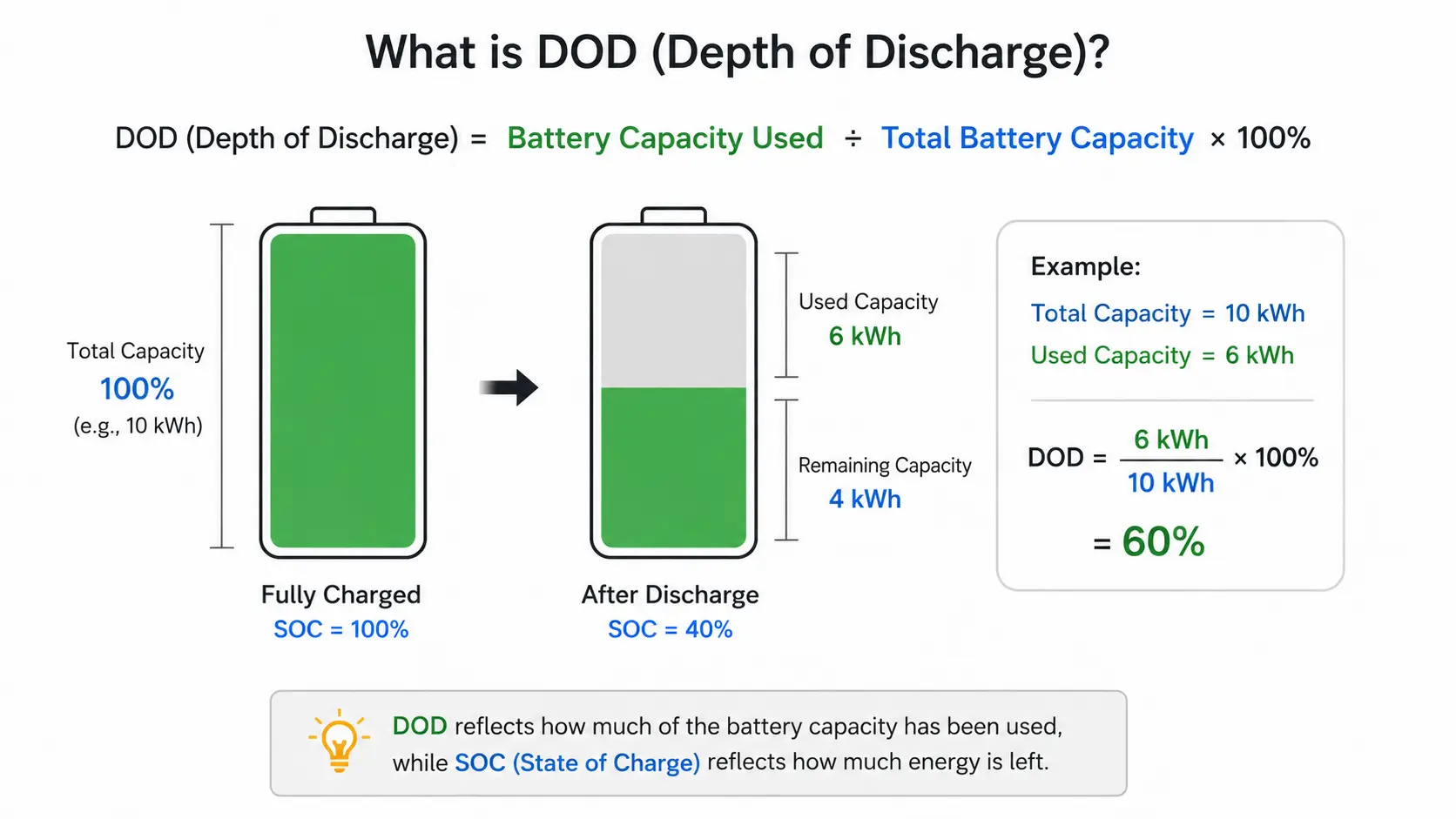
Depth of discharge – DOD – is the percentage of a battery’s stored energy you use before recharging it. Discharge a 10 kWh pack down to 5 kWh remaining and you’ve used 50% DOD. Run it until the BMS cuts off and you’ve hit 100% DOD. It sounds like a definition, but it’s actually the single most important number on the datasheet, because it sets the cycle life, the usable capacity and the warranty terms all at once.
Þessi grein útskýrir hvað DOD raunverulega er, gefur þér tölurnar sem ákvarða hversu djúpt þú ættir að losa og sýnir hvernig alvarlegt OEM/ODM samstarf nýtir DOD til að stilla rafhlöðu fyrir þinn markað.
Tölan sem ákvarðar líftíma – hvernig DOD virkar á frumustigi
DOD og afkastastöðu (SOC) eru tvær hliðar sama mynt. Rafhlaða við 30% SOC hefur verið tæmd til 70% DOD. BMS fylgist með báðum, en sá sem skiptir mestu máli fyrir langlíni er DOD, vegna þess að hvert doleyst cycle ruðst kjarna efni celluvar að hluta og djúpara losun verði það hraðar.
Take a grade-A LFP prismatic cell with a 3.2V nominal voltage and a 2.5–3.65V operating window. Discharging to 2.5V per cell is 100% DOD. At 0.5C and 25°C, that cell typically delivers 4,000–6,000 cycles before it drops to 80% of original capacity. Now limit the same cell to 80% DOD – stop at 3.2V instead of 2.5V – and the cycle count climbs to roughly 6,000–8,000. Cut it to 50% DOD and you’re looking at 10,000 cycles or more.
You’ll also notice how close 3.25V and 3.2V are. The LFP discharge curve is so flat between 3.3V and 3.2V that voltage alone can’t tell you the DOD – which is why the BMS counts coulombs instead of just watching voltage. A cheap BMS that guesses DOD from voltage will drift, and the drift shows up as premature cutoffs or over-discharge in the field.

Here’s the counter-intuitive part. A 10 kWh pack cycled at 100% DOD for 5,000 cycles delivers about 50,000 kWh over its life. The same pack cycled at 50% DOD for 12,000 cycles delivers 60,000 kWh – 20% more total energy from the same hardware, just by discharging it half as deep each time. Depth of discharge doesn’t just change how many cycles you get; it changes how much total energy the pack will ever move.
That’s why the two datasheets in the opening can’t be compared directly. 6,000 cycles at 80% DOD and 4,000 cycles at 100% DOD are the same cell, tested under different rules. The first battery will actually deliver more total kilowatt-hours over its life.
Hvað virkar raunverulegur OEM/ODM samstarfsaðili með DOD
Verslunarfyrirtæki prentar það sem DOD-númerið sem frumvinnsluveitandi gaf þeim. Framleiðandi tekur DOD sem hönnunarákvörðun, vegna þess að það er ein.
The DOD limit lives in the BMS firmware, not in the hardware. A genuine OEM/ODM partner will set the discharge cutoff voltage to match your market – 2.5V per cell for a 100% DOD product aimed at backup power, 3.2V for an 80% DOD product aimed at daily self-consumption – and they’ll tune the low-voltage warning thresholds to match. The same pack, the same cells, two different products, separated by a firmware parameter.
They’ll also align the warranty with the DOD setting. A serious manufacturer writes the warranty as a set of conditions – for example, 10 years or 6,000 cycles at 80% DOD, 0.5C, 25°C ambient – and they’ll tell you exactly what happens to the warranty if your installers run the pack deeper. If your market needs 100% DOD, they’ll spec a larger pack so the customer still gets the usable kilowatt-hours they paid for, instead of quietly voiding the warranty.
And they’ll handle the white-label side without blinking: your brand on the label, your connector variant, your firmware defaults, MOQ flexibility and sample lead times measured in weeks, not quarters. DOD is one of the parameters you get to own when you work with the factory directly.
50% vs 80% vs 100% DOD – Denn hönnunarstærð
Hér er samanburðurinn sem skiptir máli fyrir 10 kWh LFP íbúðarpakka, notkun gæðapinna-A frumefna við 0,5C og 25°C.
| Forskrift | 50% DOD | 80% DOD | 100% DOD |
|---|---|---|---|
| Nota afköst hverja tíðni | 5 kWh | 8 kWh | 10 kWh |
| Væntanlegt líf hjá 80% | 10,000+ | 6.000–8.000 | 4.000–6.000 |
| Ævi orkuflæði til lengdar | ~60.000 kWh | ~56.000 kWh | ~50.000 kWh |
| Losunarskref fyrir hvern frumu | ~3.25V | ~3.2V | 2.5V |
| Besta passa | Netbakupur, sjaldgæf volt | Daglegt sjálfneysla | Utan nets, heill yfirnótt notkun |
| avilningstaða | Langlengst, auðveldast að satisfying | Staðall | Styst, þarf stærra pakk |

Mynstrið er skýrt. Dýpsta losun gefur þér mest nothæft orka á hring, en færust tómar hringir og minnsta heildarorkan yfir líftíma pakkans. Grynnsta losun teygir ábyrgð en sóar afkastagetu sem þú borgaðir fyrir. Fyrir flest heimilismarkaðir eru 80–90% DOD sætið – og það er nákvæmlega ástæðan fyrir því að flest áhrifamikil framleiðendur senda heimilissöfnunarvörur sínar með 80% eða 90% DOD sjálfsfesti.
Fjórar leiðir DOD fer úrskeiðis på vettvangi
- Einn – Berum saman endingu hringferðar án DOD. Á 6.000 hringferðum með 80% DOD og 4.000 hringferðum með 100% DOD lýsa sama frumatöku. Kröfu um DOD, C-tíðni og hita á bak við hvert hringtölu, annars er samanburðurinn merkingarskortslaus.
- Tveir – Notkun járnkalda vana við lítium. Járnkalda rafhlöður deyja fljótt undir 50% DOD, þess vegna stærða eldsneyti heimamenn tvöfalt gagnvart nothæfu afkastagetu. LFP þolir 80–100% DOD reglulega. Ef uppsetningarmenn þínir stilla samt lítium eins og járn, þá selja þeir viðskiptavinum tvisvar sinnum rafhlöðu sem þeir þurfa.
- Þrír – Ruglingur á nothæfum og upplýstu afkastagetu. 10 kWh pakki við 80% DOD veitir 8 kWh á hring, ekki 10. Ef daglegt álag viðskiptavinar er 9 kWh, þá nær pakkið hámarki hvers nætur og BMS skráir það. Veldu pakkann í samræmi við álagið við DOD sem þú ætlar að keyra.
- Fjórir – Að yfirgleypa DOD í ábyrgðarupplýsingar. Sumar ábyrgðir eru ritaðar við 80% DOD og andar siðar ef pakkinu fer of djúpt. Lesðu ábyrgðarskilmálana áður en þú gefur hringingu líftíma hnúnnar til viðskiptavinar þíns, og fáðu DOD stillinguna skriflega staðfesta.
Spurningar sem kaupendur spyrja um DOD
Settu DOD sem markaðurinn þinn raunverulega þarf
Depth of discharge is not a spec to skim. It’s the number that sets your cycle life, your usable capacity and your warranty exposure in one stroke. Get it right and you sell a battery that delivers what the datasheet promises. Get it wrong and you’re fielding warranty claims in year three.
If you’re sourcing residential storage at volume, send us your daily load profile, your target warranty period and your market’s peak ambient temperature, and we’ll return a DOD recommendation with the cycle-life test conditions and warranty terms named in full within 24 hours.