
You care about safety first. Same here. When a home battery fails, chemistry decides whether it smolders or spreads. That’s why LiFePO4 (LFP) cells from BYD get so much attention in residential backup systems. Below, we break down the fire-safety story in plain English, with real codes and installer language—UL 9540/9540A, NFPA 855, BMS trip points, clearances, and the nail-penetration test everyone talks about. We’ll also show where TURSAN fits as a LiFePO4 Battery Supplier and LiFePO4 Battery Manufacturer for B2B buyers that want OEM/ODM, fast lead times, and clean compliance.

LiFePO4 vs NMC Thermal Runaway (Fire Behavior Reality Check)
What’s different?
- LFP (LiFePO4) has a higher thermal runaway onset and releases far less oxygen during abuse. That means a failing cell is less likely to self-feed a fire.
- NMC/NCA can reach runaway at lower temperatures; oxygen release plus flammable electrolyte can escalate.
- In simple words: LFP runs cooler under stress; it’s more forgiving if something goes wrong.
Why it matters at home:
- Indoor installs live near people and property. You want chemistry that resists ignition, limits gas release, and reduces propagation if a single cell faults.
- LFP packs pair well with UL 9540 (system listing) and UL 9540A (fire-propagation test)–driven siting rules (NFPA 855), because the baseline hazard is lower. Inspectors like that; insurers do, too.
BYD Nail Penetration Test
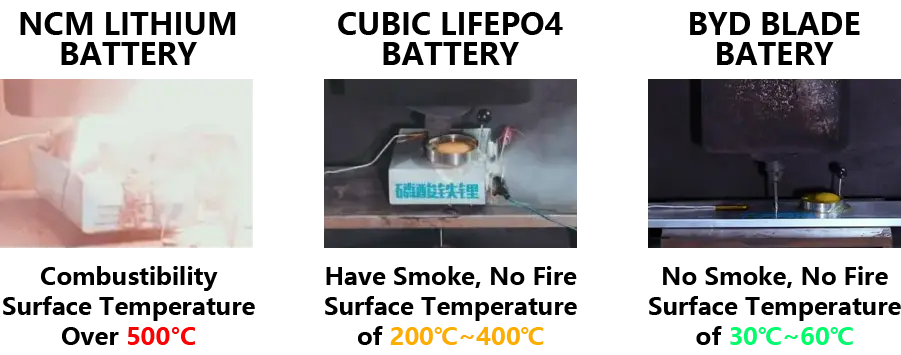
The BYD format (long prismatic LFP) earned its reputation from the nail-penetration test: no flame, minimal smoke, surface temps that stay comparatively low. In a home-backup context, that’s a big deal. A forced internal short is exactly the “worst day” scenario you never want—but if it happens, you’d prefer the chemistry and format that keep calm.
Practical takeaway for you and your installer team:
- Lower heat release during a cell fault reduces the chance of adjacent cells catching.
- Less gas/oxygen release means less energy to feed a flame front.
- Slim prismatic design can help heat spread predictably, aiding BMS and pack-level protections.
UL 9540 vs UL 9540A
- UL 9540 = the system listing (entire ESS: cells, BMS, pack, inverter interface, enclosure).
- UL 9540A = the fire-propagation test method (cell → module → unit → installation level). It gives fire officials the data to set clearances, ventilation, and indoor placement.
- NFPA 855 + building/ residential codes reference UL 9540A to write rules the AHJ (Authority Having Jurisdiction) enforces.
- Bottom line: if you want fewer site headaches, pick LFP systems with robust UL 9540 listings and recent UL 9540A reports. It’s boring paperwork, but it keeps projects on schedule.
Data Table: Fire-Safety Factors That Favor BYD LiFePO4
| Factor | What it means in a house | Why LFP helps |
|---|---|---|
| Thermal runaway onset | Higher onset temp → fewer “surprise” events | LFP chemistry is more stable under abuse |
| Oxygen release | Less oxygen → lower flame energy | Less self-feeding combustion |
| Nail-penetration behavior | Internal short doesn’t turn into a torch | demo: no flame, minimal smoke |
| Heat propagation | Less likely to cascade across modules | LFP + prismatic design mitigate spread |
| Code pathway | Easier UL 9540/9540A outcomes | AHJ approvals go smoother |
| Indoor siting | Lower hazard profile | Friendlier to utility rooms/garages (per 9540A outcomes) |
Note: No battery is “fireproof.” Installation quality, BMS logic, and site conditions still decide a lot.
What Installers Actually Check
- 9540 listed? The whole ESS, not just the cell.
- 9540A summary? Your AHJ may ask for test level (unit-level, room-level) and clearance recommendations.
- BMS interlocks (over-temp, over-current, cell-balancing), contactors, fuse/ MCCB, shunt trip, and isolation—the “stop it before it gets hot” toolkit.
- SOC window & derating for hot climates; beef up ventilation where airflow is poor.
- Enclosure rating and flame-retardant housing (ABS+PC V0) to slow ignition and limit spread.
- Grounding/bonding and EMC so protection circuits aren’t noisy or blind.
- Serviceability: clear access to disconnects; logs from the BMS to prove the event trail.
- No shortcuts. Cheap busbars, loose torque, or bad crimps—this is how fires start. Don’t do like this.
Real-World Scenes Where LFP Shines
- Suburban garage + inverter backfeed: LFP’s calmer fault behavior lowers the risk envelope near people, cars, and combustible storage.
- Small commercial sites (retail/clinic/education): Indoors near public areas, staff may not be trained like a power plant crew; you want chemistry that forgives.
- Telecom/remote huts: Fewer site visits, wider ambient swings; LFP stability + robust BMS is a good fit.
- Off-grid cabins or farms: Mixed loads (pumps, tools, refrigeration). LFP handles deep cycles; abuse tolerance is a plus. It isn’t perfect, but is better.
TURSAN: Where the Safety Story Meets Supply (OEM/ODM, B2B)
Who we serve: global B2B buyers—distributors, energy-storage integrators, outdoor/off-grid suppliers, EV-charging service providers, industrial and public-sector operations. What you get: China-based manufacturing with OEM/ODM, low MOQ (100 pcs), one-stop trade/clearance/logistics, an R&D team (50+), 15 production lines, fast sampling (~2 days) and bulk lead times (~25 days), plus English-speaking consultants for pre-sale engineering. Safety story baked in: multiple-protection BMS, pure sine wave inverter output, ABS+PC V0 enclosure options, and water/dust protection per model specs—aligned with home and off-grid scenarios listed on our site.
If you’re shopping for a Custom LiFePO4 Battery or Wholesale LiFePO4 Battery, asking for the UL 9540 file number and a one-page UL 9540A summary is not rude—it’s smart. TURSAN can prep that pack-level documentation workflow for your AHJ and insurer, so approval isn’t stuck in limbo.
Internal Product Links
- Home backup, 48 V class: 48V 100Ah LiFePO4 – 5.22 kWh Home Backup Battery — typical residential use case; pairs with hybrid inverters.
- Home backup, larger stack: 48V 300Ah LiFePO4 – 15.36 kWh Home Backup Battery — longer autonomy or higher surge loads.
- 12 V platform (custom packs, fleets, field gear): 12V 102Ah LiFePO4 Battery — a simple reference design for modular builds.
- Hybrid inverter pairing: 10 kW Home/Commercial Pure Sine Wave Hybrid Inverter — for ESS that need PV + grid + battery orchestration.

Table: Buyer Decision Criteria (So You Don’t Miss a Safety Box)
| Criterion | What to ask for | Why it reduces risk |
|---|---|---|
| Chemistry & format | BYD LFP cells or equivalent LFP | Higher stability, calmer fault behavior |
| System listing | UL 9540 certificate (entire ESS) | Ensures pack, BMS, inverter interface, enclosure are evaluated together |
| Propagation test | UL 9540A summary (relevant level) | Sets the rules for clearances, indoors/outdoors, venting |
| BMS features | Over-temp, over-current, cell-level monitoring/ balancing; event logs | Stops faults early; leaves a trail for AHJ/insurers |
| Enclosure & materials | ABS+PC V0 options; ingress protection per site | Slows ignition, helps with dust/moisture in garages and sheds |
| Install docs | Wiring diagrams, torque specs, commissioning checklist | Bad torque and thin busbars cause heat—you don’t want that |
| Service & logistics | OEM/ODM drawings, spare modules, lead times, multilingual support | Keeps projects moving; no long downtime after an event |
Table: TURSAN at a Glance (for B2B Safety-First Programs)
| Capability | What you get |
|---|---|
| LiFePO4 Battery Manufacturer / Supplier | BYD LiFePO4 battery solutions for home backup, portable, and off-grid |
| OEM/ODM | Custom LiFePO4 pack designs, enclosure tweaks, BMS tuning, harness sets |
| R&D + Production | 50+ engineers, 15 lines; sample ~2 days; bulk ~25 days |
| Compliance Support | 9540 documentation flow, test summaries, AHJ Q&A |
| Logistics | One-stop trade, clearance, global shipping in 30+ languages |
| After-sales | Training for installers, maintenance guides, spare module programs |
(No cost calc here; we tailor per spec.)

BYD LiFePO4 + Home Backup = Safer Baseline, Not a Magic Shield
Let’s be clear. LFP lowers the baseline hazard, but installation quality—cable routing, torque, breaker selection, ventilation, firmware updates—decides the rest. It’s like seatbelts and airbags: they’re great, but you still drive carefully.
Quick best-practice hits:
- Keep clearances per the 9540A report and installer manual.
- Use correct overcurrent protection; coordinate trip curves so contactors and breakers don’t fight.
- Follow torque specs; check busbars after thermal cycles.
- Keep firmware current; BMS alarms aren’t decorations—set thresholds and verify they actually trip.
- If the site runs hot (attic, shed), discuss derating and added venting.
- Don’t stack third-party add-ons without a design review; patchwork control logic can mask faults. It’s not good.
Friendly Questions People Ask (and How to Answer)
Is LiFePO4 safer than NMC for home use?
Yes, generally — LFP’s runaway threshold and gas behavior make it more stable. Add a well-tuned BMS and you have a safer starting point for indoor installs.
What’s special about BYD cells?
Format + testing — Slim prismatic cells, proven nail-penetration behavior, and pack-level engineering aimed at limiting propagation.
Do I need UL 9540/9540A if chemistry is safer?
Absolutely — Chemistry helps, but codes approve systems, not just cells. Your AHJ will want 9540 listing and 9540A-based siting.
Can I get a Custom LiFePO4 Battery for my project?
Yes — That’s normal in B2B. TURSAN handles pack shape, voltage, BMS profile, and enclosure for your Wholesale LiFePO4 Battery needs. We also align docs for smoother permitting.
Putting It Together (Why This Choice Pays Off)
Pick BYD LiFePO4 for home backup if you want a safer chemistry with a strong testing story. Pair it with a UL 9540 listed ESS that shows 9540A results your AHJ can accept. Then work with a LiFePO4 Battery Supplier who understands installation realities, not just catalog pages.
That’s where TURSAN fits: A LiFePO4 Battery Manufacturer focused on OEM/ODM, B2B logistics, multilingual support, and documentation that inspectors actually use. You get less downtime, fewer redesigns, and a calmer safety baseline at the home.



 English
  العربية
  日本語
日本語  한국어
한국어  Tiếng Việt
  ไทย
ไทย  Bahasa Melayu
  فارسی
فارسی  Bahasa Indonesia
  ဗမာစာ
ဗမာစာ  简体中文
简体中文  香港中文
香港中文  繁體中文
繁體中文  Русский
  Deutsch
  Nederlands
  Italiano
  Français
  Español
  Português
  Afrikaans
  Azərbaycan dili
  Български
  ਪੰਜਾਬੀ
  हिन्दी
  اردو
اردو  বাংলা
বাংলা  Հայերեն
  Íslenska
  Қазақ тілі
  नेपाली
  Српски језик
  Kiswahili
  తెలుగు
  Basa Jawa
  தமிழ்
தமிழ்  मराठी
मराठी