
You can have a huge battery, but if the ports don’t fit your loads, the field performance will disappoint. Trips on startup, laptops that trickle at 12 W, 12 V fridges browning out—these are common tickets. This guide keeps it practical: what each port does, where it shines, and how to spec a build that just works for your B2B buyers.
We’ll keep it conversational, use real-world cases (no fake stories), and include tables you can hand to procurement or engineering. If you need OEM/ODM, TURSAN is both a Portable Power Station Supplier and Portable Power Station Manufacturer—we’ll show how to map ports to your loads and choose the right SKUs.
USB-A vs USB-C in Portable Power Stations
USB ports look similar. They don’t behave the same. Charging logic, protocols, and cable limits decide whether your laptop sips at 12 W or gulps 100 W+.
USB-A output — 5 V legacy fast charge (12–18 W typical)
Typical power: 5 V×2.4 A ≈ 12 W; some “fast charge” modes reach ~18 W.
Great for: phones, TWS earbuds, headlamps, action cams, routers with micro-USB.
Watch-outs: marketing sometimes says “Fast Charge,” but if the device doesn’t support that vendor protocol, it’ll fall back to 5 V basics. That’s okay for small gadgets, not for notebooks.
Field take: If a team expects to run tablets, RF handhelds, and barcode scanners all day, a bank of USB-A is fine. For laptops? No—use USB-C PD or AC.
USB-C Power Delivery (PD 3.0/3.1) — up to 100–240 W (device-dependent)
PD 3.0: up to 100 W (5/9/12/15/20 V rails).
PD 3.1 (EPR): higher voltage rails (28/36/48 V), headroom up to 140–240 W on compliant endpoints and 5 A e-marked cables.
Why it matters: direct DC-to-DC. Fewer conversion losses than running your laptop via AC brick, so you get more runtime per Wh.
Case: Field engineering laptops (65–100 W) charge directly over USB-C PD. If the project needs mobile workstations or displays over a hub, spec PD 100–140 W ports. Your laptop want PD, not a random 5 V booster.
Cable & negotiation checklist
Use 5 A e-marked USB-C cables for >100 W.
Confirm the port label: “PD 60 W,” “PD 100 W,” or “PD 140 W.”
Dual-port sharing rules vary: 100 W single may split 65 W + 35 W under two-device load—read the allocation notes.
If a device sleeps and wakes at 20 V, re-negotiation can drop to 5 V for a moment; good firmware restores fast. Don’t panic.

DC Barrel & 12 V car socket — stable DC for appliances
“DC barrel” (often called 5521) and the 12 V car socket exist for one reason: deliver regulated 12 V to DC appliances without the AC inverter overhead.
Regulated 12 V/10 A — why it saves your fridge
Spec to look for: 12 V regulated, 10 A per port (≈120 W).
Loads: 12 V compressor fridges (40–80 W running, higher on startup), LED strips, ham radios, routers, small pumps, fans.
Benefit: when battery SOC drops, a regulated 12 V bus maintains voltage. Without it, some fridges cut out around 10.5–11 V and food warms up. Not fun on a job site, or a desert run.
Field case: A 60 W DC fridge runs 24/7 on a regulated 12 V port. At night, ambient cools, compressor duty cycle falls, and your runtime stretches. If that same fridge sits on a “floating” 12 V, voltage sag at low SOC makes it short-cycle or crash.
Connector fit, polarity, current limits
Plug size: 5.5×2.1 mm vs 5.5×2.5 mm. Close isn’t equal—wrong fit causes heat and arcing under load.
Polarity: almost always center-positive—verify before you power RF or medical gear.
Current: keep below the per-port limit; parallel splitters don’t magically double current if the rail is 10 A OCP-limited.
AC outlet (pure sine wave, continuous vs surge) in Portable Power Stations
If you plug in anything with a motor, compressor, or transformer, AC quality matters: waveform, continuous rating, and surge (inrush).
Surge math: motors, compressors, power tools
Continuous power is what the inverter can supply all day.
Surge is short-term headroom (often around 2× the continuous rating for a few seconds).
Loads that need surge: fridges/freezers, grinders, circular saws, small air compressors, CPAPs with heated humidifiers (on startup).
Practical sizing: a 600 W continuous inverter with 1200 W surge can start many fractional-horsepower tools once at a time. But a grinder starting under load may spike higher—leave margin. If your tool trips, it’s not broken; inrush is doing what physics do. Try soft-start or upsize the AC channel.
Waveform quality: sine, THD, motor heat
Pure sine wave outputs keep THD low, which keeps motors cool and SMPS happy.
Modified sine can work for some resistive loads, but for fleets and compliance, pure sine is safer and quieter (electrically).
Sensitive RF, lab gear, and some chargers require sine. Also kinder to audio.
Port-to-use case matrix (quick pick)
| Load / Scenario | Best Port | Typical Power | Why this choice | Notes |
|---|---|---|---|---|
| Phones, earbuds, lights | USB-A | 5–18 W | Simple, universal | Try not to block USB-C ports for these |
| Modern laptops | USB-C PD | 60–100 W (up to 140 W+) | DC-DC efficiency, fewer adapters | Use 5 A e-marked cable for >100 W |
| Camera batteries, drones | USB-C PD or DC | 30–100 W | Faster charge curves | Check charger PD profiles |
| 12 V compressor fridge | DC barrel / car 12 V | 40–80 W run, higher at start | Regulated 12 V prevents brownout | Verify plug size & polarity |
| Routers, radios | DC barrel 12 V | 6–30 W | Clean DC, no inverter loss | Keep antennas clear of inverters |
| Small power tools | AC pure sine | 300–1000 W run, surge 2× | Handles inrush | Start one tool at a time |
| CPAP (heated) | AC sine or DC (if adapter supports) | 60–120 W | Stability while sleeping | Use DC adapter to save energy |

Real-world sizing examples
65 W laptop + phone bank: one USB-C PD 100 W port for the laptop; leave USB-A ports for phones. Don’t waste the PD port on 5 V loads.
12 V fridge + area lights: regulated 12 V/10 A for the fridge; keep lights on a second DC barrel or USB-A if 5 V strips. Avoid sharing one 12 V rail with spikes + radio gear.
Grinder on site: 600–800 W continuous inverter, pure sine, with surge ~2×. Test no-load start first; then light load. If it trips, you need more headroom or a soft-start module. It do work for many use cases, but not all.
B2B checklist
- USB-C PD budget: how many PD ports? Max per-port power? Concurrent split rules?
- DC 12 V: regulated vs unregulated; per-port OCP limit (10 A?), connector standard (5.5×2.1?)
- AC channel: continuous, surge, waveform, and THD. Any NRTL/CE/UKCA flavors required for your markets?
- Battery & safety : BYD LiFePO4 cells, multi-protection BMS (OCP/OVP/OTP/ short-circuit), GB/T 31485– 2015 & GB 31241– 2014 conformity.
- Unit : ABS+PC V0 flame-retardant, optional sheet-metal housings, water/dust-resistant models.
- Commercials : OEM/ODM, reduced MOQ (100 pcs), examples in ~ 2 days , mass in ~ 25 days , English-speaking PMs.
- Regions : over 30 nations (EU, Americas, MEA, APAC) with multilingual security.
TURSAN supports all of the above as a Portable Power Station Manufacturer with Wholesale Portable Power Stations and Custom Portable Power Stations for integrators and distributors.
Matching TURSAN SKUs to ports & loads
If you’re scoping a fleet, start here and map ports to duty:
- 600 W Portable Power Station — balanced AC headroom, PD fast charge, DC rails for 12 V fridges and comms. https://tursan-pps.com/solutions/portable-series/600w-portable-power-station/
- 1200 W Portable Power Station — for multi-device crews, light tools, and longer fridge autonomy; better surge tolerance. https://tursan-pps.com/solutions/portable-series/1200w-portable-power-station/
- 2400 W Portable Power Station — heavy AC zone, simultaneous high-draw loads, and field teams running laptops + bench PSUs. https://tursan-pps.com/solutions/portable-series/2400w-portable-power-station/
- Wholesale / Bulk Purchasing — channel programs, tiered pricing, logistics. https://tursan-pps.com/wholesale/
- Custom OEM/ODM (Portable Series overview) — tailor port mix, PD budgets, and DC rails to your devices. https://tursan-pps.com/solutions/portable-series/
Spec tables you can share with engineering
Port capability table (typical values; confirm final SKU datasheet)
| Port | Voltage rails | Max per-port power | Best for | Buyer notes |
|---|---|---|---|---|
| USB-A | 5 V (QC variants up to ~9/12 V) | 12–18 W | Phones, headlamps, wearables | Great density for small stuff |
| USB-C PD 3.0 | 5/9/12/15/20 V | 60–100 W | Laptops, tablets, cameras | Ask about dual-port sharing |
| USB-C PD 3.1 (EPR) | 28/36/48 V AVS | 140–240 W* | Workstations, displays, hubs | Needs 5 A e-marked cable |
| DC barrel 12 V | 12 V regulated | 120 W (10 A) | Fridges, routers, radios | Confirm plug 5.5×2.1 or 5.5×2.5 |
| Car socket 12 V | 12 V regulated | 120 W (10 A) | Auto accessories | Good mechanical retention |
| AC pure sine | 230/120 V | See model (e.g., 600–2400 W) | Tools, bricks, appliances | Check surge rating too |
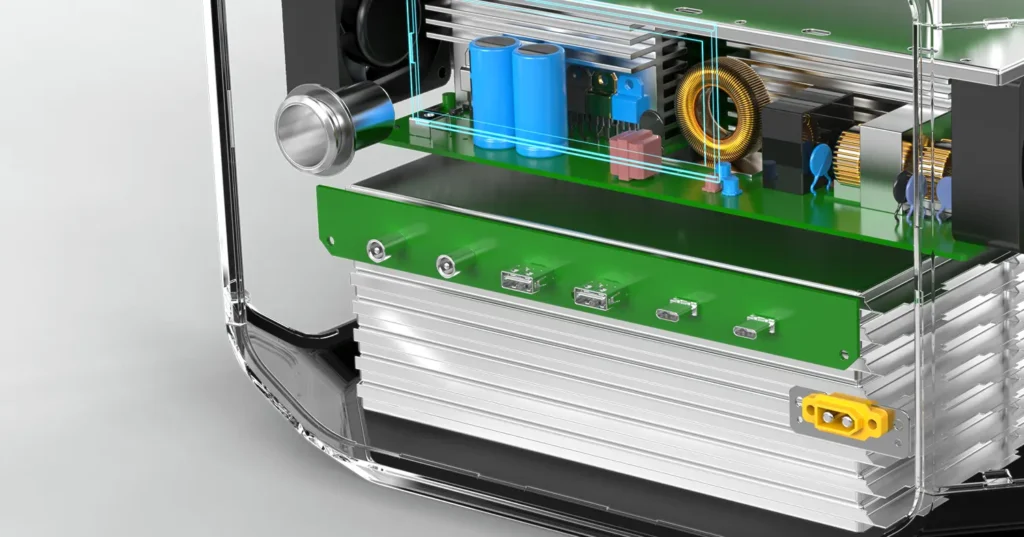
How to choose—fast
- List your loads and their startup behavior (continuous + surge).
- Match AC only if you truly need it; prefer USB-C PD or 12 V DC for efficiency.
- Demand regulated 12 V if a fridge or radio is on the BOM.
- For laptops, spec PD 100–140 W and e-marked 5 A cables.
- Size inverter with surge headroom and stagger starts.
- For B2B, lock MOQ, warranty, and service SLAs as part of the quote.
TURSAN can deliver Wholesale Portable Power Stations and Custom Portable Power Stations with the exact port mix and protections your vertical needs—outdoor/off-grid, education, mining, emergency, comms, you name it. We’re a Portable Power Station Manufacturer with R&D, 15 lines, and English-speaking consultants who actually pick up the phone.
Final Thoughts
Ports are the handshake between stored energy and your devices. USB-A handles the basics, USB-C powers the future, DC barrels keep 12V gear alive, and AC outlets drive the heavy hitters.
Whether you’re a distributor, system integrator, or field operator, understanding these differences avoids costly mistakes like fried routers or tripped inverters.
And if you need a Portable Power Station Supplier who gets these pain points, TURSAN delivers with Custom Portable Power Stations designed around your workloads.


 English
  العربية
  日本語
日本語  한국어
한국어  Tiếng Việt
  ไทย
ไทย  Bahasa Melayu
  فارسی
فارسی  Bahasa Indonesia
  ဗမာစာ
ဗမာစာ  简体中文
简体中文  香港中文
香港中文  繁體中文
繁體中文  Русский
  Deutsch
  Nederlands
  Italiano
  Français
  Español
  Português
  Afrikaans
  Azərbaycan dili
  Български
  ਪੰਜਾਬੀ
  हिन्दी
  اردو
اردو  বাংলা
বাংলা  Հայերեն
  Íslenska
  Қазақ тілі
  नेपाली
  Српски језик
  Kiswahili
  తెలుగు
  Basa Jawa
  தமிழ்
தமிழ்  मराठी
मराठी