
Stacked home batteries are climbing fast in global homes, farms, telecom shelters, and off-grid cabins. They’re compact, modular, and easy to scale. But every engineer, installer, or B2B buyer knows one thing: grounding makes or breaks the entire system.
If grounding goes wrong—even a tiny bonding mistake—the system may behave weird: sudden BMS resets, noisy inverter output, shock risk, or worse, a thermal event you don’t want to see twice.
This guide walks through real-world grounding logic for stacked home batteries. It’s written from the field—tight rooms, metal racks, dusty basements, and rooftop solar sheds. And yes, it mixes what global distributors keep asking with what a serious Stacked Home Battery Supplier or Manufacturer must get right.
Why Grounding Matters in Stacked Home Battery Systems
Grounding in a stacked pack isn’t just a checkbox. It’s the backbone of safety and system stability. You ground to:
- Move fault currents safely
- Stabilize BMS sensing
- Stop EMI noise drifting through DC bus
- Reduce arc-flash chance
- Protect inverter’s clean sine wave
- Keep enclosure and rack at the same potential
In short, grounding is the first thing you design, not the last thing you “also do”.
Core Grounding Principles for Stacked Home Battery Installations
Below is a summary table that integrators use when choosing grounding strategy:
| Grounding Principle | Why It Matters | How It Affects Stacked Battery |
|---|---|---|
| Equipotential bonding | Prevent voltage difference between metal parts | Stops small shocks & BMS false readings |
| Single-point earth | Avoid earth loops and oscillation | Gives stable inverter & DC bus reference |
| Low-impedance path | Ensure faults go straight to earth | Reduces arc-flash risk |
| Bond enclosure & rack | Metal parts must stay safe | Prevents enclosure becoming “live” |
| BMS ground stability | Keeps voltage detection stable | Prevents SoC jumps and imbalance alarms |
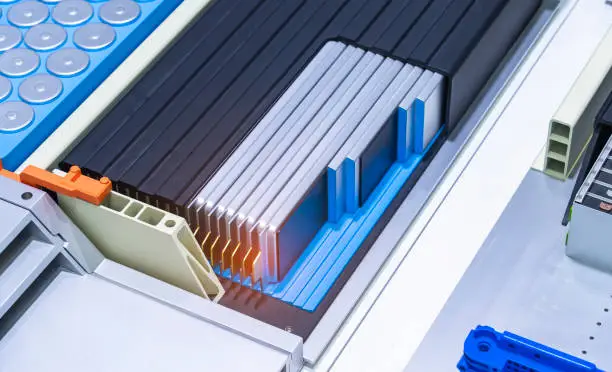
These rules stay almost the same whether you install a 5kW, 10kW, or a 25kW pack like the ones here:

Design Considerations for DC Grounding in High-Capacity LiFePO4 Systems
A stacked home battery uses LiFePO4 cells, often arranged in 48V / 51.2V modules. Systems built with BYD-grade cells—like those used in TURSAN—have stable chemistry but still require proper ground logic.
Bonding the Negative Bus to Ground
Most installers follow negative-to-earth bonding because:
- It stabilizes DC reference
- Reduces EMI noise
- Helps BMS measure pack voltage accurately
If left floating, the pack may “hunt” for reference, creating sudden system resets.
Grounding the Metal Enclosure
Stacked modules come with sheet-metal or ABS+PC V0 housings. Metal should always bond first. Even V0 plastics may include steel frames that pull static.
Managing Short Earth Paths
One mistake we see from new installers: using long thin grounding wire. Long wires = high impedance = delayed fault clearing. In B2B projects, TURSAN usually recommends:
- shortest earth route
- thick copper
- anti-corrosion lugs
It’s simple, and it works.
Bonding Between Stacked Modules
Each module usually slides into a rack. You want the bonding strap to make sure all racks, all rails, all shells are at one potential. If not, a tiny voltage drift may appear between top pack and bottom pack. That’s when you get random BMS cell imbalance alarms.
AC Side Grounding and Inverter Integration
Stacked batteries rarely work alone—they pair with hybrid inverters. And each inverter has its own grounding logic. You must match both sides.
- Some inverters ground the neutral internally.
- Some inverters require external neutral-earth bonding.
- Some inverters isolate AC and DC until grid loss.
If the grounding map isn’t planned, you may get:
- AC hum
- Residual current device tripping
- Arc-flash window when switching modes
- Neutral floating issues
When clients order TURSAN systems with hybrid inverters, the engineering team draws a simple “grounding map” for their installer. Nothing fancy—just enough to avoid the classic neutral-earth mistakes.

Ground Fault Protection in Stacked Home Battery Systems
Ground faults are silent until they’re not. A weak connection may produce small leakage tracks that slowly carbonize the enclosure.
Fault signs you can catch early:
- “Metal-touch tingling” sensation
- Sudden drop in inverter output quality
- BMS undervoltage noise on random cells
- RCD tripping on no load
Good grounding reduces 90% of these.
Grounding Requirements for Different Installation Scenarios
Residential Installations
Homes tend to have mixed metal parts, moisture, and long AC runs. Grounding must consider:
- AC panel distance
- Inverter type
- Solar roof bonding
- Basement moisture
A Custom Stacked Home Battery installation often involves irregular walls, narrow corners, or external cabins.
Commercial or Industrial Sites
Factories and telecom shelters often have metal frames, steel shelves, and strong EMI. Here grounding must be more aggressive:
- Extra rack bonding
- Surge protection
- Lightning path audit
- Shielded grounding cables
This is where a reliable Wholesale Stacked Home Battery provider must document ground paths clearly.
Field Example: Why Loose Grounding Makes the System Misbehave
In several EU projects, installers reported:
“The inverter works fine during the day but resets at night.”
The cause turned out simple: The stacked battery rack wasn’t bonded properly. When the inverter switched from solar-heavy daytime mode to evening load mode, tiny EMI shifts caused sensing drift. The SoC dropped randomly. Users thought the battery “is broken”, but it was just grounding.
This is very common in modular stacks.
Best Practices for Stacked Home Battery Grounding Design
Below is a simple checklist that B2B clients often request:
| Checklist Item | Purpose | Status Tip |
|---|---|---|
| Bond every metal part | Stops enclosure touching events | Use serrated washers |
| Single earth point | Avoid earth loop | Mark “EARTH-NODE” on rack |
| Short earth wire | Faster fault clearing | Avoid wall-routing if possible |
| BMS reference stability | Accurate readings | Keep DC negative bonding tight |
| Inverter-battery alignment | Clean AC waveform | Follow inverter manual closely |
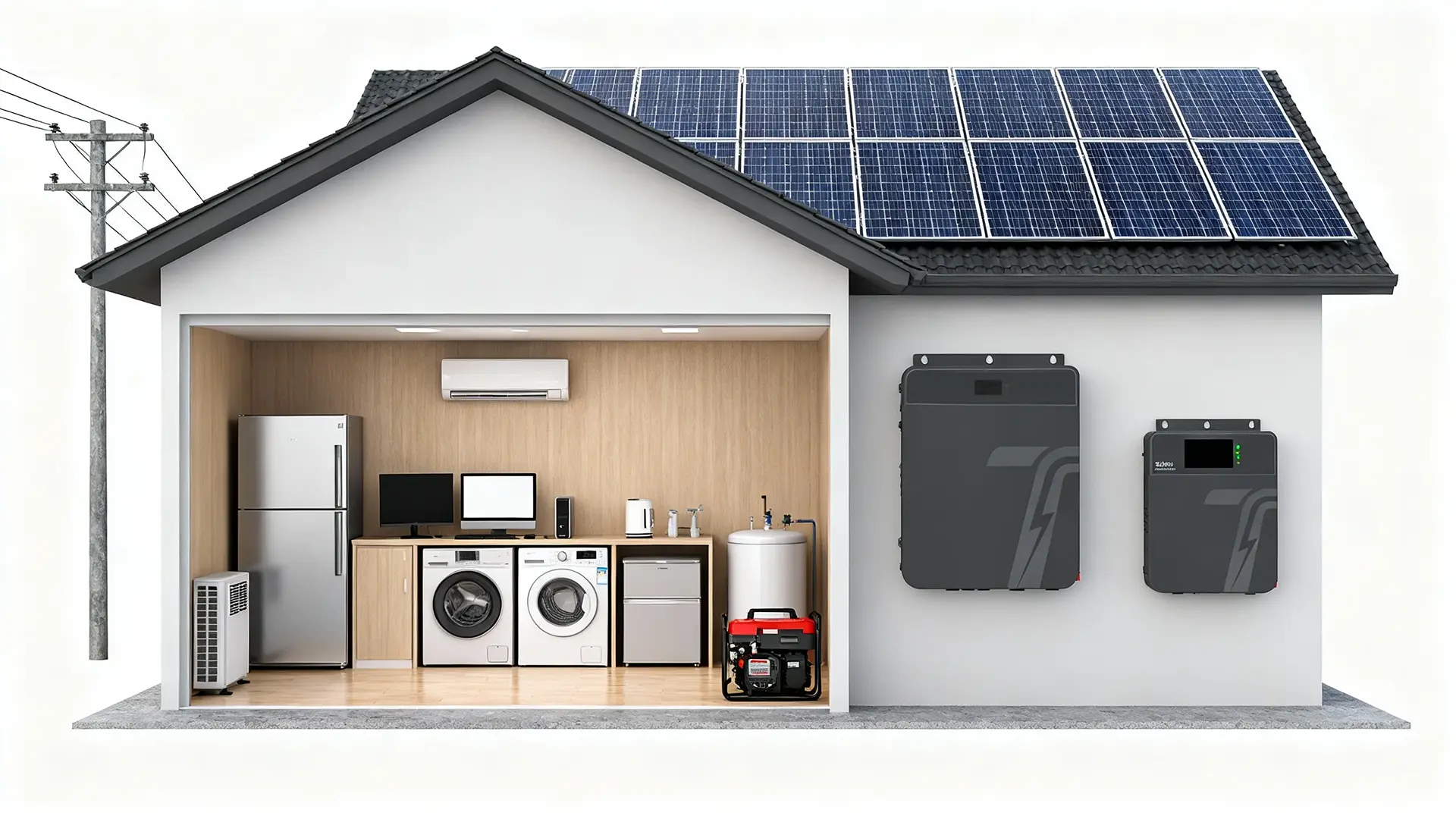
To simplify work, TURSAN includes internal bonding points and grounding terminals across all stack sizes:
These reduce installation mistakes and keep grounding predictable.
How TURSAN Designs Grounding into its Stacked Systems
As a Stacked Home Battery Manufacturer, TURSAN builds OEM/ODM systems with:
- BYD-grade LiFePO4 cells
- BMS with multi-layer protections
- ABS+PC V0 fire-safe housings
- Pure sine wave inverter compatibility
- Short earth path inside the rack
- Anti-corrosion grounding terminals
For B2B buyers, the biggest value often isn’t the battery itself but the engineering behind it. Many partners choose TURSAN because:
- Low MOQ supports pilot projects
- R&D team helps produce grounding maps
- 25-day delivery makes scaling easy
- 15 production lines ensure consistency
- OEM/ODM allows customized grounding ports
If a distributor wants Custom Stacked Home Battery variants with extra grounding lugs or thicker bonding straps, the engineering team just redesigns the shell mold.
A lot of factories say “we can customize,” but they don’t own molds. TURSAN does.
Maintenance and Troubleshooting
Even the best-stacked systems need periodic grounding checks.
Common issues that appear after 1–2 years:
- Rusted grounding lugs
- Loose screws from vibration
- Cable jacket cracking
- RCD nuisance tripping
- Inverter frequency noise
All these usually point to the grounding line.
Quick maintenance routine:
- Tighten grounding bolts
- Measure continuity between rack layers
- Clean corrosion from lugs
- Check inverter’s neutral-earth bonding mode
- Inspect surge protectors
Simple work, huge value.

Conclusion: Grounding Is the Quiet Part That Keeps Everything Running
Stacked home batteries are getting bigger—15kWh, 20kWh, 25kWh—like these:
When capacity grows, grounding becomes even more important. You don’t see grounding on the brochure, but you feel it every day in system stability.
Good grounding means:
- No weird inverter resets
- No random SoC jumps
- No enclosure shocks
- No arc-flash window
- No EMI drift
- No lost nights of troubleshooting
That’s why a serious Stacked Home Battery Supplier must design grounding from the start, and a serious installer must follow through.
Grounding is not for decoration. It’s the reason the system stays quiet, safe, and stable for ten years.
If you’re building your own projects or need OEM/ODM models, TURSAN can help design grounding that fits your system layout and region standards. Because once grounding is right, everything else becomes easier.

 English
  العربية
  日本語
日本語  한국어
한국어  Tiếng Việt
  ไทย
ไทย  Bahasa Melayu
  فارسی
فارسی  Bahasa Indonesia
  ဗမာစာ
ဗမာစာ  简体中文
简体中文  香港中文
香港中文  繁體中文
繁體中文  Русский
  Deutsch
  Nederlands
  Italiano
  Français
  Español
  Português
  Afrikaans
  Azərbaycan dili
  Български
  ਪੰਜਾਬੀ
  हिन्दी
  اردو
اردو  বাংলা
বাংলা  Հայերեն
  Íslenska
  Қазақ тілі
  नेपाली
  Српски језик
  Kiswahili
  తెలుగు
  Basa Jawa
  தமிழ்
தமிழ்  मराठी
मराठी