 Français
  English
  العربية
  日本語
日本語  한국어
한국어  Tiếng Việt
  ไทย
ไทย  Bahasa Melayu
  فارسی
فارسی  Bahasa Indonesia
  ဗမာစာ
ဗမာစာ  简体中文
简体中文  香港中文
香港中文  繁體中文
繁體中文  Русский
  Deutsch
  Nederlands
  Italiano
  Español
  Português
  Afrikaans
  Azərbaycan dili
  Български
  ਪੰਜਾਬੀ
  हिन्दी
  اردو
اردو  বাংলা
বাংলা  Հայերեն
  Íslenska
  Қазақ тілі
  नेपाली
  Српски језик
  Kiswahili
  తెలుగు
  Basa Jawa
  தமிழ்
தமிழ்  मराठी
मराठी How Many Years Can a Battery Last With One Charge and Discharge Cycle Per Day
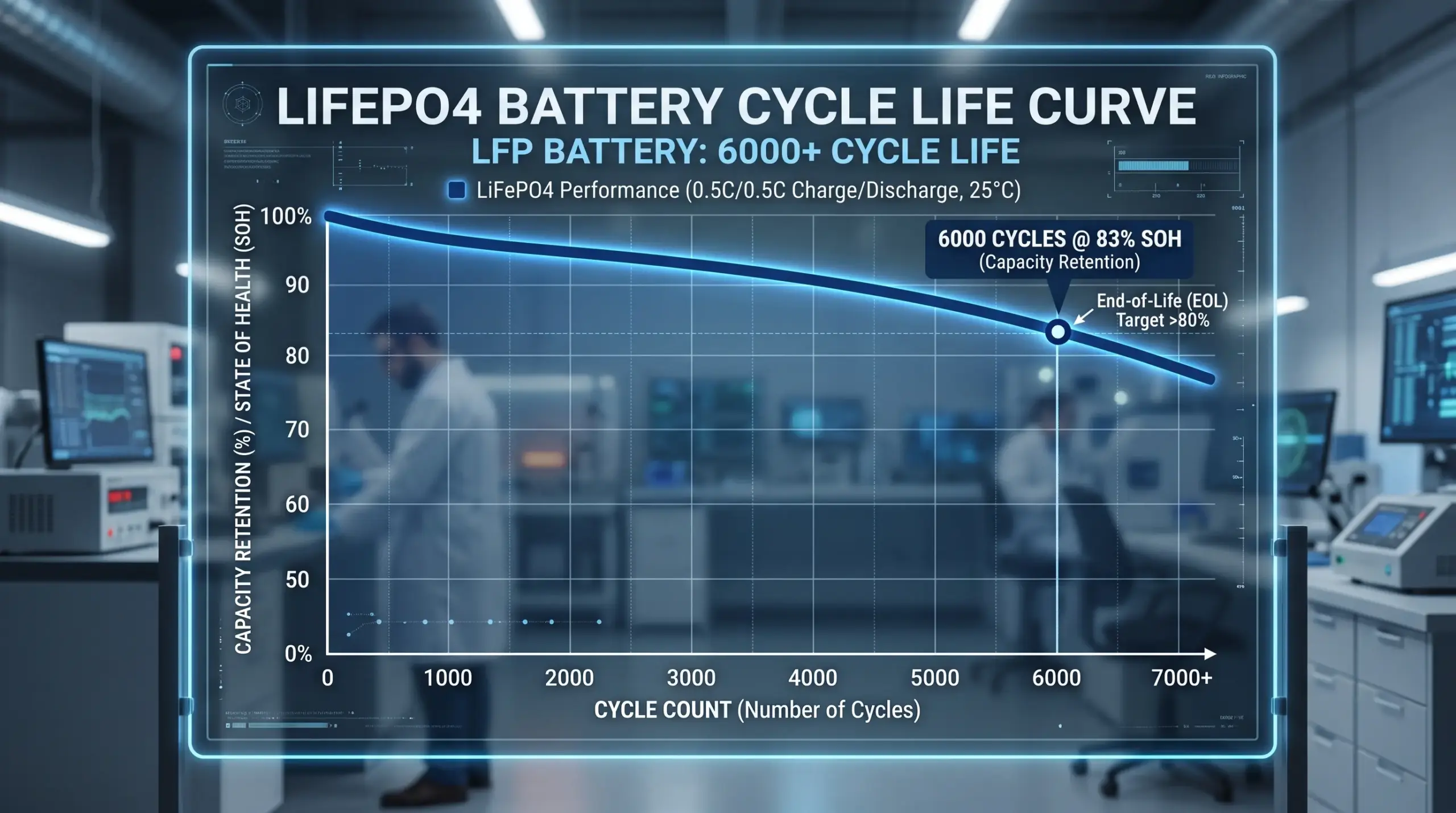
If a battery completes one full charge and discharge cycle every day, the simple calculation is easy. A pack rated for 4,000 cycles could theoretically operate for about 11 years. A 6,000-cycle pack reaches roughly 16 years.
That calculation gives you a useful starting point, not a guaranteed replacement date. Real service life also depends on depth of discharge, cell chemistry, temperature, charging voltage, and how well the BMS controls the pack. For most modern LFP energy storage systems, daily cycling commonly supports around 8 to 15 years of practical service when the system operates within its specified limits.
The Cycle Count Only Tells Part of the Story
One cycle usually means one full equivalent cycle, or 100% cumulative throughput. Two discharges of 50% each count as approximately one full cycle. This distinction matters because a battery that discharges only 70% of its capacity each day puts less stress on its cells than a battery that reaches 100% depth of discharge every day.
Use this calculation for a first estimate:
Expected cycle-based life = rated cycle count / cycles per year
At one cycle per day, the system completes about 365 cycles per year. A 5,000-cycle LFP battery therefore has a theoretical cycle-based life of about 13.7 years. That figure often assumes 25°C, a moderate charge and discharge rate such as 0.5C, and a defined end-of-life capacity, commonly 70% or 80% of the original capacity.

| Battery configuration | Typical cycle rating | Theoretical life at one full cycle per day | Practical planning range |
|---|---|---|---|
| LFP home storage pack | 4 000 cycles | 11 years | 8-10 years |
| LFP commercial rack battery | 6 000 cycles | 16 years | 10-15 years |
| NMC battery system | 2,000-3,000 cycles | 5.5-8.2 years | 4-7 years |
The battery may still work after the planning range ends. It simply stores less energy and may no longer meet the output or backup time required by the application. Calendar ageing can also limit life before the rated cycle count is reached, especially when the pack stays at a high state of charge in a hot enclosure.
What an OEM or ODM Buyer Should Check
cURL Too many subrequests by single Worker invocation. To configure this limit, refer to https://developers.cloudflare.com/workers/wrangler/configuration/#limits.
Un cURL Too many subrequests by single Worker invocation. To configure this limit, refer to https://developers.cloudflare.com/workers/wrangler/configuration/#limits cURL Too many subrequests by single Worker invocation. To configure this limit, refer to https://developers.cloudflare.com/workers/wrangler/configuration/#limits.
cURL Too many subrequests by single Worker invocation. To configure this limit, refer to https://developers.cloudflare.com/workers/wrangler/configuration/#limits cURL Too many subrequests by single Worker invocation. To configure this limit, refer to https://developers.cloudflare.com/workers/wrangler/configuration/#limits cURL Too many subrequests by single Worker invocation. To configure this limit, refer to https://developers.cloudflare.com/workers/wrangler/configuration/#limits.
cURL Too many subrequests by single Worker invocation. To configure this limit, refer to https://developers.cloudflare.com/workers/wrangler/configuration/#limits
- cURL Too many subrequests by single Worker invocation. To configure this limit, refer to https://developers.cloudflare.com/workers/wrangler/configuration/#limitscURL Too many subrequests by single Worker invocation. To configure this limit, refer to https://developers.cloudflare.com/workers/wrangler/configuration/#limits.
- cURL Too many subrequests by single Worker invocation. To configure this limit, refer to https://developers.cloudflare.com/workers/wrangler/configuration/#limitscURL Too many subrequests by single Worker invocation. To configure this limit, refer to https://developers.cloudflare.com/workers/wrangler/configuration/#limits.
- cURL Too many subrequests by single Worker invocation. To configure this limit, refer to https://developers.cloudflare.com/workers/wrangler/configuration/#limitscURL Too many subrequests by single Worker invocation. To configure this limit, refer to https://developers.cloudflare.com/workers/wrangler/configuration/#limits.
- cURL Too many subrequests by single Worker invocation. To configure this limit, refer to https://developers.cloudflare.com/workers/wrangler/configuration/#limitscURL Too many subrequests by single Worker invocation. To configure this limit, refer to https://developers.cloudflare.com/workers/wrangler/configuration/#limits.
Questions fréquemment posées
cURL Too many subrequests by single Worker invocation. To configure this limit, refer to https://developers.cloudflare.com/workers/wrangler/configuration/#limits
cURL Too many subrequests by single Worker invocation. To configure this limit, refer to https://developers.cloudflare.com/workers/wrangler/configuration/#limits
cURL Too many subrequests by single Worker invocation. To configure this limit, refer to https://developers.cloudflare.com/workers/wrangler/configuration/#limits
cURL Too many subrequests by single Worker invocation. To configure this limit, refer to https://developers.cloudflare.com/workers/wrangler/configuration/#limits
cURL Too many subrequests by single Worker invocation. To configure this limit, refer to https://developers.cloudflare.com/workers/wrangler/configuration/#limits LFP battery cURL Too many subrequests by single Worker invocation. To configure this limit, refer to https://developers.cloudflare.com/workers/wrangler/configuration/#limits.
cURL Too many subrequests by single Worker invocation. To configure this limit, refer to https://developers.cloudflare.com/workers/wrangler/configuration/#limits.