Battery Parallel: More Capacity Without Losing Control
...

Battery Parallel: More Capacity Without Losing Control

Energy Systems / Field Note 04

A practical guide to expanding a battery bank with confidence: understand capacity, current sharing, protection, and the design decisions that make parallel storage reliable.

Read time / 6 minPower begins with balance

The Core Idea Behind Battery Parallel

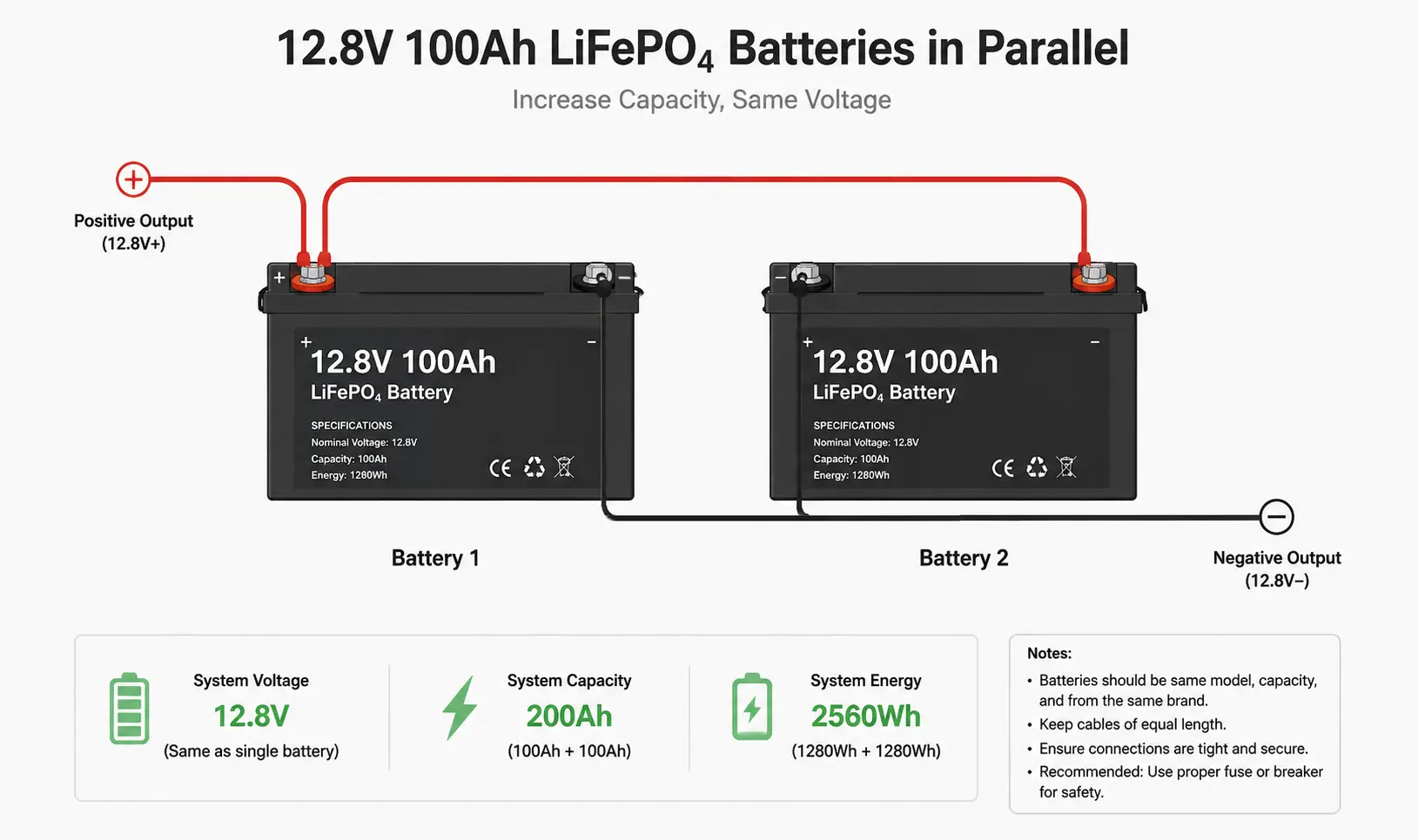
Connecting batteries in parallel joins their positive terminals and their negative terminals. The system keeps the same nominal voltage while increasing available capacity and current. Two matching 12.8V, 100Ah batteries, for example, create a 12.8V, 200Ah bank. That is the appeal: more runtime, more usable energy, and a modular path to expansion without redesigning the entire electrical system.

cURL Too many subrequests by single Worker invocation. To configure this limit, refer to https://developers.cloudflare.com/workers/wrangler/configuration/#limits

Parallel connection is not simply “adding another battery.” It creates a shared electrical network, so every cable, fuse, connector, and battery management system becomes part of the balance. When the components are matched and wired correctly, current divides naturally. When they are not, one battery may work harder, age faster, or trigger protection before the rest of the bank is fully used.

Capacity scales cleanly only when resistance, voltage, and protection are designed as one system.Design principle / 01

What Changes, And What Stays The Same

Parallel batteries retain voltage but increase amp-hour capacity. A 51.2V architecture remains 51.2V after adding a compatible module in parallel, while the available Ah and watt-hours increase. This makes parallel expansion useful for solar storage, backup power, telecom equipment, marine systems, and mobile workstations that need longer autonomy rather than higher system voltage.

  • 電壓: remains the same when batteries are connected in parallel.
  • 容量: adds together, increasing runtime at a comparable load.
  • Available current: can increase, subject to each battery’s BMS and the system wiring.
  • System limits: inverter, charger, fuses, and disconnects still need correct ratings.

How To Build A Balanced Parallel Bank

Start With Matching Batteries

Use batteries with the same chemistry, nominal voltage, capacity, and approved operating limits. Ideally, modules should come from the same model family and have similar age and state of charge. Mixing a new battery with a heavily aged unit can create unequal internal resistance, which makes current sharing less predictable. A compatible battery management system is equally important because protection thresholds must work together.

Equalize The Current Path

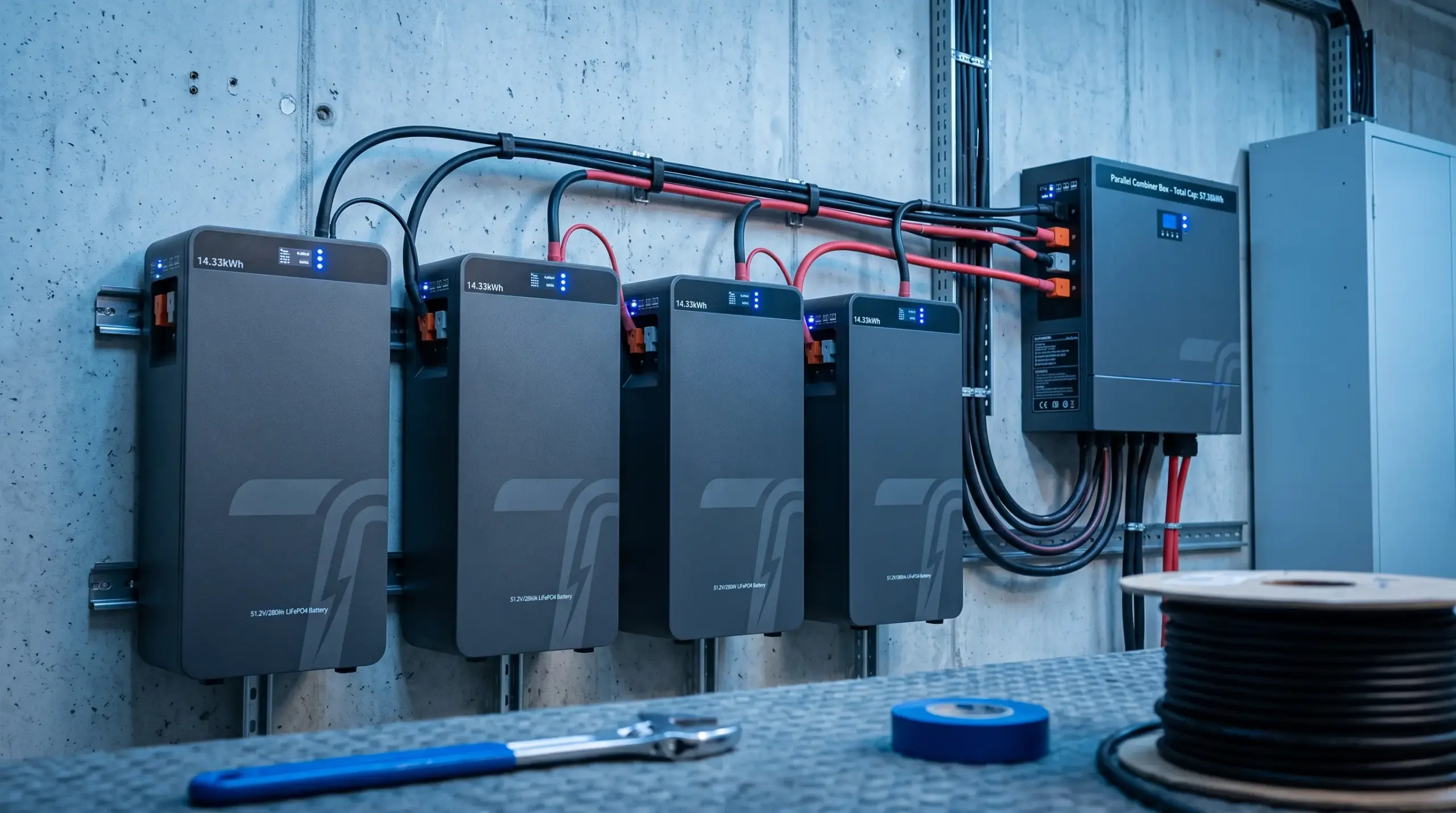
Every battery should see a comparable cable resistance. The cleanest method is a busbar arrangement: connect each battery to positive and negative busbars with cables of the same length and gauge, then connect the load and charger to the busbars. Avoid taking the load from the first battery in a chain. That shortcut can make the nearest battery supply more current than the farthest one.

Before closing the circuit, bring batteries to a similar voltage and confirm polarity with a meter. Install a fuse or breaker close to each battery’s positive terminal. The protection device should interrupt a fault before the cable becomes the limiting component. For larger banks, use a main disconnect and label every branch clearly.

配置標稱電壓容量Approx. Energy
One 12.8V / 100Ah module12.8伏100安時1.28千瓦時
Two modules in parallel12.8伏200安時2.56千瓦時
Four modules in parallel12.8伏400Ah5.12千瓦時
Two 51.2V / 100Ah modules51.2V200安時10.24kWh

Performance, Safety, And Longevity

Parallel expansion increases stored energy, but it does not automatically increase every part of system performance. The inverter must support the intended continuous and surge load. The charger must be compatible with the bank’s voltage and maximum charge current. If four batteries can each accept 50A, the theoretical bank limit may be 200A, but the actual permitted value depends on the manufacturer, temperature, wiring, and BMS communication.

Three Checks Before You Energize

  1. Verify equal state of charge and compatible battery firmware or communication settings.
  2. Confirm branch fuses, cable sizes, busbars, disconnects, and inverter terminals are rated for the possible fault and operating current.
  3. Test the bank under a measured load, checking voltage drop, temperature, and whether current is shared consistently.

Heat is a useful signal. A warm terminal, fuse holder, or cable lug indicates resistance and deserves immediate investigation. Keep connections clean and torqued to specification, provide ventilation appropriate to the enclosure, and leave room for inspection. In a professional installation, monitoring should show pack voltage, current, temperature, and alarms rather than only a percentage gauge.

LiFePO4 batteries are often selected for parallel storage because of their stable chemistry and long cycle life, but chemistry alone is not a safety strategy. The battery pack, BMS, enclosure, protection, and installation method must be treated as a complete design. Follow the manufacturer’s parallel limits and local electrical codes, especially for high-voltage or whole-home systems.

When Battery Parallel Is The Right Move

Choose parallel expansion when the present system voltage is correct and the real problem is runtime or usable capacity. It works well when demand grows gradually: a cabin adds refrigeration, a solar array supports more overnight loads, or a mobile workshop needs longer shifts between charges. Modular expansion also improves serviceability because one branch can be isolated for inspection when the system architecture allows it.

cURL Too many subrequests by single Worker invocation. To configure this limit, refer to https://developers.cloudflare.com/workers/wrangler/configuration/#limits.

常見問題

cURL Too many subrequests by single Worker invocation. To configure this limit, refer to https://developers.cloudflare.com/workers/wrangler/configuration/#limits

cURL Too many subrequests by single Worker invocation. To configure this limit, refer to https://developers.cloudflare.com/workers/wrangler/configuration/#limits.

cURL Too many subrequests by single Worker invocation. To configure this limit, refer to https://developers.cloudflare.com/workers/wrangler/configuration/#limits

cURL Too many subrequests by single Worker invocation. To configure this limit, refer to https://developers.cloudflare.com/workers/wrangler/configuration/#limits.

cURL Too many subrequests by single Worker invocation. To configure this limit, refer to https://developers.cloudflare.com/workers/wrangler/configuration/#limits

cURL Too many subrequests by single Worker invocation. To configure this limit, refer to https://developers.cloudflare.com/workers/wrangler/configuration/#limits.

cURL Too many subrequests by single Worker invocation. To configure this limit, refer to https://developers.cloudflare.com/workers/wrangler/configuration/#limits

cURL Too many subrequests by single Worker invocation. To configure this limit, refer to https://developers.cloudflare.com/workers/wrangler/configuration/#limits.

cURL Too many subrequests by single Worker invocation. To configure this limit, refer to https://developers.cloudflare.com/workers/wrangler/configuration/#limitscURL Too many subrequests by single Worker invocation. To configure this limit, refer to https://developers.cloudflare.com/workers/wrangler/configuration/#limits.
太阳能锂电池的批发并不复杂,先进制造商为您提供知识解说:

立即聯繫

1 分鐘內與我們的專家交談
有問題嗎?直接聯絡我,我會快速直接地幫助您。
1 分鐘內與我們的專家交談
有問題嗎?直接聯絡我,我會快速直接地幫助您。
微信影片
使用微信滑動觀看我們的影片!

立即聯繫

1 分鐘內與我們的專家交談
有問題嗎?直接聯絡我,我會快速直接地幫助您。
TURSAN 智慧製造
看看我們的電池如何製成——從電芯到完成的模組——完整的品質控制與嚴格測試。提交您的需求,我們的參觀協調人員將與您聯繫。.