 简体中文
简体中文  English
  العربية
  日本語
日本語  한국어
한국어  Tiếng Việt
  ไทย
ไทย  Bahasa Melayu
  فارسی
فارسی  Bahasa Indonesia
  ဗမာစာ
ဗမာစာ  香港中文
香港中文  繁體中文
繁體中文  Русский
  Deutsch
  Nederlands
  Italiano
  Français
  Español
  Português
  Afrikaans
  Azərbaycan dili
  Български
  ਪੰਜਾਬੀ
  हिन्दी
  اردو
اردو  বাংলা
বাংলা  Հայերեն
  Íslenska
  Қазақ тілі
  नेपाली
  Српски језик
  Kiswahili
  తెలుగు
  Basa Jawa
  தமிழ்
தமிழ்  मराठी
मराठी Field notes / charging performance
Off grid does not mean slow. The weakest link in the charging path sets the pace.
一个 离网系统 does not automatically charge a battery more slowly. The charging speed depends on the available energy source, the inverter-charger rating, and the battery’s own limits. A 5 kW solar array with a correctly sized charger can charge at a similar rate whether the site has a utility connection or not.
The practical difference appears when the off-grid source cannot deliver steady power. Cloud cover, a small generator, low winter temperatures, or a full battery can reduce the charge rate. For installers and distributors, the right question is not simply whether the system operates off grid, but how much usable charging power the complete system can deliver during the daily charge window.
Read the whole charging path
Available charge power is constrained by the source, charger and battery together.
What Controls Off Grid Charging Speed
The battery accepts power only after the source passes through the charge controller or inverter-charger. In a typical 51.2 V LFP battery, a 100 A BMS charge limit allows about 5.12 kW of DC charging power. If the inverter-charger can provide only 3 kW, the system will stop at roughly 3 kW. If the solar array produces 1.4 kW at that moment, the battery receives close to 1.4 kW after conversion losses.
The battery also changes its behaviour as it fills. A 10 kWh LFP pack charging at 0.5C can receive about 5 kW in the constant-current stage, but the BMS or charger may reduce current near 90–95% state of charge. At 25°C, a well-matched system may reach about 95% DC-to-DC 往返效率. At 0°C, many LFP batteries restrict or stop charging until the cells warm up because lithium plating can damage them.
This means off-grid charging often feels slower because the energy source varies. The battery chemistry itself does not become slower simply because the utility grid is absent.
How OEM and ODM Design Choices Affect the Result
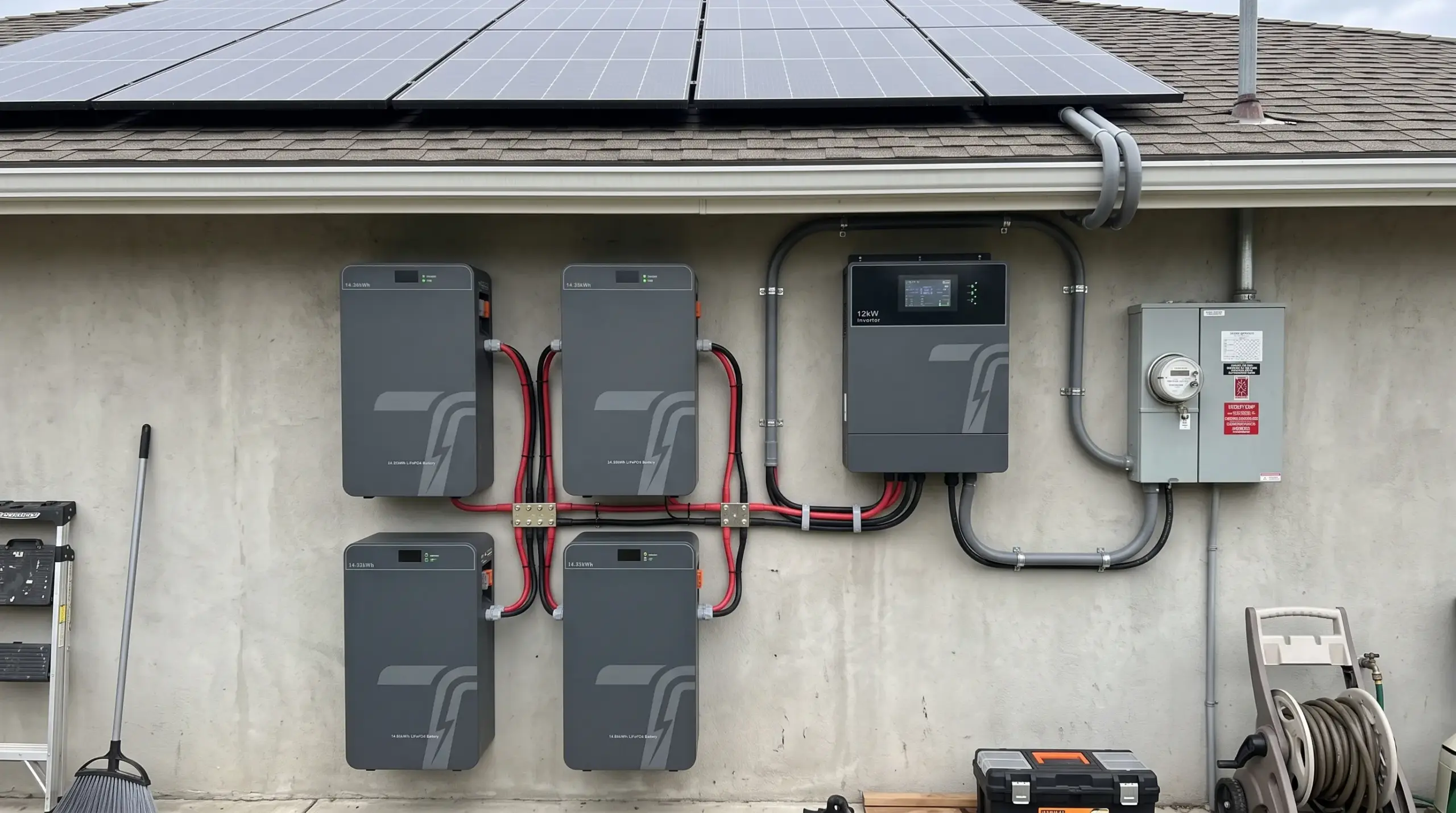
一个 cURL Too many subrequests by single Worker invocation. To configure this limit, refer to https://developers.cloudflare.com/workers/wrangler/configuration/#limits can tune the charging profile around the source that the installer actually uses. Firmware can set solar priority, generator input limits, and charge current by state of charge. A 48 V rack battery may use CAN or RS485 communication to send its voltage, temperature, and allowable current to the inverter. Without that communication, the installer may need conservative manual settings.
The hardware details matter as well. A 5 kWh LFP module with prismatic cells, a 100 A BMS, and passive enclosure cooling will behave differently from a module with a 50 A BMS. Label branding, connector selection, cable length, and a local-language manual can be included in an OEM program. Confirm the sample firmware and communication protocol before committing to a production batch.
Off Grid Charging Configurations Compared
| 配置 | Typical available charge power | Likely charging behaviour | Suitable check |
|---|---|---|---|
| 3 kW solar array with 5 kWh LFP battery | 0–3 kW | Fast in clear sun, variable under clouds | Confirm MPPT voltage range and seasonal solar yield |
| 5 kW generator with 10 kWh battery | 3–5 kW after generator and charger limits | Steady, but limited by fuel use and input setting | Check generator waveform and continuous rating |
| 1.5 kW solar array with 10 kWh battery | 0–1.5 kW | Slow when the battery is deeply discharged | Size the array for the required daily recovery time |
Four Common Off Grid Charging Pitfalls
- Sizing the battery without sizing the source A large 15 kWh battery may need more than one sunny day to recover from a low solar input. Calculate daily load, peak load, and the available charging hours together.
- Ignoring the inverter-charger limit A 6 kW PV array cannot charge at 6 kW through a 3 kW charger. Check continuous charge power, not only the inverter’s headline output.
- Charging cold LFP cells Ask for the battery’s low-temperature charge threshold. A heater, insulated cabinet, or charging pause may be required below 0°C.
- Mismatching communication settings Incorrect CAN termination, a wrong protocol, or an incompatible charge-current limit can force the inverter into a low fixed current. Test the exact battery and inverter combination before shipment.
FAQ About Off Grid Charging
Does a battery charge faster from the grid than from solar?
Why does charging slow down near full capacity?
Can I increase the off-grid charging speed by adding batteries?
结论
An energy storage system may charge more slowly off grid, but the operating mode is rarely the direct cause. Source variability, charger power, temperature, battery SOC, and communication settings determine the actual rate. Share your system voltage, battery capacity, daily load curve, and charging source; an OEM team can return a preliminary charging and BOM recommendation within 24 hours.