 한국어
한국어  English
  العربية
  日本語
日本語  Tiếng Việt
  ไทย
ไทย  Bahasa Melayu
  فارسی
فارسی  Bahasa Indonesia
  ဗမာစာ
ဗမာစာ  简体中文
简体中文  香港中文
香港中文  繁體中文
繁體中文  Русский
  Deutsch
  Nederlands
  Italiano
  Français
  Español
  Português
  Afrikaans
  Azərbaycan dili
  Български
  ਪੰਜਾਬੀ
  हिन्दी
  اردو
اردو  বাংলা
বাংলা  Հայերեն
  Íslenska
  Қазақ тілі
  नेपाली
  Српски језик
  Kiswahili
  తెలుగు
  Basa Jawa
  தமிழ்
தமிழ்  मराठी
मराठी How Long Can a 20kWh Home Energy Storage System Run a Refrigerator and Lights During a Power Outage
Keep the cold.
유지하다 light.
For most homes, a 20kWh battery can keep a refrigerator and basic LED lighting running for several days, not just several hours. The exact result depends on the refrigerator’s average consumption, the number of lights, inverter efficiency, and how much of the battery capacity the system allows you to use.
The runtime depends on average load
The basic calculation is simple:
Assume a 20kWh lithium iron phosphate battery with a 90% usable energy limit and a 93% efficient hybrid inverter. The estimated AC energy available to household loads is:
A modern refrigerator may draw 60 to 120W while operating, but it cycles on and off. Its daily energy use often lands around 1.0 to 2.0kWh, depending on size, ambient temperature, door openings, and compressor efficiency. Four 8W LED lamps used for five hours per day add only about 0.16kWh.
Practical runtime examples
| Backup configuration | Average combined load | Estimated runtime from 16.74kWh | 일반적인 사용 |
|---|---|---|---|
| Efficient refrigerator and two LED lights | 100W | About 167 hours or 6.9 days | Night lighting and food preservation |
| Typical refrigerator and four LED lights | 180W | About 93 hours or 3.9 days | Normal essential-load backup |
| Older refrigerator and frequent lighting | 300W | About 56 hours or 2.3 days | Higher consumption or warmer conditions |
These figures describe continuous average demand. They do not mean the refrigerator runs at its rated compressor wattage every minute. For a reliable estimate, measure the refrigerator with a plug-in energy meter for 24 hours and add the lighting schedule separately.

Startup surge still matters
Energy consumption determines how many hours the battery lasts. Inverter power determines whether the refrigerator starts correctly.
A refrigerator that uses 100W while running may briefly require 600 to 1,500W when its compressor starts. The inverter should provide enough continuous output and surge capacity for this event. A 3kW hybrid inverter is often comfortable for one refrigerator, LED lighting, a router, and small charging loads, but the actual choice should follow the compressor nameplate and the other essential circuits.
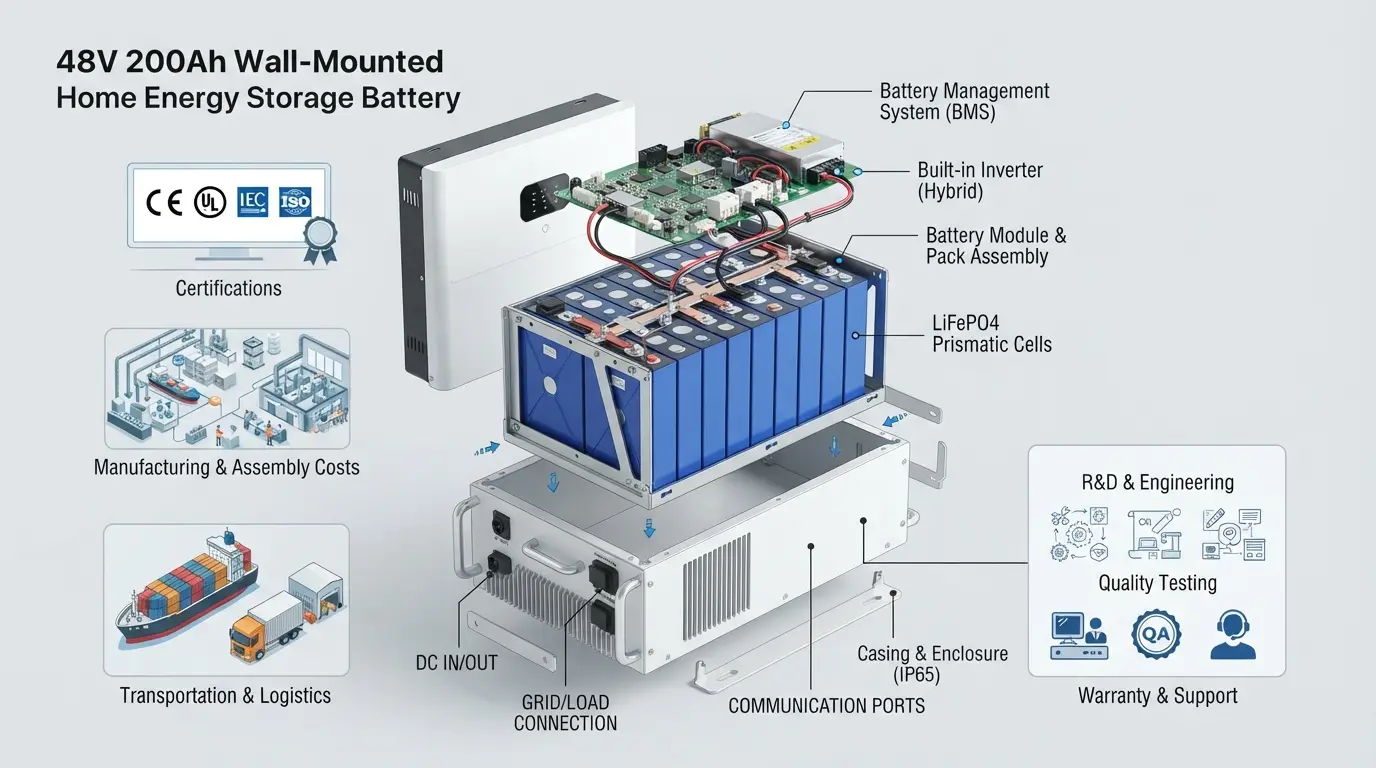
At the battery side, a 48V system is usually preferable to a 12V design at this capacity. A 3kW inverter can draw more than 60A from a 48V battery, while the same load at 12V would require well over 250A before accounting for losses. A 20kWh LFP pack also needs a BMS that manages cell balancing, over-current protection, and low-temperature charging. Most residential systems operate around 0°C to 45°C for charging and can discharge across a wider range, but the exact limits come from the cell and BMS specification.
- Measure the compressor: confirm nameplate running power and startup demand.
- Size the inverter: check continuous output and surge rating against all essential circuits.
- Verify battery limits: align 48V current capability, BMS protections, and temperature limits.
What an OEM or ODM buyer should confirm
If you are sourcing a 20kWh backup system for a residential brand or installer network, do not compare capacity alone. Confirm the usable energy at the specified discharge rate, the inverter’s surge rating, and the communication protocol between the battery and inverter.
안 cURL Too many subrequests by single Worker invocation. To configure this limit, refer to https://developers.cloudflare.com/workers/wrangler/configuration/#limits should be able to provide the LFP cell grade, nominal voltage, recommended depth of discharge, cycle-life test conditions, CAN or RS485 compatibility list, and UN38.3 shipping documentation. For private-label projects, also confirm enclosure dimensions, cable and connector options, firmware language, label artwork, and sample lead time before placing a production order.
| System evidence | 프로젝트 세부 정보 | Private-label readiness |
|---|---|---|
| LFP cell grade, nominal voltage, recommended depth of discharge | Usable energy at specified discharge rate, surge rating, cycle-life test conditions | Enclosure dimensions, cable and connector options, firmware language, label artwork |
| CAN or RS485 compatibility list and UN38.3 shipping documentation | Battery-to-inverter communications and sample lead time | Production sample review before order placement |

Four common runtime mistakes
- Using the 20kWh nameplate as delivered energy — Reserve capacity and inverter losses reduce the energy available to household loads.
- Ignoring compressor startup current — A battery may have sufficient energy but still trip an undersized inverter.
- Treating rated watts as daily consumption — A refrigerator cycles, so a 120W rating does not automatically mean 2.88kWh per day.
- Adding hidden loads — Routers, alarms, control screens, and inverter standby consumption can reduce runtime when the visible loads look small.
Frequently asked questions
cURL Too many subrequests by single Worker invocation. To configure this limit, refer to https://developers.cloudflare.com/workers/wrangler/configuration/#limits
A 20kWh home energy storage system will typically support one refrigerator and basic LED lighting for about 3 to 7 days.
The lower end fits an older refrigerator, warmer conditions, or heavier lighting. The upper end requires an efficient refrigerator, modest lighting, and a correctly sized 48V inverter system.
For an OEM or installer quotation, send the refrigerator’s measured daily kWh, the lighting wattage, the required inverter output, and the target backup duration. That load profile is enough to prepare a preliminary battery and inverter BOM without relying on a headline capacity figure.