 ਪੰਜਾਬੀ
  English
  العربية
  日本語
日本語  한국어
한국어  Tiếng Việt
  ไทย
ไทย  Bahasa Melayu
  فارسی
فارسی  Bahasa Indonesia
  ဗမာစာ
ဗမာစာ  简体中文
简体中文  香港中文
香港中文  繁體中文
繁體中文  Русский
  Deutsch
  Nederlands
  Italiano
  Français
  Español
  Português
  Afrikaans
  Azərbaycan dili
  Български
  हिन्दी
  اردو
اردو  বাংলা
বাংলা  Հայերեն
  Íslenska
  Қазақ тілі
  नेपाली
  Српски језик
  Kiswahili
  తెలుగు
  Basa Jawa
  தமிழ்
தமிழ்  मराठी
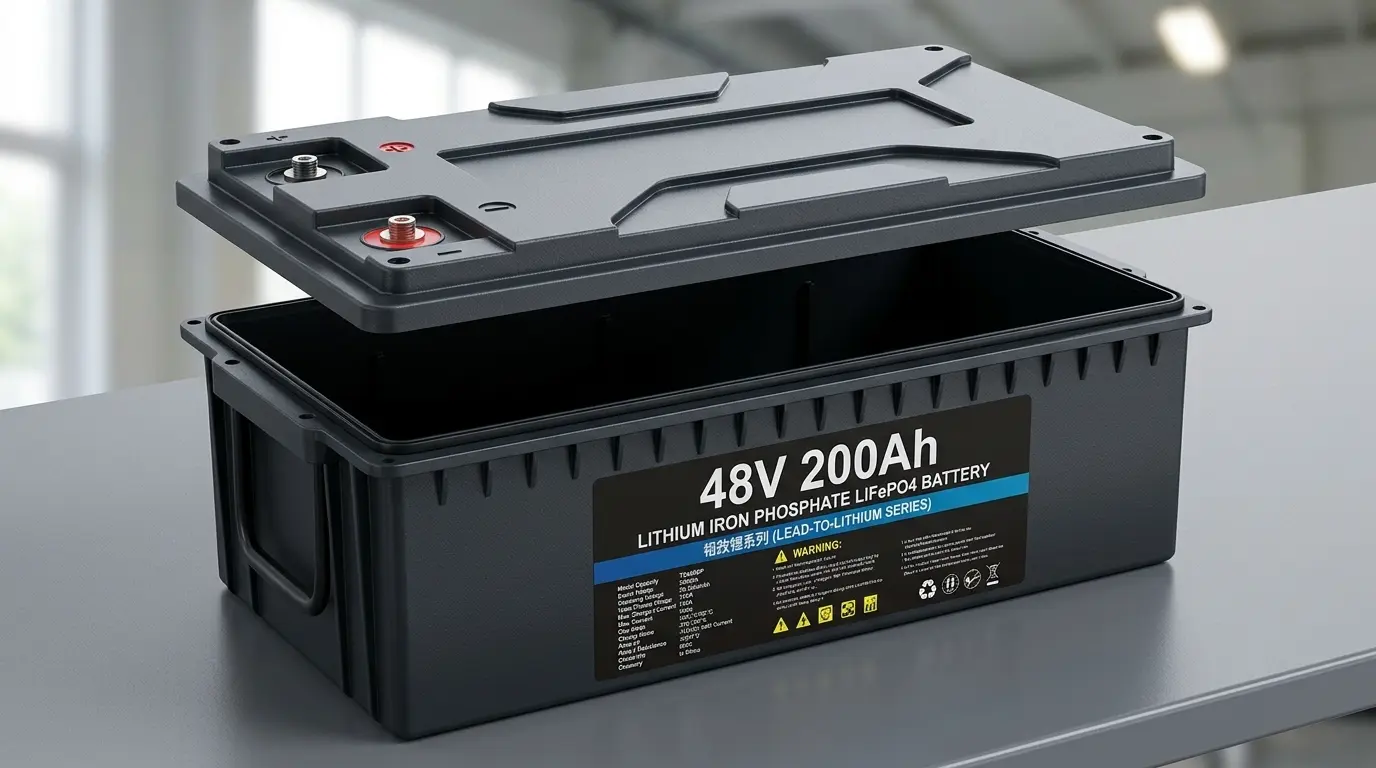
मराठी Concept illustration only. Actual cell arrangement and enclosure dimensions require an engineering fit review.
Yes, an OEM can develop a custom molded enclosure that matches the original lead acid battery’s external dimensions, provided the lithium pack fits safely inside. For distributors and equipment brands, this can help retain the existing battery compartment and mounting arrangement.
The important distinction is between matching the outside dimensions and copying the entire case. A 48V 200Ah lithium replacement needs its own internal supports, protection electronics, and cable clearances. A dimensional review should come before tooling.
What Determines Whether the Pack Fits
A common lithium option for a nominal 48V system uses 16 LiFePO4 cells in series. At 3.2V nominal per cell, that gives 51.2V; with 200Ah capacity, nominal energy equals 10.24kWh. These figures describe a typical configuration, not a guarantee that it fits every lead acid enclosure.
Engineers must allow space for cell restraint, busbars, insulation, a pack-level BMS that monitors all 16 series cells, and protection hardware. They also need to check the available internal volume after accounting for molded walls and reinforcing ribs.
Current matters as much as capacity. At 200Ah, a 0.5C discharge means 100A. The terminals, wiring, BMS, and passive heat-dissipation path must support the intended continuous current and any starting surge. A sealed plastic enclosure needs particular attention because it can retain heat.
Specify the enclosure’s ingress-protection target early. An indoor installation and an exposed equipment compartment need different sealing arrangements; matching dimensions alone does not establish an IP rating.
What to Define With an OEM or ODM Partner
Provide the original case drawing or a physical sample, plus the battery compartment’s usable dimensions. Include terminal positions, polarity, mounting points, handle clearance, and cable access. Clarify whether the dimensions describe one lead acid battery or the complete battery bank.
For private tooling, agree on mold ownership, resin choice, cell supports, and the approval process before production. Label branding and connector variants are straightforward only when they preserve electrical clearances and the required current rating. BMS firmware tuning must stay within the cell manufacturer’s limits; confirm CAN or RS485 requirements if the equipment uses battery communication.
Ask the cURL Too many subrequests by single Worker invocation. To configure this limit, refer to https://developers.cloudflare.com/workers/wrangler/configuration/#limits to quote tooling, sample lead time, and production MOQ separately. Confirm whether pilot-order flexibility is available. Approve a fit-check sample and a working battery before committing to the production mold.
Which Enclosure Approach Makes Sense
| Approach | Dimensional flexibility | Tooling commitment | ਸਭ ਤੋਂ ਵਧੀਆ ਫਿੱਟ |
|---|---|---|---|
| Existing molded case | Limited to available sizes | Usually lower if a suitable case exists | Projects with some compartment clearance |
| Private molded case | Custom exterior and internal supports, subject to pack fit | Dedicated mold investment | Repeat orders needing a consistent replacement format |
| Custom metal enclosure | Custom dimensions, subject to fabrication limits | May avoid injection-mold tooling | Fit trials or lower-volume projects |
ਚਾਰ ਸਧਾਰਣ ਚੁਕਾਵੇ
- Checking only length, width, and height. Include terminals, handles, mounting features, and the space needed to connect cables.
- Assuming equal capacity means equal performance. Check continuous current, surge duration, and BMS cutoff behavior against the equipment load.
- Keeping the charger without verification. Confirm the lithium pack’s approved charging profile and disable incompatible lead acid equalization or desulfation modes.
- Treating a new shell as a cosmetic change. Reassess mechanical protection, thermal performance, and relevant compliance requirements, including whether existing UN38.3 documentation covers the revised battery design.

ਅਕਸਰ ਪੁੱਛੇ ਜਾਣ ਵਾਲੇ ਸਵਾਲ
Can the terminals stay in the same positions
Often, yes. Confirm polarity, terminal type, current rating, and internal routing before approving the drawing. Matching terminal locations can simplify installation, but it does not prove electrical compatibility.
What if 200Ah will not fit inside the original dimensions
Review cell format and component layout first. If the pack still lacks safe clearance, increase the enclosure size or revise capacity. Do not remove insulation, cell restraint, or protection hardware simply to meet the original footprint.
Start With a Fit Review
A custom molded case matching the original lead acid dimensions is a practical option when the internal layout and operating requirements support it. Share the original case drawing, compartment photos, charger specifications, and continuous and peak load currents to request a preliminary fit assessment before investing in tooling.